
Lieferung heute & morgen

Qualitätsgarantie

Willkommens-Angebote freischalten: KOSTENLOSE Lieferung | Bis zu 80 % RABATT | Kostenlose 30-Tage-JoyPlus-Testphase
App herunterladen
A flat car battery often happens at the worst possible time – when there is no power socket, no one else nearby and no breakdown service available. A car jump starter power bank can provide a practical backup in these situations. Many models combine car battery jump-starting, a power bank, an LED light and a tyre inflator in one compact unit.
However, high amp figures on the packaging alone do not automatically make a battery jump starter suitable for every vehicle. What really matters is actual vehicle compatibility, battery maintenance and the features of the safety clamps.
Figures such as 2.000 A, 4.000 A or 8.000 A generally refer to the peak current. This value describes a short-term surge of power, not necessarily the current available over a longer period. When choosing a 12V jump starter, you should therefore also check:
For example, a device for petrol engines up to 4.0 litres and diesel engines up to 2.0 litres is not automatically suitable for a large diesel van.
Manufacturers often state capacity in mAh, while the usable energy also depends on the cell voltage and the electronics. Capacity alone is therefore not sufficient for comparing devices for jump-starting. Look at the combination of capacity, starting current, peak current and approved vehicle types.
One more important point: a car jump starter power bank loses charge when stored for a long time. Depending on the model, the product details may recommend checking or recharging it every three to twelve months. If you leave the device uncharged in the boot, it may not be ready to use when you need it.
A jump starter with compressor is suitable for topping up a tyre with low pressure. However, it is not a substitute for regular checks using a calibrated device at a petrol station or garage. You should also check whether the device has automatic shut-off, a pressure display and suitable valve adapters.
The figure “150 PSI” is a maximum pressure value. The recommended pressure for car tyres is normally considerably lower and depends on the vehicle manufacturer’s specifications.
Most cars, motorbikes, SUVs and smaller vans require a 12V jump starter. This does not mean that a 24V system for heavy commercial vehicles will automatically be compatible. The permitted engine size should always match your vehicle. Diesel engines often require more starting power than comparable petrol engines.
Useful safety features include:
These features reduce the risk of incorrect operation, but they do not replace checking the connections. The red clamp must be connected to the positive terminal, while the black clamp belongs on the negative terminal or a suitable earth point as specified in the instruction manual.
If you also want to use the car power bank for tyres, compare:
A compact model weighing around 330 g can easily be stored in the glove compartment or a motorbike top box. More powerful devices, on the other hand, can weigh two kilograms or more and require correspondingly more space.

Why this product suits this profile: This compact model is aimed at drivers looking for a straightforward car battery jump starter for 12V petrol and diesel vehicles, along with an additional USB charging function.
The product details specify 1.200 A peak current, 600 A starting current and clear suitability for petrol engines up to 4.0 litres and diesel engines up to 2.0 litres.
12800 mAh, LCD display, USB output, three light modes and a weight of around 330 g.
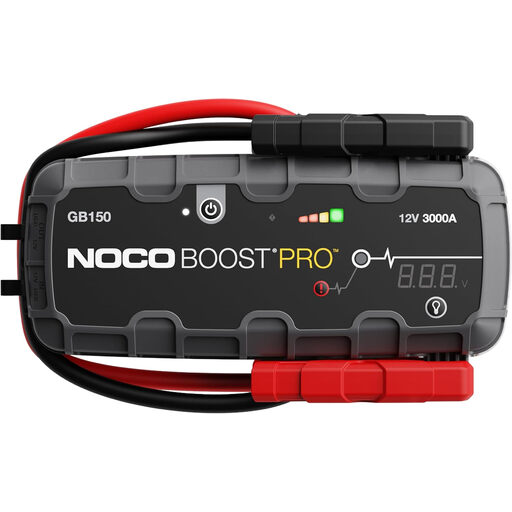
Why this product suits this profile: For users who value a robust housing, clearly defined vehicle limits and protection against dust and water spray.
The specifications state 12 V, IP65 and suitability for petrol engines up to 9.0 litres and diesel engines up to 7.0 litres. This helps distinguish it from smaller devices.
3000 A peak current, IP65 classification, LED light and a 1-year warranty according to the product details.
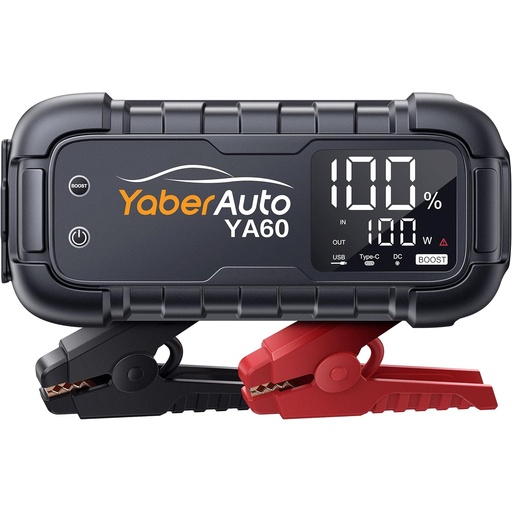
Why this product suits this profile: Suitable for travellers, campers and owners of larger vehicles who also need a powerful car power bank.
The specifications list 12.0 litres for diesel engines, 65 W USB-C charging and ten safety functions. You should still check that it is suitable for your own vehicle.
26800 mAh, USB-C at 65 W, two USB-A outputs, a 150 W DC output and 600-lumen LED light.
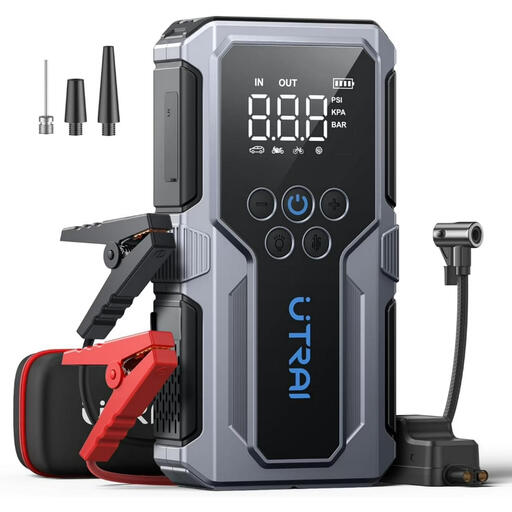
Why this product suits this profile: A practical combination for drivers who want a digital tyre inflator for cars and motorbikes as well as vehicle jump-starting capability.
The compressor has an LCD display, preset pressure settings and automatic shut-off. According to the specifications, compressor operation is limited to ten minutes.
3000 A peak current, 150 PSI maximum pressure, 15000 mAh battery, LCD screen and ten safety functions.
We have put together a complete, regularly updated list of products that fully meet these strict selection criteria and the safety regulations applicable in the EU.
Do not use a car jump starter on damaged, leaking or frozen batteries. Store lithium batteries in a dry place away from excessive heat. A CE marking describes the supplier’s declaration of conformity, but it is not an independent quality seal and does not replace checking the technical specifications.
Its lifespan depends on the cell type, charging cycles, temperature and storage conditions. Regularly recharging it according to the manufacturer’s instructions and avoiding excessive heat can help keep it ready for use. If the device shows visible damage, has a swollen casing or is leaking fluid, it must not be used again.
No. First check the vehicle’s system voltage, engine size and whether it is a petrol or diesel engine. A 12V jump starter is not automatically suitable for 24V vehicles or the high-voltage systems of electric vehicles.
The direct electricity consumption when charging is normally low. Costs mainly arise from the energy required for charging and, where applicable, a replacement battery at a later date. A compressor uses considerably more energy during operation than the USB charging function. The key point is to fully recharge the device after use.