
Lieferung heute & morgen

Qualitätsgarantie

Willkommens-Angebote freischalten: KOSTENLOSE Lieferung | Bis zu 80 % RABATT | Kostenlose 30-Tage-JoyPlus-Testphase
App herunterladen
A flat car battery often happens when there's no help nearby: on the commuter car park, outside the supermarket, or during a trip. A car jump starter power bank can be a handy addition to your car's emergency kit in these situations. However, it won't replace a faulty battery and isn't suitable for every vehicle.
That's why the Joybuy Product Recommendation Officer selection isn't based solely on high amp ratings. What really matters is the right engine specification, verified safety features, how it's stored in the vehicle, and straightforward operation.
A rating of "2,000 A" or "4,000 A" usually describes the maximum peak current. On its own, it doesn't tell you whether a device will reliably support a particular engine. You should also check:
A diesel engine often needs more energy to start than a comparable petrol engine. For a van, SUV, motorhome or boat, the stated engine size shouldn't be cut too fine.
A power bank for the car with a high mAh rating doesn't automatically deliver more starting power. The actual suitability depends on factors including cell type, voltage, discharge current, cables and clamps. What's more, nominal capacity and usable capacity are different.
When choosing a portable jump starter, peak current, starting current, 12 V compatibility and engine limit are more important than the mAh rating alone.
A battery booster shouldn't just deliver power – it should also monitor the connection. Depending on the model, useful features include:
These features won't prevent operating errors in every situation. You still need to connect the red and black clamps correctly. Never use a jump starter on a battery that is visibly damaged, swollen, leaking or frozen.
For smaller cars and motorcycles, a compact jump starter with a moderate engine approval can be sufficient. Larger petrol and diesel engines need more reserve. Look for a clear manufacturer specification such as "up to 6.0 L petrol" or "up to 4.0 L diesel".
Some models are designed for 12 V vehicles such as cars, SUVs, vans, motorcycles or small boats. 24 V systems on heavy commercial vehicles, buses or construction machinery must not be connected unless expressly permitted.
Lithium-based devices should be recharged after use and checked regularly during long-term storage. Depending on the product, recharging every two to six months is recommended. Don't leave the power bank for the car permanently in direct sunlight or in extreme heat inside the vehicle.
A stated temperature range is a technical parameter, but not a guarantee for every starting situation. Battery performance drops in cold weather. Store the portable battery booster in a dry, protected place and follow the instruction manual.
Look for sufficiently long and sturdy clamp cables, clearly visible displays and a secure connection to the device. A jump starter with an LED torch can be useful if you break down in the dark. USB outputs also make the device a power bank for your smartphone, GPS or tablet.
LED modes such as constant light, flashing light and SOS signal are handy extras, but they don't replace a hi-vis vest, warning triangle or any legally or situationally required safety equipment.
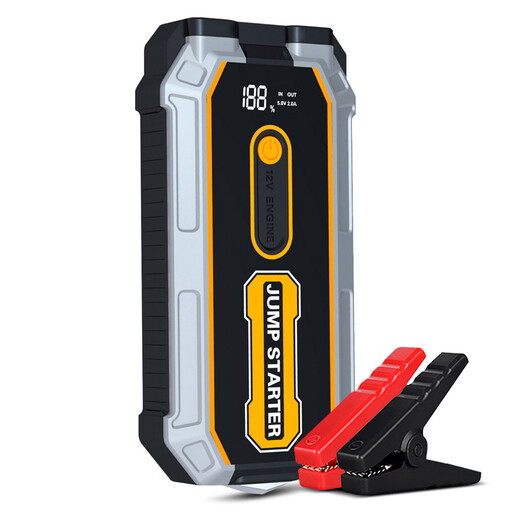
Why this product fits the profile: This compact model is aimed at car, SUV and motorcycle drivers looking for a space-saving car battery jump starter with a display and USB function.
The specifications separately state 1,200 A peak current and 600 A starting current. This makes it easier to assess the performance than with a single amp rating.
12 V support, LCD display, 12,800 mAh battery, USB output at 10 W and LED light with three modes.
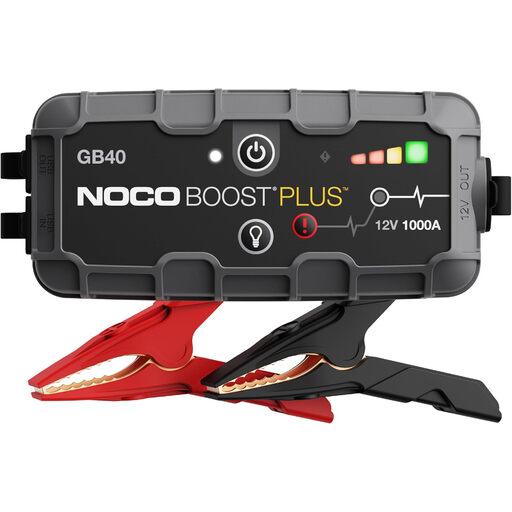
Why this product fits the profile: This device appeals to drivers who prefer a clearly specified portable jump starter for cars, motorcycles and boats.
The product specifications highlight reverse polarity and spark-proof protection. The limits are also stated as up to 6.0 L petrol and 3.0 L diesel.
1,000 A peak current, up to 20 jump starts according to product specifications, IP65 housing and 100-lumen LED torch.
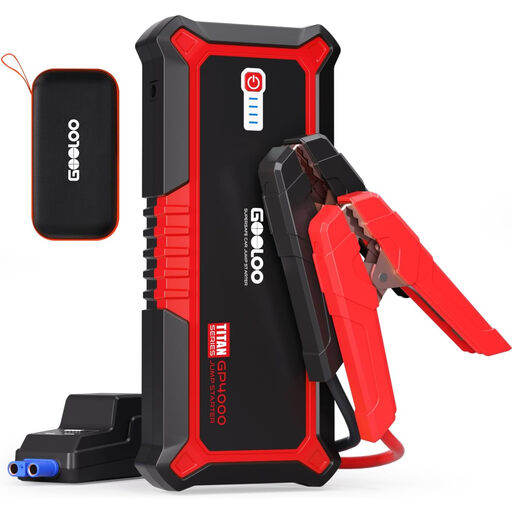
Why this product fits the profile: This model is aimed at users with larger petrol engines or diesel engines up to the stated limit, as well as drivers with additional charging needs.
The specifications mention a boost function for very low battery voltage. Correct polarity and 12 V approval are still required before use.
4,000 A peak current, support for petrol engines and diesel engines up to 10.0 L according to the product description, USB outputs and protective case.
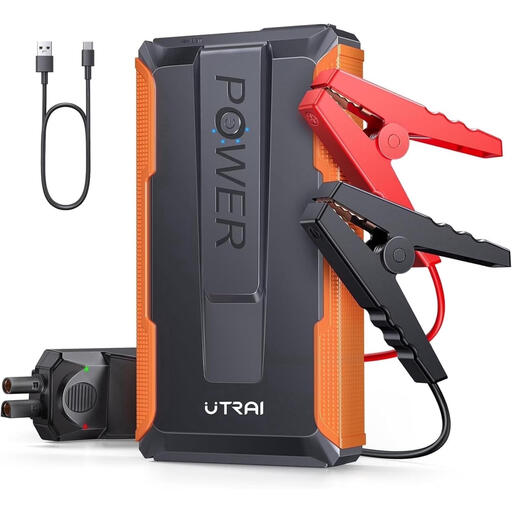
Why this product fits the profile: For longer journeys, this device offers a USB charging function and an LED light for situations in the dark, alongside the car jump start capability.
The smart clamp signals reverse polarity, short circuit and overheating, according to the product description. The manual limits repeated start attempts and requires charging intervals.
Up to 2,000 A peak current, 12 V support, USB Quick Charge 3.0, three LED modes and stated operating temperature of -20 °C to 60 °C.
We've put together a complete, regularly updated list of products that fully meet these strict selection criteria and the safety regulations in force in the EU.
That depends on the model and battery type. For long periods without use, many manufacturers recommend an interval of two to six months. Check the charge indicator before longer journeys and recharge the device after a jump start.
Some devices have a boost mode for very low battery voltage. However, this depends on the model. A damaged, frozen or leaking battery must not be jump started. If the start is unsuccessful, the vehicle battery should be professionally checked.
There are no ongoing fuel costs for the jump start itself. Electricity is only needed to recharge the battery. Additional costs can arise if the device fails due to incorrect storage, deep discharge or mechanical damage. That's why regular charge checks and dry, moderate storage are important.