
Lieferung heute & morgen

Qualitätsgarantie

Willkommens-Angebote freischalten: KOSTENLOSE Lieferung | Bis zu 80 % RABATT | Kostenlose 30-Tage-JoyPlus-Testphase
App herunterladen
A car jump starter power bank with compressor can replace several individual devices in your vehicle: it helps start a flat 12-volt battery, inflates tyres, charges smartphones and doubles as a work light in an emergency. For commuters, families, SUV and van drivers, as well as motorcyclists, this combination is practical – provided the technical specifications match your vehicle.
Many poor purchases happen not because of missing features, but because of misleading marketing claims. What really matters are the actual performance figures stated, the engine compatibility and how easy it is to use in real-world conditions.
The capacity in mAh mainly describes the amount of energy stored. For starting an engine, you also need to consider the starting current, the peak current, the system voltage and whether it's suitable for your particular engine type. A 12 V battery booster with high capacity could still be unsuitable for your vehicle if the stated current or the approval for diesel and petrol engines doesn't match.
A 150 PSI tyre inflator may show a high maximum pressure value, even though the practical inflation performance, hose length or heat build-up during continuous use aren't explained in detail. For car tyres, a precise pressure display and an easy shut-off function are more important than the highest possible maximum value. The recommended tyre pressure is listed in your owner's manual, on the door frame or inside the fuel filler flap.
Even a device with low self-discharge should be checked before long journeys and after winter. The charge level, cables, clamps, air hose and work light all form part of a basic inspection. For a product with a lithium or sodium-ion battery, you should also follow the manufacturer's storage instructions. A jump starter shouldn't be left loose among tools, to avoid damaging the connections and casing.
Pay attention to the figures for 12 V, the normal starting current and the peak current. Equally important is the stated engine size, separated into petrol and diesel. A model rated for up to 8 litres of engine capacity isn't automatically suitable for every van; the vehicle type, battery size and engine condition can increase the requirements.
For motorcycles, you also need to check whether the clamps are small enough to handle and whether the instruction manual covers use with smaller batteries. For larger SUVs, pick-ups or commercial vehicles, you should carefully compare the manufacturer's specifications with your own vehicle.
A portable car compressor with a maximum pressure of 150 PSI is sufficient for most topping-up situations. However, what remains important is:
The compressor does not replace a professional tyre repair. If you notice visible damage, a significant loss of pressure or a warning from your tyre pressure monitoring system, the cause should be investigated.
A mobile jump starter should have clearly marked clamps, polarity-safe operating instructions and a suitable charging port. For the charging function, USB-C or USB-A outputs are relevant. The WOLFBOX models in our selection, for example, state 65 W or 18 W at certain outputs; these values refer to the respective ports and not automatically to every connected device.
When storing the device in your vehicle, pay attention to the stated temperature range. For the GOKKCL GK01, the product description mentions an operating range of -40 °C to 80 °C. Such figures shouldn't be taken as blanket approval for every storage or usage situation. Before using it in very low temperatures, always follow the instructions.

Why this product fits the profile: This model is aimed at car drivers looking for a compact 12-volt jump starter with an LED display and work light. According to the product description, it is designed for petrol engines up to 7 litres and diesel engines up to 6 litres.
The stated engine compatibility makes it easy to check before buying. The LED display shows the charge level when in use.
44.4 Wh capacity, LED display and LED light; charging adapter not included according to the product name.
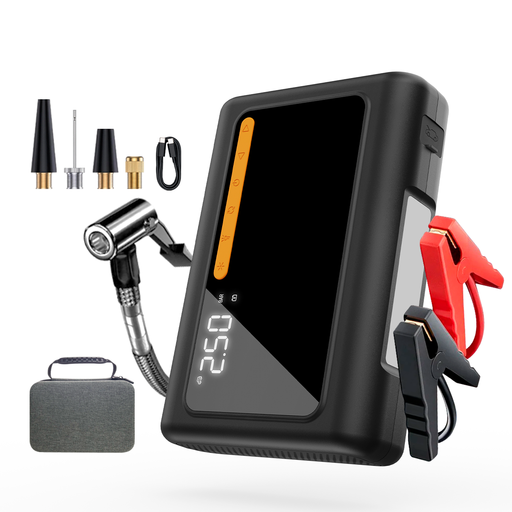
Why this product fits the profile: For users who want to combine jump starting, a compressor, charging function and a light in one 4-in-1 jump starter. It is rated at 600 A starting current, 1,500 A peak current and is suitable for petrol and diesel engines up to 8 litres.
The product description gives specific current values, a 150 PSI compressor and four pump modes instead of just a general performance claim.
Sodium-ion battery with up to 6,000 charge cycles according to the product information, PD60W input and output, 200-lumen light and stated self-discharge of approximately 1% per month.
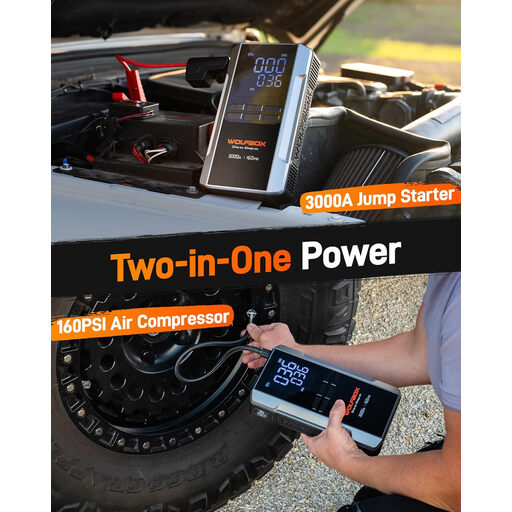
Why this product fits the profile: This model is of interest to drivers who want to combine a 12 V battery booster with a compressor and fast charging function. According to the product name, it is designed for petrol engines up to 8 litres and diesel engines up to 6 litres.
Alongside the starting current, the maximum compressor pressure of 160 PSI is explicitly stated. This allows you to check two key buying criteria separately.
3,000 A according to the product name, 59.2 Wh, 65 W fast charging function and integrated air compressor.
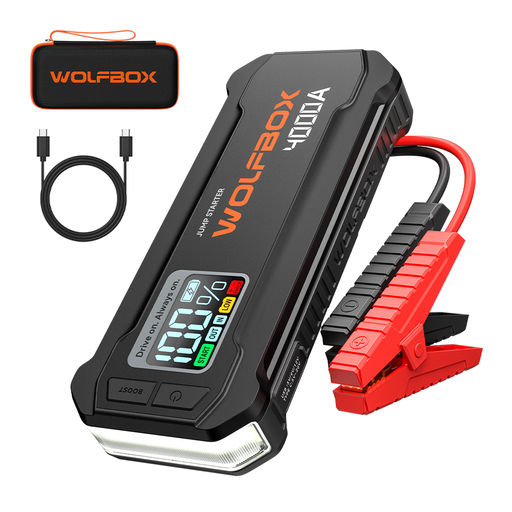
Why this product fits the profile: For SUV, pick-up and vehicle owners with higher power requirements, the stated support for up to 10 litres of engine capacity for both petrol and diesel could be relevant. You should compare these figures with your own vehicle.
The combination of 4,000 A according to the product name, 88.8 Wh and 65 W charging function provides several verifiable data points for your selection, rather than a vague claim like "for all cars".
High stated peak power, 88.8 Wh capacity, LED display and LED light.
We've put together a complete, regularly updated list of products that fully meet these strict selection criteria and the safety regulations in force in the EU.
That depends on the tyre size, the starting pressure and the compressor's performance. A model with a maximum pressure of 150 or 160 PSI can be suitable for topping up. However, if a tyre is completely flat or damaged, you should call a garage or breakdown service. Always follow the manufacturer's information on continuous operation and cooling times.
The service life depends on the battery type, charge cycles, temperature and how well it's maintained. For the GOKKCL GK01, the product description states up to 6,000 charge cycles for the sodium-ion battery and a self-discharge of approximately 1% per month. These values are product claims and not a guarantee for every usage situation. A regular function test is still a good idea.
The electricity costs for recharging are usually low compared to the price of the device. What matters is the capacity, the charge level and charging losses. What can be more expensive is infrequent maintenance, if the device is flat when you need it in an emergency, or if the clamps and hose are damaged. That's why checking the charge and storing it safely are essential parts of a practical car emergency kit.