
Lieferung heute & morgen

Qualitätsgarantie

Willkommens-Angebote freischalten: KOSTENLOSE Lieferung | Bis zu 80 % RABATT | Kostenlose 30-Tage-JoyPlus-Testphase
App herunterladen
A flat car battery often strikes at the worst moment: on the commuter car park, before a long journey, or in cold weather. A car jump starter power bank can be a practical alternative to jump leads and relying on a stranger's help in these situations. However, to ensure the device actually works with your vehicle in an emergency, buyers should look beyond just a high amperage rating.
Ratings like 2,000, 3,000 or even 8,000 A usually refer to the maximum peak current under specific conditions. The actual suitability also depends on the battery condition, cable cross-section, temperature and engine size. Therefore, the limits specified by the manufacturer for petrol and diesel engines should be compared with your own vehicle.
A 12V jump starter is also not automatically suitable for 24-volt lorries, buses or construction machinery. With hybrid vehicles, you also need to check whether only the 12-volt auxiliary battery is supported. The high-voltage battery of an electric vehicle cannot be started with such a device.
A large mAh number describes the battery capacity but says little about the starting power. For a car battery jump starter, peak current, starting current, voltage and the permissible engine size are particularly relevant. The power bank function for a smartphone or sat nav is a useful extra, but it does not replace a suitable starting current specification.
A car battery booster should have a clear display or audible warning for incorrect polarity. Protection features against short circuits, overheating, overcharging and overcurrent reduce the risk of incorrect operation. However, they do not make correct connection unnecessary.
Lithium-containing devices should not be permanently exposed to high heat inside a closed vehicle. For readiness, regular checks are recommended and – depending on the instructions – recharging every two to six months.
First, check that the device is explicitly intended for 12-V vehicles. Then compare the specified maximum engine capacity separately for petrol and diesel. A diesel engine generally requires higher starting power than a comparable petrol engine.
For motorbikes, smaller vehicles and compact cars, more compact devices are often sufficient. For SUVs, vans, motorhomes or boats, higher power reserves and robust clamps are advisable. A jump starter for SUVs and lorries should not be equated across the board: many portable devices are only suitable for smaller 12-volt commercial vehicles, not for heavy 24-volt lorries.
Look for sufficiently long, sturdy cables as well as insulated clamps with a secure grip. A smart clamp unit should indicate the connection and warn if the polarity is reversed. For heavily discharged batteries, a special boost or force start mode may be required. This should only be used according to the operating instructions.
A power bank with jump start is practical if it has USB-A or USB-C ports. Fast charging specifications like QC 3.0 or USB-C Power Delivery are only relevant if your own accessories are compatible.
A jump starter device with a compressor can be helpful if your tyre pressure is too low. The decisive factors here are the specified maximum pressure, the auto shut-off function and the included valve adapters. The compressor does not replace regular tyre pressure checks and is not intended for repairing damaged tyres.
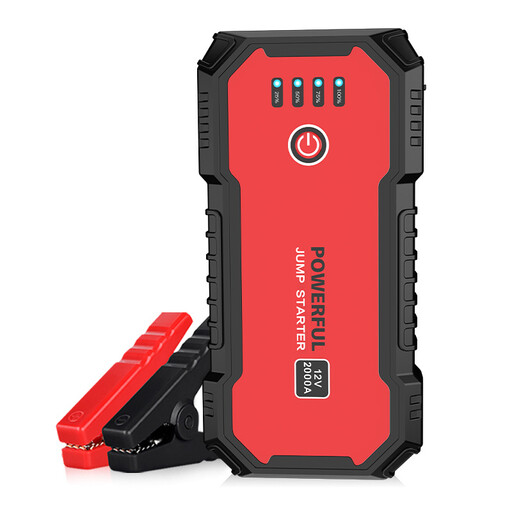
Why this product fits the profile: This compact device, weighing around 430 g, is suitable for drivers of small cars, motorbikes, vans and SUVs who want a space-saving emergency car jump starter.
The specifications state separate limits for petrol and diesel engines up to 6.0 and 4.0 litres respectively, as well as 12-volt operation.
1,500 A peak current, 14,000 mAh battery, QC3.0 output and LED light with three modes.
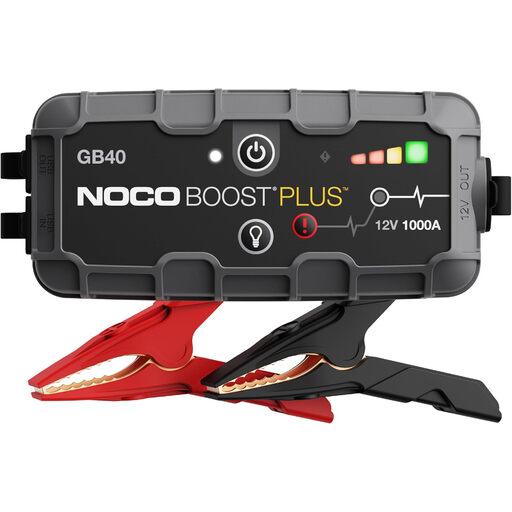
Why this product fits the profile: This device is aimed at drivers of cars, motorbikes and boats who value compact dimensions, safety features and clearly defined engine coverage.
The product data specifies concrete limits up to 6.0 litres for petrol and 3.0 litres for diesel, as well as an IP65-rated housing.
1,000 A peak current, up to 20 starting attempts according to the product specification, plus integrated USB power bank and LED light.
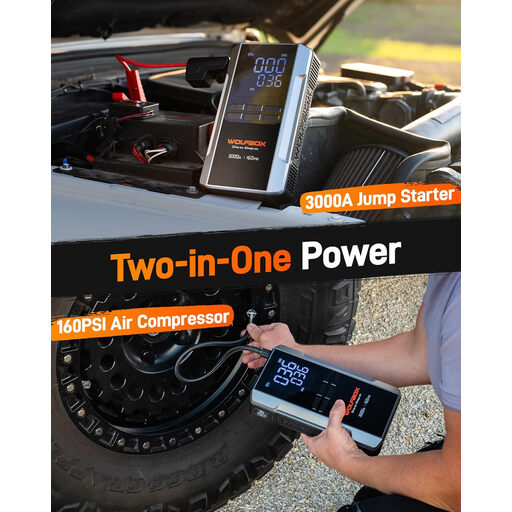
Why this product fits the profile: For travellers, motorhome owners and outdoor enthusiasts, the combination of car battery jump starter, power bank and mobile compressor is appealing.
The features are not limited to a high current rating; it also specifies 160 PSI, 65-watt charging and an LED display.
3,000 A peak current, 59.2 Wh battery capacity, 8.0-litre petrol and 6.0-litre diesel limit according to product data.
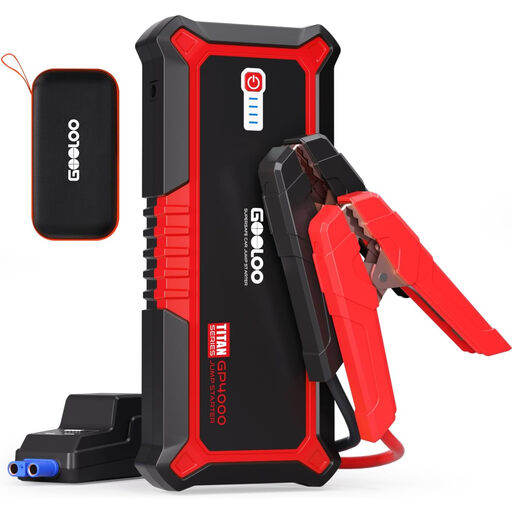
Why this product fits the profile: This model is designed for larger 12-volt vehicles and frequent use, provided the engine limits specified by the manufacturer match your vehicle.
The specifications explicitly point out the limitation to 12-volt systems and state up to 10.0 litres for diesel as well as several safety features.
4,000 A peak current, force start function, two USB outputs and robust clamps according to the product description.
We have compiled a complete, regularly updated list of products that fully meet these strict selection criteria and the safety regulations in force in the EU.
Do not use the booster on a damaged, leaking or frozen battery. Clamps must not touch each other during operation. Lithium batteries should not be disposed of in household waste at the end of their life; take them to designated collection points.
The lifespan depends on the cell type, usage, storage and charging intervals. Extreme heat, complete discharge and long storage periods without recharging can impair battery performance. The care instructions from the respective manufacturer are decisive. For emergency devices kept in the car, a functional and charge check at regular intervals is advisable.
No. The decisive factors are the 12-volt electrical system, engine size, fuel type and manufacturer approval. A device for 6.0 litres of petrol and 3.0 litres of diesel is not automatically suitable for larger diesel engines. A standard 12-volt booster is not intended for 24-volt vehicles or the high-voltage battery of an electric car.
The electricity consumption when charging is low in everyday use and depends on the battery capacity, charger and charge level. Additional costs mainly arise from replacement when the battery ages, or from accessories such as a USB-C charger, carry case or compressor adapter. If you check the device regularly and do not unnecessarily fully discharge it, you will reduce maintenance requirements.