
Lieferung heute & morgen

Qualitätsgarantie

Willkommens-Angebote freischalten: KOSTENLOSE Lieferung | Bis zu 80 % RABATT | Kostenlose 30-Tage-JoyPlus-Testphase
App herunterladen
A flat car battery often strikes when temperatures are low, the vehicle has been standing for a while, or you've been using lots of electrical accessories day to day. A car jump starter power bank can be a handy addition to traditional breakdown assistance in these situations. However, it shouldn't be chosen based on a high amperage figure alone.
For car drivers, SUV and van owners, as well as riders of motorcycles or small boats, the key factors are the right 12-V compatibility, sufficient engine power and clear safety features. The following guidance will help you interpret marketing claims and find a suitable device for your needs.
Figures like 1500A, 2000A or 4000A usually refer to the maximum peak current. This value alone doesn't tell you how long the device can support the starter motor. Buyers should also pay attention to the engine size stated by the manufacturer, separately for petrol and diesel engines.
A 12V jump starter for a small petrol car needs different reserves than a diesel van or a large-capacity SUV. Always cross-check the vehicle compatibility claims with your owner's manual and the actual engine specifications.
An ordinary power bank for smartphones usually can't deliver the required starting power. A car battery booster therefore has special jump leads, clamps and electronics designed for short bursts of high current. USB ports are a useful extra, but they don't replace a proper starting circuit.
Reverse polarity, short circuits, overheating and sparking can pose risks if connections are made incorrectly. Smart clamps with visual or audible indicators are a sensible feature. Nevertheless, the correct connection order remains important: red clamp to positive, black clamp to negative or a suitable earth point as per the instruction manual.
A jump starter is also not a repair tool for a damaged, leaking or frozen battery. If you can see visible damage, do not attempt a jump start.
Most portable devices in this category are designed for 12-V vehicle systems. Depending on the model, they are suitable for petrol engines up to, for example, 6.0, 7.5 or 8.0 litres, and for diesel engines with a lower maximum capacity. A 24-V lorry system or the high-voltage battery of an electric vehicle is not compatible.
If you're looking for a jump starter for petrol and diesel engines, you should consider the two values separately. A device with a high petrol engine limit is not automatically suitable for a diesel engine of the same size.
Capacity is often given in mAh. For meaningful comparison, you also need to consider the voltage, the actual output power and the charging time. USB-C, Quick Charge 3.0 or USB Power Delivery can speed up charging of smartphones and the booster itself, provided your charger and cable support the relevant standard.
For longer journeys, two USB outputs, a charge indicator and an included cable are practical. If you only intend to use the device as an emergency power bank for your car, you may prefer fewer extra features.
Lithium-based devices should not be exposed to prolonged heat inside a parked car. Many product specifications state an operating range of roughly -20 °C to +60 °C. This doesn't mean every battery delivers the same performance at every temperature.
If you're not using the device for a while, check the charge level regularly. Depending on the model, recharging every two to six months is recommended. Always follow the specific instructions in the user manual. Storing the device in its case, in a dry place away from direct sunlight, can help protect the connectors and casing.
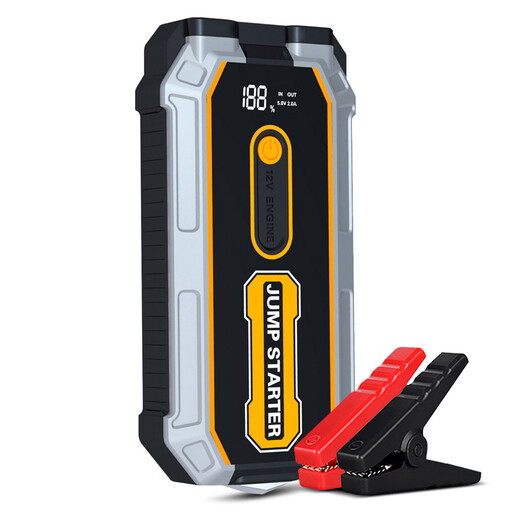
Why this product fits the profile: For drivers of smaller 12-V vehicles, motorcycles or as a compact reserve for the glovebox, the manufacturer states 1200A peak current and suitability for petrol engines up to 4.5 litres and diesel engines up to 2.5 litres.
The engine size specifications are clearly separated. An LCD display shows the charge level according to the product description, so you don't have to guess whether it's ready to use.
12-V design, USB output, LCD display and LED light with three modes, with a stated weight of around 330 g.
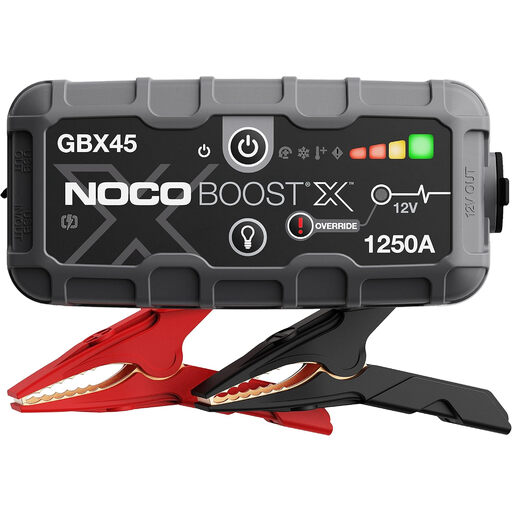
Why this product fits the profile: The product name indicates 1250A and a 12-V system. According to the manufacturer, this model is designed for petrol engines up to 6.5 litres and diesel engines up to 4.0 litres.
The stated vehicle limits make selection easier. Before buying, check whether your diesel or petrol engine falls within these values.
Compact 12-V jump starter with included cables and storage pouch according to product specifications.
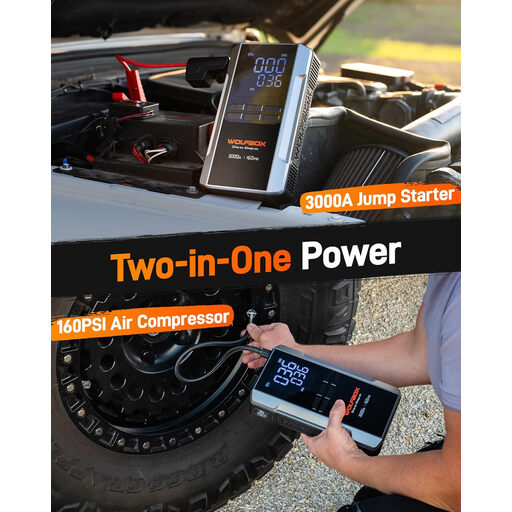
Why this product fits the profile: For SUV, van and outdoor users, the combination of jump starting and tyre inflation could be appealing. According to the product specifications, the device supports 12-V vehicles up to 8.0 litres petrol and 6.0 litres diesel.
The higher current rating is backed up by specific engine capacity limits and a 12-V designation. Before use, check the charge level and clamp connections.
3000A peak current according to product specification, 160 PSI compressor, 65 W fast charging and LED display.
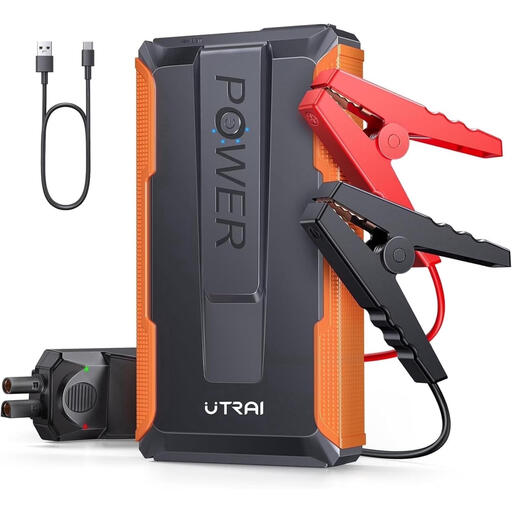
Why this product fits the profile: According to the product description, this portable jump starter is designed for petrol engines up to 7.5 litres and diesel engines up to 5.5 litres. This makes it suitable for drivers of larger cars, SUVs, vans and small boats with a 12-V system.
The Smart Clamp is said by the manufacturer to detect reverse polarity, short circuits, overheating and sparking. The instructions still require you to manually check the positive and negative connections.
2000A peak current, USB Quick Charge 3.0, USB-C charging input and LED light with constant, strobe and SOS modes according to product data.
We've put together a full, regularly updated list of products that fully meet these strict selection criteria and the safety regulations in force in the EU.
A car battery starter should not be used if the casing, cables or battery are damaged, swollen or leaking. After their useful life, lithium devices should not be disposed of with household waste.
This depends on the model and the battery type. Many manufacturers recommend checking and recharging every two to three months when in storage; some devices specify longer intervals. Always follow the manufacturer's instructions. After a jump start, the device should be fully recharged promptly.
Yes, provided the device is explicitly approved for diesel. The permitted diesel engine size is often lower than the figure given for petrol engines. Before buying, compare the engine capacity, on-board voltage and the vehicle category stated by the manufacturer.
In normal use, the main cost is the small amount of electricity for regular recharging. The key factors for service life are battery quality, correct storage, protection from heat and avoiding unnecessarily long starting attempts. With proper care, the device does not need to be permanently connected to the vehicle.