
Lieferung heute & morgen

Qualitätsgarantie

Willkommens-Angebote freischalten: KOSTENLOSE Lieferung | Bis zu 80 % RABATT | Kostenlose 30-Tage-JoyPlus-Testphase
App herunterladen
A flat car battery or an under-inflated tyre can bring commuters, families and travellers to an unexpected standstill. A car jump starter with compressor combines two functions: it can support a 12-V battery when starting the engine and inflate tyres while you are on the road. Depending on the model, it may also include a car power bank, an LED emergency light or an SOS light.
However, performance specifications vary considerably. High ampere or PSI figures alone say little about whether a device is suitable for your vehicle and intended use. Before buying, you should therefore check several common marketing pitfalls and key technical specifications.
Figures such as 1,500 A, 4,500 A or 5,500 A generally describe the maximum peak current. This value does not automatically indicate whether the device is suitable for every engine. Other important factors include:
A jump starter for petrol and diesel engines should therefore always be selected according to the manufacturer's specifications. A completely damaged or frozen battery must not simply be jump-started.
A 150 PSI compressor may be designed for the maximum pressure range of various tyres and inflatable items. In practice, however, airflow, hose length, operating time and cooling breaks are also important. A device with automatic shut-off and a digital pressure display makes inflating tyres easier, but it does not remove the need to follow the tyre pressure recommended by the vehicle manufacturer.
You should also look for a clear indication of the continuous operating time. Some devices need to cool down after around ten minutes of compressor use.
A portable jump starter is only available when its battery is sufficiently charged. Long periods of storage in a hot vehicle can affect battery performance. We recommend:
With a corded car tyre compressor, there is no internal battery to recharge. However, you will need a 12-V socket and should run the vehicle engine during operation in accordance with the manufacturer's instructions, so as not to put additional strain on the starter battery.
For cars, SUVs, motorcycles, vans and boats, you should first check whether the device is designed for 12 V. Engine approval is often stated separately for petrol and diesel engines. Diesel engines generally require different current reserves when starting than comparable petrol engines.
The manufacturer's stated engine size is a guide, not a guarantee for every starting attempt. For large engines, heavily discharged batteries or low temperatures, a device with sufficient reserve capacity is advisable.
A portable air compressor should clearly specify at least the following:
A digital tyre pressure gauge clearly displays the current and preset pressure. However, the compressor display does not replace regular checks with a suitable gauge or reference to the information provided on the vehicle.
For jump-starting, reverse-polarity protection, short-circuit protection, overload protection and temperature monitoring are all important features. A clear status display can help reduce operating errors. Nevertheless, the clamps must be connected correctly: red goes to the positive terminal, while black goes to the negative terminal or the vehicle's designated earth point.
An LED light, strobe and SOS function are useful additional features for breakdowns in the dark. They do not replace a high-visibility vest, warning triangle or a properly secured breakdown location.
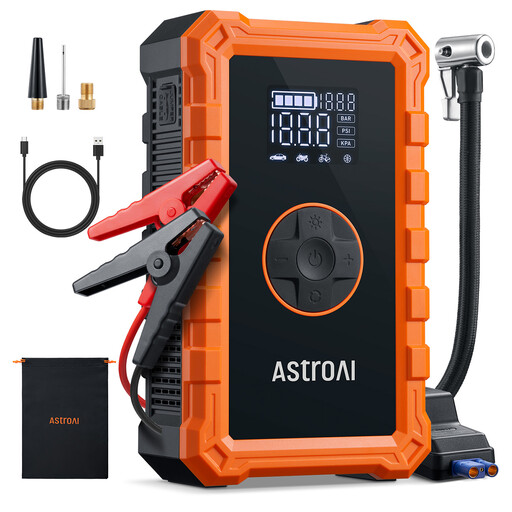
Why this product suits this profile: This compact combination device brings together 12-V jump-starting, a tyre compressor, a power bank and three light modes for everyday use in cars.
The engine rating is stated as up to 6.0 l petrol and 3.0 l diesel. The compressor features automatic shut-off and a 2.4-inch display.
1,500 A peak current, 150 PSI maximum pressure, five preset modes and integrated accessory storage.

Why this product suits this profile: This model is aimed at drivers who want to support larger petrol or diesel vehicles and benefit from several safety and monitoring features.
The product specifications list ten safety features, including reverse-polarity protection, overload protection and temperature monitoring. The LCD screen displays pressure and battery level.
4,500 A peak current, rated for up to 9.0 l petrol and 8.0 l diesel, plus a 500-lumen LED light with SOS mode.
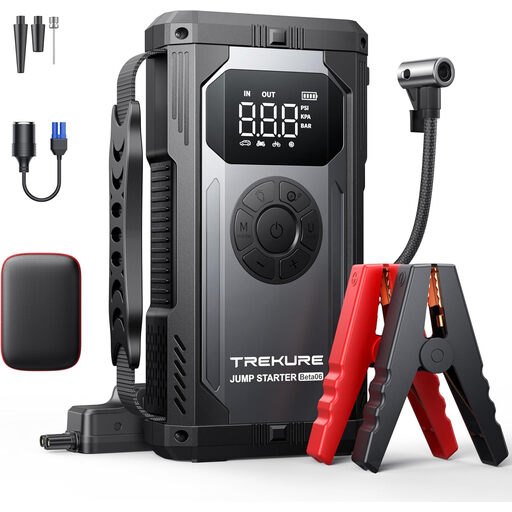
Why this product suits this profile: For travel, outdoor use and larger vehicles, this device combines jump-starting, a compressor, lighting and USB charging in one unit.
The specifications state an operating temperature range of -20 to 60 °C, automatic pressure shut-off and several safety features. The operating instructions remain the key reference before use.
5,500 A peak current, airflow of up to 35 l/min, 150 PSI, two USB-A outputs and a 12-V output.

Why this product suits this profile: This corded model is suitable for users who mainly need a small tyre compressor and do not expect an integrated jump-starting battery.
Direct connection to the vehicle's power supply prevents a separate compressor battery from being stored while flat. Additional jump-starting equipment is required for a flat car battery.
Five preset modes, 3–150 PSI, 0.5-PSI adjustment, three light modes and a stated weight of approximately 90.3 g.
We have put together a complete, regularly updated list of products that fully meet these strict selection criteria and the safety regulations applicable in the EU.
Before jump-starting, park the vehicle safely, secure it against rolling away and protect the breakdown location with hazard warning lights, a high-visibility vest and a warning triangle. Check the clamps, cables and casing for damage. When using the compressor, follow the cooling times specified in the instructions; a 150-PSI rating does not mean that every tyre may be inflated to this pressure.
For battery-powered devices, ongoing costs are mainly limited to the electricity needed for recharging and, where applicable, replacing the battery at a later date. Corded devices have no charging cycles, but they require the 12-V socket during use. A power bank function adds practical value, but it should not result in the battery being completely discharged before a planned journey.
First, switch off the device and check the instructions. Connect the red clamp to the positive terminal and the black clamp to the designated negative or earth point. Then activate the jump-starting function. Once the engine has started successfully, remove the clamps in the order specified by the manufacturer. Do not attempt to jump-start damaged, leaking or frozen batteries.
Its service life depends on cell quality, charge level, temperature and usage. For storage, a cool, dry place is recommended. Check the battery regularly and recharge it according to the manufacturer's instructions. Even a rarely used car jump starter should not be left completely discharged for months at a time.
No. A compressor can top up the air and provide temporary assistance in the event of a slow loss of pressure. It cannot repair damage to the tyre, valve or wheel rim. If there is visible damage, a significant loss of pressure or unusual handling, do not continue driving on the tyre. Contact a breakdown service instead.