
Lieferung heute & morgen

Qualitätsgarantie

Willkommens-Angebote freischalten: KOSTENLOSE Lieferung | Bis zu 80 % RABATT | Kostenlose 30-Tage-JoyPlus-Testphase
App herunterladen
An LED ambient lighting system for your car interior can visually define the dashboard, footwell and doors. However, before making a purchase, drivers shouldn't just focus on the number of colours. What really matters are the power supply, light guides, installation method and the actual contents of the kit.
Specifications like "593 LEDs" or "600 LEDs" might sound impressive at first. However, they don't solely determine how evenly the light is distributed inside your vehicle. With conventional light guides, individual light sources can appear brighter than others. Acrylic light guides distribute light along the material. According to product descriptions, this can contribute to a more uniform line of light, but it doesn't replace careful installation.
A universal car interior LED kit may be designed for many saloons, SUVs and vans. Nevertheless, gap sizes, trim panels, centre consoles and power connections all differ. So before you buy, you should check:
Bluetooth app control only works if the designated app is compatible with your smartphone and the controller is paired correctly. Music sync usually responds to a built-in microphone. It therefore follows ambient noise or voices, rather than directly tracking the vehicle's audio signal. A stable connection and a suitable position for the controller are important for proper use.
Many kits operate on 12 V DC and are therefore fundamentally suitable for typical vehicle electrical systems. Some product specifications state an operating range of 10 to 16 V. Nevertheless, check whether the connection is suitable for your vehicle. A kit with a 12 V plug is used differently from one with USB or Type-C.
The power supply should not be connected temporarily to safety-related wiring. During installation, it's advisable to switch off the ignition and follow your vehicle's manual. Cables must not block the pedals or interfere with airbags, the steering column or seat adjustments.
Acrylic light guides are flexible, but according to product specifications they must not be kinked or bent too sharply. Otherwise, light transmission can be affected. When shortening them, also pay attention to the ends: on some versions, resistors or control components are located in certain sections. Therefore, only cut at the designated points and test the strips before final installation.
For a subtle accent lighting effect in your car, thin light guides are suitable, which can be inserted into existing gaps in the interior trim. For visible LED footwell lighting in your car, separate lamp modules are needed.
Depending on the model, one or more control zones are available. A Bluetooth app control can offer static colours, brightness, timer settings and dynamic programmes. With Dreamcolor kits featuring Smart IC, you can sometimes set running or colour-changing programmes. A dual-zone control can, for example, operate the dashboard and footwell separately.
Also pay attention to the name of the app. Product details mention names such as "LED LAMP", "Magic Lantern", "Lotus Lantern", "LotusLamp X" or "ZENGGE". Before buying, check whether the relevant app is available for your iPhone or Android device.
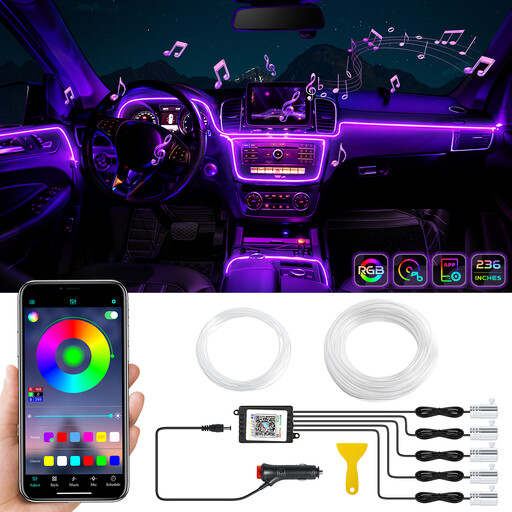
Why this product suits the profile: This kit is aimed at users looking for a relatively straightforward solution for the dashboard or door areas. According to the product details, it includes 6 metres of light guide, five RGB LEDs, a 12 V car charger and installation tools.
The stated total length and the option to cut it into several sections make custom installation easier. Before fitting, the light distribution should be tested in the planned locations.
Bluetooth app control, 16 million stated colour combinations and a music sensor according to the product description.
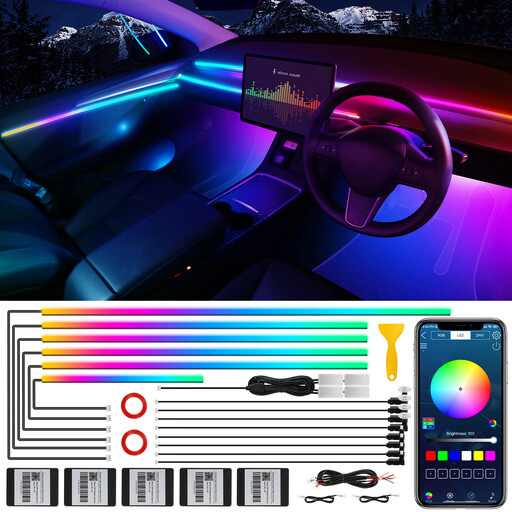
Why this product suits the profile: This version combines six acrylic light strips with four footwell lights. According to the details, it features 600 LEDs, Smart IC control, two zones and multiple controllers.
The separate control can help you configure the dashboard and footwell differently. Testing before installation is recommended in the product information.
Dual-zone function, touch button, app control and a stated operating temperature range of -20 °C to 60 °C.

Why this product suits the profile: This complete kit is designed for users who want to include door handles, storage compartments and door speakers in addition to the dashboard and footwell. According to the product details, multiple controllers and extension cables are included for this purpose.
The kit contents list the intended areas individually. This reduces the risk of having to plan for additional door or footwell modules after purchase.
22-in-1 kit contents, music sync, RGB Smart IC and, according to the product description, multiple separately connectable areas.
Plan your cable routes before fitting the RGB LED strips in your car. Clean the contact surfaces, test all components and secure the controllers so that they neither rattle nor are exposed to moisture. Light must not impair your vision, displays or other road users. If you are unsure about installation or whether it is permitted on the road, it's a good idea to consult a professional garage or testing centre.
For LED door lighting in your car, keep moving door parts, window regulators and seals clear. An RGB neon LED strip for your car will only look tidy if excess cables are hidden and the light guides are routed without sharp kinks.
We've put together a complete, regularly updated list of products that fully meet these strict selection criteria and the safety regulations in force in the EU.
Many kits are powered via a 12 V connection, a USB port or a Type-C adapter. The exact connection depends on the product. Check the voltage, plug and controller before permanently installing the lighting.
The lifespan depends on the LED components, temperature, vibrations, moisture and the quality of the cable routing. A general usage period cannot be reliably stated without specific manufacturer information. Continuous operation at high brightness can increase the strain.
Music sync primarily uses the sensor and the controller. However, power consumption mainly depends on the number of LEDs, the brightness and the selected effect. In vehicles with sensitive electrical systems, the lighting should not be operated continuously without the engine running.