
Lieferung heute & morgen

Qualitätsgarantie

Willkommens-Angebote freischalten: KOSTENLOSE Lieferung | Bis zu 80 % RABATT | Kostenlose 30-Tage-JoyPlus-Testphase
App herunterladen
A car phone holder should keep your smartphone visible and accessible for navigation without obstructing your view or interfering with the vehicle’s controls. In practice, however, models differ significantly in terms of mounting, compatibility and everyday usability. If you only focus on terms like “strong”, “universal” or “360°”, you risk overlooking important details.
A universal phone holder must be compatible with your smartphone, its case and the chosen mounting point. With clamp-style holders, the stated device size is crucial. Magnetic models, on the other hand, require a suitable metal plate, MagSafe compatibility or an appropriate ring.
Additionally, a thick protective case can affect the holding strength or the clamp width. Before purchasing, you should therefore match your smartphone size, case thickness and weight against the product specifications.
A phone holder with 360° rotation lets you orient your device in portrait or landscape mode. This is handy for navigation and hands-free calling. However, the rotation feature says little about the stability of the base. A loose ball joint can shift or amplify vibrations if the mount isn’t secured properly.
What matters, therefore, is not just the rotation angle, but also the construction of the clamp, the contact surfaces and its suitability for your particular vehicle surface.
A phone holder with a suction cup generally sticks to smooth, clean and sufficiently flat surfaces. Dust, grease, pronounced unevenness or high temperatures can impair adhesion. An adhesive mount for the dashboard also requires a dry, grease-free surface and should be left to set according to the instructions after installation.
A vent-mounted phone holder is not equally suitable for every vehicle either. Very thin, flexible or rounded air vent slats can offer less grip than sturdy, horizontal ones.
The models presented here include specific details about supported device sizes. According to the product description, the Wozinsky WCHBK7 is designed for smartphones from 4.7 to 6.9 inches. The Baseus Car Mount Steel Cannon 2 is specified for smartphones from 4.7 to 6.76 inches. For the Wozinsky WMH-06, devices from 4 to 6.9 inches are listed, provided a metal plate or compatible case is used.
These figures describe the intended compatibility, but they don’t replace checking against your own device. Especially with cases that have a card slot, a ring or an extra bumper, the actual fit may differ.
The car mount for smartphones must not unnecessarily restrict your field of view and should not be placed in the deployment zone of airbags. Switches, ventilation controls and the view of your instruments must also remain unobstructed. The final position depends on your vehicle model.
Your smartphone should not be operated or repositioned while driving. A holder supports navigation, but it doesn’t replace safe and attentive driving.
The following selection assigns different mounting solutions to specific everyday situations. The decisive factors are the stated mounting types, materials, device sizes and functions.
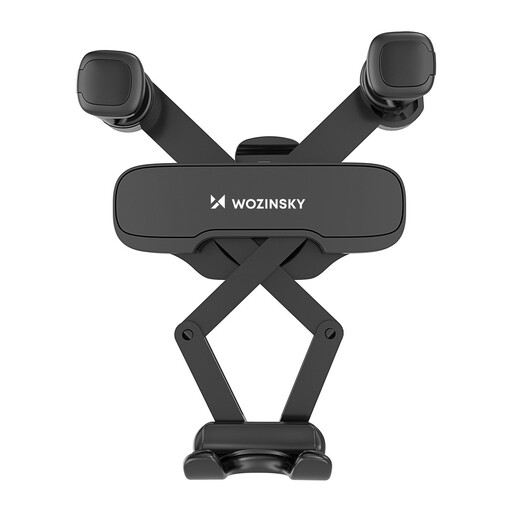
Why this product fits the profile: This air vent holder is designed for smartphones from 4.7 to 6.9 inches and uses a mechanical gravity clamp for one-handed insertion and removal.
The product data specifies the mounting type, device size and a clamp construction with hooks and non-slip pads, rather than just vague stability claims.
360° rotation, ABS and aluminium components, and a stated device range of 4.7 to 6.9 inches.
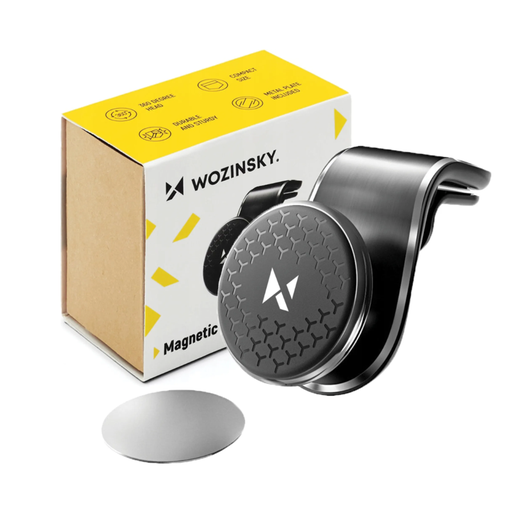
Why this product fits the profile: This magnetic car phone holder combines an air vent mount with 360° adjustment and is ideal for users who frequently attach and remove their smartphone.
The construction is described as a magnetic base with an adjustable holder. This allows you to check the position precisely, rather than relying solely on an unspecified magnetic strength.
Stated 360° rotation, metal plate included and a weight of 0.05 kg.
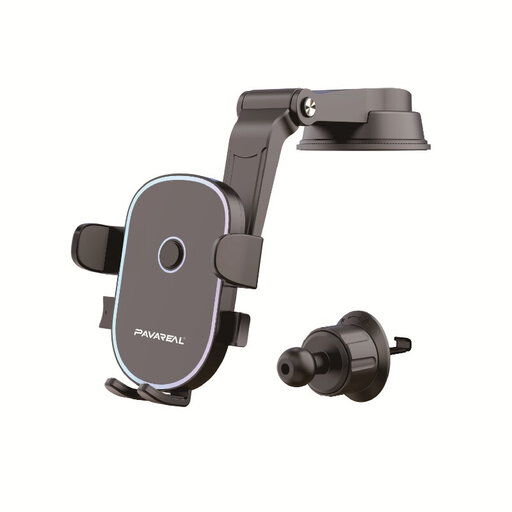
Why this product fits the profile: Two installation methods give commuters and those who switch between vehicles more mounting options. The one-handed operation is designed for frequent insertion and removal.
The product description mentions ABS, PC and metal, along with a non-slip, multi-angle adjustment. This clearly identifies the key construction features.
Two mounting methods, one-handed operation and a described anti-slip construction.

Why this product fits the profile: The adhesive base is designed for a flat dashboard surface. The 360° adjustment supports orientation for navigation in portrait or landscape mode.
The instructions specify concrete steps: clean the surface, press the base for 30 seconds and allow at least 24 hours to cure. This reduces installation errors caused by loading it too soon.
Eight integrated magnets, 360° ball joint and compatibility stated for devices from 4 to 6.9 inches with a metal plate or suitable case.
We’ve put together a complete, regularly updated list of products that fully meet these strict selection criteria and the safety regulations in force in the EU.
Before installation, clean the contact surface of dust and grease. For adhesive bases, observe the setting time stated in the instructions. Suction cups can, depending on the design, be removed and cleaned; a damaged or permanently deformed adhesive surface should not be reused.
Check regularly:
It’s not possible to give a reliable lifespan without details on load, temperature, vehicle and usage. Adhesive pads and suction cups in particular are wear parts and should be replaced when their grip weakens.
That depends on your vehicle, field of view and smartphone. An air vent holder is space-saving, while a suction cup or dashboard solution can offer more freedom in positioning. What matters is that the holder sits securely and doesn’t obstruct your view or the vehicle controls.
Not automatically. The device needs either MagSafe compatibility or a suitable metal plate or ring. If you use wireless charging, check whether the plate affects the charging function. Always follow the product specifications for device size and mounting.
The price depends mainly on the mounting type, materials, adjustment mechanism and accessories. An inexpensive model may be sufficient for a single vehicle. For frequent use, switching between vehicles or multiple mounting options, a 2-in-1 or 3-in-1 solution may be more practical. The key is to compare specific product data rather than relying on a general price promise.