
Lieferung heute & morgen

Qualitätsgarantie

Willkommens-Angebote freischalten: KOSTENLOSE Lieferung | Bis zu 80 % RABATT | Kostenlose 30-Tage-JoyPlus-Testphase
App herunterladen
A reliable car phone mount isn't a luxury; it's a necessity for safe navigation and hands-free calls. However, the market is crowded, and many products don't live up to their promises. A smartphone rattling on cobblestone streets, a suction cup that detaches during the first heatwave, or an air vent clip that breaks after just a few weeks—these are problems familiar to many drivers.
As your Joybuy Product Recommendation Officer, I'm here to help you cut through the noise. This guide will show you the most common pitfalls to avoid and which technical features you should really look for to find a suitable and long-lasting smartphone mount for your car.
Before you make a decision, you should be aware of the typical weaknesses that often only become apparent after the purchase:
car mount with a charging function sounds convenient, but many models fail to deliver the promised power. The result: the battery drains faster during navigation than it charges, or the device overheats and disables the charging function to protect itself.To avoid a bad purchase, focus on three objective criteria that determine the quality and functionality of a car phone mount.
The mounting location is crucial for stability and safety. Each option has specific pros and cons.
How the smartphone attaches to the mount affects both convenience and security.
An integrated in-car Qi charger is a convenient addition. Pay attention to the following specifications:
Here are some recommendations tailored to different needs and vehicle types.

Why it's a great fit: Ideal for drivers who want a simple, discreet, and cost-effective solution that avoids complex mechanics and focuses on the core function: holding the smartphone securely.
This model avoids failure-prone suction cups or vent clips, instead relying on an adhesive base that creates a permanently stable connection on smooth surfaces.
A compact design that doesn't obstruct the view, and universal compatibility thanks to the included metal plate for non-magnetic devices.
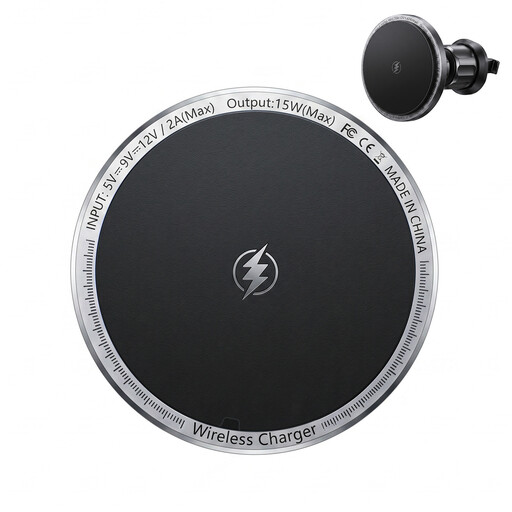
Why it's a great fit: Perfect for commuters with a MagSafe-enabled iPhone who need seamless integration, fast charging, and a secure hold for their daily drive.
It addresses the issues of slow charging and overheating with up to 15W of power and an integrated metal heat sink that keeps the temperature down.
Efficient charging combined with a strong magnetic lock for true one-handed operation and a compact design for the air vent.

Why it's a great fit: For drivers who use a mount in different vehicles or don't want to commit to a single mounting location. It offers maximum flexibility for various cockpit layouts.
It solves the compatibility problem by offering two mounting options in one package: one for the air vent and one for the dashboard. This ensures you don't buy the wrong type of mount.
Dual mounting options, strong N52 magnets for a secure hold, and an included metal ring that ensures compatibility even with non-MagSafe devices.
We've curated a full, up-to-date list of products that fully meet these strict selection criteria and German safety regulations.
Yes, with models featuring high-quality magnets (e.g., N52 magnets), the holding force is more than sufficient for the weight of modern smartphones under normal driving conditions. The magnetic force is designed to hold the device securely even during vibrations, without interfering with the smartphone's electronics. For very heavy cases or driving on extremely rough terrain, a mechanical clamp mount may offer additional security.
According to § 23 of the German Road Traffic Regulations (StVO), the driver's view must not be obstructed. The mount must be placed so that it blocks neither the view of the road nor of the instruments or mirrors. Areas where airbags deploy are also off-limits. Mounting on the air vent, on the dashboard outside the primary field of vision, or in the lower area of the windshield is generally a legally compliant choice.
No, this is not a risk with certified products that comply with the Qi standard. These mounts have built-in safeguards against overheating, overvoltage, and overcurrent, which protect both the smartphone and the charging electronics. A moderate amount of heat during the wireless charging process is normal. Models with good heat dissipation ensure that the temperature remains within a safe range.