
Lieferung heute & morgen

Qualitätsgarantie

Willkommens-Angebote freischalten: KOSTENLOSE Lieferung | Bis zu 80 % RABATT | Kostenlose 30-Tage-JoyPlus-Testphase
App herunterladen
A car polisher can save time when restoring the finish on car paintwork, metal, wood or glass. However, choosing the wrong machine can quickly lead to uneven results, overheated surfaces or unnecessary extra costs. What matters is not just the stated speed or an impressive-looking range of accessories, but how the type of movement, speed range, pad size and intended use work together.
A high maximum speed says little about how much control you’ll have while polishing. Applying wax and carrying out light finishing work usually call for lower speeds than tackling signs of oxidation. Without fine speed adjustment, a machine may be too aggressive for delicate areas of paintwork.
Polishing pads aren’t universally compatible. Before buying, check that the backing plate diameter, attachment system and pad shape are all compatible. A car polishing sponge with a hook-and-loop or adhesive backing needs a suitably designed base. A wool polishing pad must not be used with an unsuitable backing plate either.
A cordless car polisher gives you greater freedom of movement, but it needs a charged battery and may require a spare. On larger vehicles, you may have to stop work to recharge. Corded models avoid this limitation, but you’ll need to manage the cable safely and take care not to damage the paintwork.
A dual-action polisher moves the pad in an offset circular motion as well as rotating it. This spreads the work over a larger area. It can be a manageable option for DIY users and hobbyist detailers. A purely rotary motion concentrates more force in one area and requires especially even handling.
However, the type of movement doesn’t replace careful technique. Before working over a large area, test the machine on an inconspicuous spot. An automotive polisher generally can’t completely remove deep scratches if they extend into the deeper layers of paint.
Look for a clearly stated range in revolutions per minute (RPM) and several speed settings. A lower speed is generally better for applying wax and finishing polishes. Higher settings can be used with suitable pads and polishes to tackle oxidation or fine sanding marks.
It’s also important to have easy-to-reach controls, a safe start function and a stable grip. A display or LED indicator makes it easier to keep track of the settings, but it doesn’t replace choosing the right pad and polish.
A 125 mm pad covers a larger area and can be handy for broad body panels. Smaller pads between 50 and 80 mm make it easier to work in tight spaces, around contours or on headlights. Car polishing pads should be cleaned after every use and left to dry completely.
Where possible, use separate pads for different polishes. Otherwise, dust and dried polish residue can leave new marks on the paintwork.
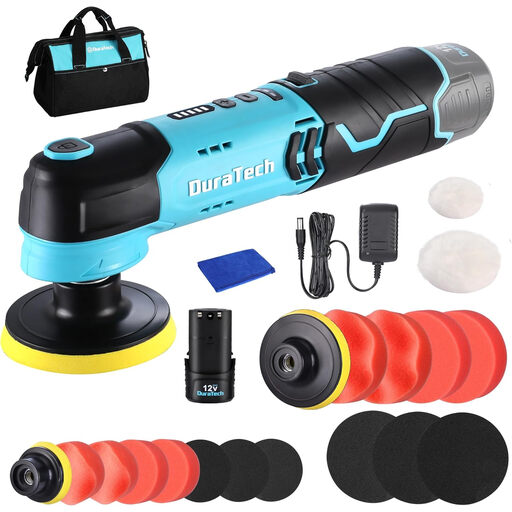
Why this product suits this profile: Weighing 810 g, this compact machine has five speed settings from 600 to 3000 RPM and comes with two pad sizes. It’s suitable for smaller vehicles, furniture and spot repairs.
The adjustable speed means you don’t have to work at a high speed all the time. The package includes 50 and 80 mm pads.
12 V battery, LED indicator, spindle lock, storage bag and accessories for paintwork, furniture and metal.
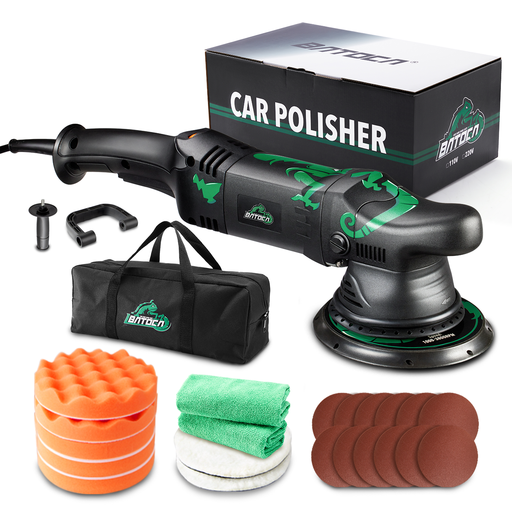
Why this product suits this profile: This corded model has a 1100 W motor, six speed settings from 2500 to 5500 RPM and a 5-inch backing plate.
The six speed settings cover lower speeds for wax and polish, as well as higher speeds for tackling oxidation. It runs on mains power, so there’s no need to change batteries.
Dual-action movement, adjustable side handle and D-handle, plus replaceable carbon brushes according to the product description.
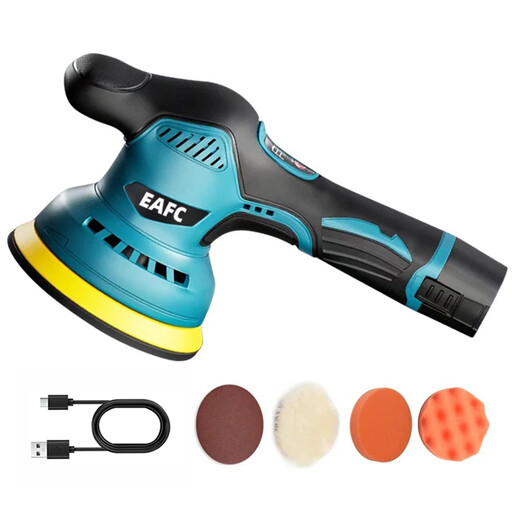
Why this product suits this profile: This cordless machine has eight settings from 2800 to 5500 RPM, a 125 mm backing plate and a stated orbital throw of 0.9 cm. It’s worth considering for larger areas and a range of jobs.
The wide speed range lets you adjust the setting to suit the job. The adhesive backing makes it quick to change compatible pads.
12 V lithium battery, anti-vibration handle, heat dissipation through multiple air vents and compatibility with 125 mm discs.
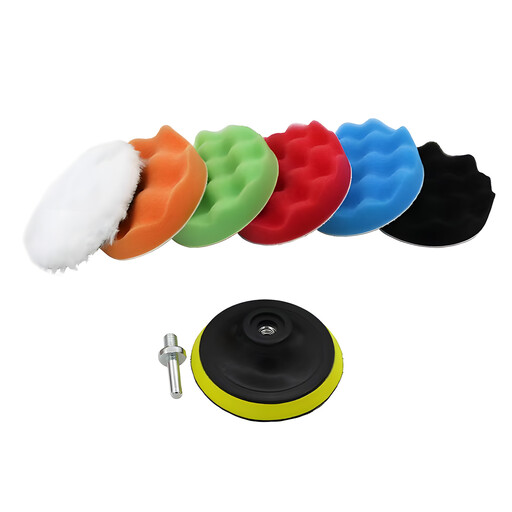
Why this product suits this profile: The set includes five foam pads, a synthetic wool pad, an M10 adapter, an adhesive backing plate and a screw for a variety of jobs.
The different pad grades make it easier to keep sanding, polishing and finishing work separate. The hook-and-loop fastening allows for quick changes.
Washable, reusable pads suitable for car paintwork, glass, stone, ceramics, wood and metal.
Clean the surface thoroughly before polishing, removing any sand, dust and loose dirt. Start at a low speed and use light pressure. Guide the car polisher evenly, and don’t linger on edges, contours or areas with thin paintwork.
When using a new pad, check the manufacturer’s guidance on maximum speed and backing plate compatibility. Before you start, make sure the pad is fully attached and centred. After use, clean foam and wool polishing pads with water and leave them to dry in a well-ventilated place.
We’ve put together a complete, regularly updated list of products that meet these strict selection criteria and fully comply with the safety regulations in force in the EU.
A low to medium setting is best for spreading wax. The right setting depends on the machine, pad, wax and paintwork. Start with a small test area and avoid applying too much pressure.
Depending on the condition of the paintwork, polish and pad, you may be able to reduce fine wash marks and superficial marks left by previous work. Deep scratches that go all the way through the clear coat can’t be reliably removed by polishing alone.
Run time depends on battery capacity, speed, pressure and the material you’re working on. One battery may be enough for occasional jobs. For larger vehicles, a spare battery or a corded model can be useful, as either option reduces charging breaks.