
Lieferung heute & morgen

Qualitätsgarantie

Willkommens-Angebote freischalten: KOSTENLOSE Lieferung | Bis zu 80 % RABATT | Kostenlose 30-Tage-JoyPlus-Testphase
App herunterladen
As a Joybuy Product Recommendation Officer, I see it as my duty to provide you with clear and objective information. Anyone who travels frequently knows the problem: your laptop battery is dead, but the nearest power outlet is miles away. A 12V to 230V car power inverter is a practical solution. It converts the 12V direct current (DC) from your car battery into 230V alternating current (AC), allowing you to use standard household appliances in your vehicle. This article serves as a guide to help you choose the right device for your needs.
The market is flooded with options, and technical specifications can be confusing. The following three points will help you make an informed decision.
The type of AC voltage produced is a crucial factor.
An inverter's power is measured in watts (W). A 300W power inverter is a common standard for running laptops (approx. 60–90W), charging cameras, or operating other small devices.
However, keep in mind that most car cigarette lighter sockets are only rated for a maximum load of about 150W. If you want to use the inverter's full power, a direct connection to the car battery is often necessary.
Modern devices offer more than just a standard AC outlet. An inverter with USB ports is standard today. Look for the latest fast-charging technologies like Power Delivery (PD) for USB-C or Quick Charge (QC) to efficiently charge smartphones and tablets.
A car power inverter works with high voltages, so it's crucial to look for integrated protection mechanisms. These include protection against overheating, over-voltage, under-voltage, short circuits, and overload. A built-in fuse is also an important feature. Models with T?V certification have been tested for safety by an independent body and offer an extra layer of reliability. A quiet, temperature-controlled fan also ensures the device doesn't overheat without being unnecessarily loud at low loads.
Based on the criteria above, we've compiled a selection of models that cater to different needs.
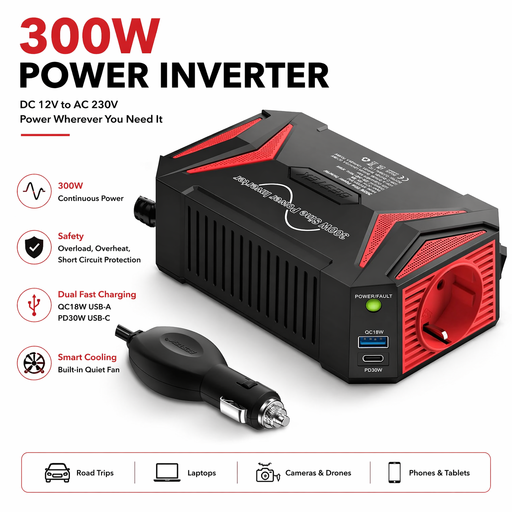
Why it stands out: This model is designed for maximum charging efficiency for modern devices. With a 30W Power Delivery port and an 18W Quick Charge port, it can rapidly charge the latest smartphones, tablets, and even some laptops like the MacBook.
Pros:
Who it's for: Users who prioritise the fastest charging speeds for their modern gadgets and need a reliable, clean power source for laptops, cameras, and other sensitive electronics.
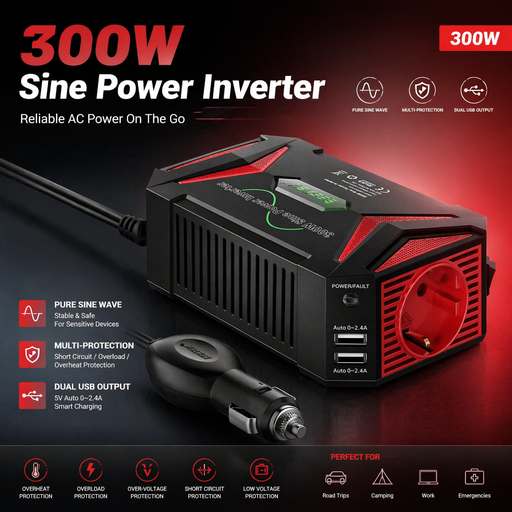
Why it stands out: This model's focus is on certified safety and stable performance. The T?V certification confirms compliance with high safety standards, while the pure sine wave ensures interference-free operation for a wide range of devices.
Pros:
Who it's for: Safety-conscious users looking for a reliable and certified cigarette lighter converter to safely power laptops, tablets, game consoles, or Hi-Fi systems in their car.
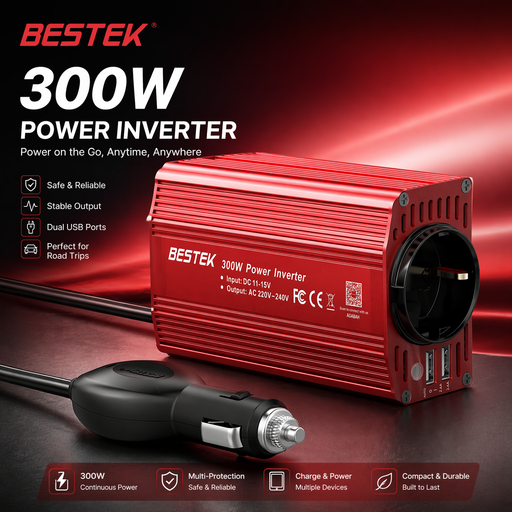
Why it stands out: This model is a cost-effective solution for basic power needs. It offers a solid set of essential features, including all necessary protections for operating non-sensitive devices.
Pros:
Who it's for: Budget-conscious users who mainly want to power simple devices like lamps or chargers for smartphones and tablets and do not require a pure sine wave.
If the models presented here don't perfectly match your requirements, or if you're looking for more specialised solutions like compact travel adapters, you can find a wider selection in our category.
Explore more ultra-fast charging travel adapters here.
A 300-watt inverter is suitable for most consumer electronics like laptops (approx. 60–90W), tablets, smartphones, cameras, small fans, or lamps. It is not designed for devices with a high start-up current or high continuous power consumption, such as coffee makers, hair dryers, microwaves, or power drills. Remember that the power available from the cigarette lighter socket is usually limited to about 150W.
Yes, using a pure sine wave inverter is highly recommended for laptops and other devices with sensitive power supplies. The "dirty" power from a modified sine wave inverter can cause interference, reduce the power supply's efficiency, generate excess heat, and, in the worst-case scenario, damage the device.
Inverters with a power rating up to about 150 watts can typically be used with the cigarette lighter socket without any issues. For devices that require more power, the inverter should be connected directly to the car battery using the provided clamps. This prevents overloading the vehicle's fuse and ensures a stable power supply.