
Lieferung heute & morgen

Qualitätsgarantie

Willkommens-Angebote freischalten: KOSTENLOSE Lieferung | Bis zu 80 % RABATT | Kostenlose 30-Tage-JoyPlus-Testphase
App herunterladen
Whether you're a commuter needing to charge your laptop on the go, running a coffee machine while camping, or a tradesperson using power tools on-site, a reliable 230V power source in your vehicle is often essential. A power inverter, also known as a converter, transforms your car battery's 12V DC power into 230V AC power, providing you with a standard household outlet.
However, navigating the technical differences to choose the right device can be overwhelming. This article serves as a practical guide to help you find the perfect 12V to 230V power inverter for your car, tailored precisely to your needs.
Your Joybuy Product Recommendation Officer
To make an informed decision, three criteria are particularly important: power output, the type of output voltage, and the available connections.
The power of an inverter is measured in watts (W) and is the most critical factor. A distinction is made between rated power (continuous power) and peak power (short-term maximum power).
The waveform of the output voltage is crucial for compatibility with your devices.
A modern car power converter should offer more than just a car power outlet. Additional USB ports (ideally with fast-charging technology like QC 3.0 or Power Delivery) allow for simultaneous charging of smartphones and tablets. Also, look for integrated protection mechanisms such as overload, short-circuit, overheating, and low-voltage protection. These features protect both your devices and your car battery.
Based on the criteria mentioned, we have compiled a selection of models that cover different use cases.
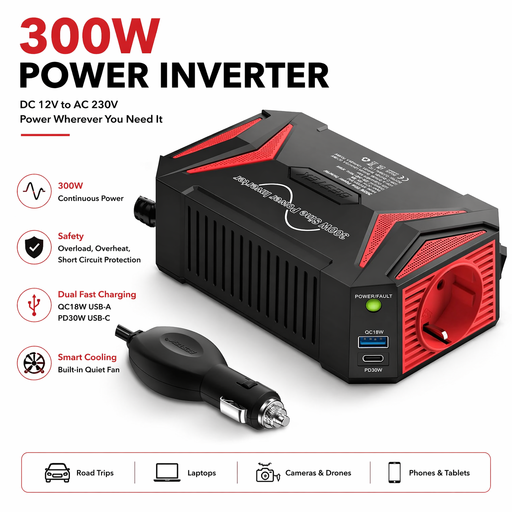
Why this model stands out: This model combines a pure sine wave with modern fast-charging ports, making it an excellent solution for the mobile office or daily use in the car.
Features at a Glance:
Who is it for? Ideal for commuters, field staff, and travellers who need to safely and quickly charge sensitive devices like laptops (including MacBooks), cameras, or drones on the go.
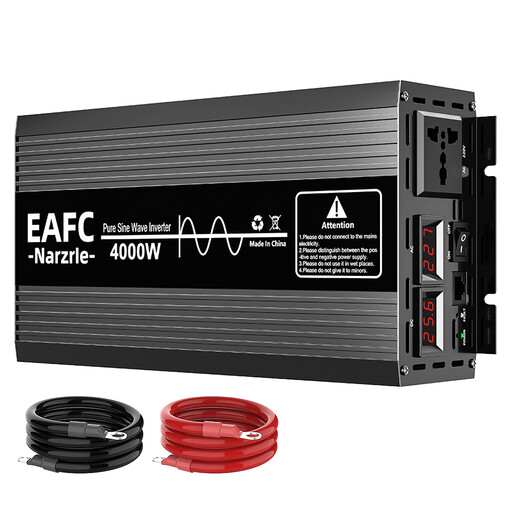
Why this model stands out: With its high rated power of 2000W and pure sine wave output, this inverter is a powerhouse capable of reliably supplying even power-hungry devices.
Features at a Glance:
Who is it for? Perfect for RV and truck drivers, campers, and tradespeople. It easily powers coffee machines, small refrigerators, drills, and other power tools that require high and stable performance.
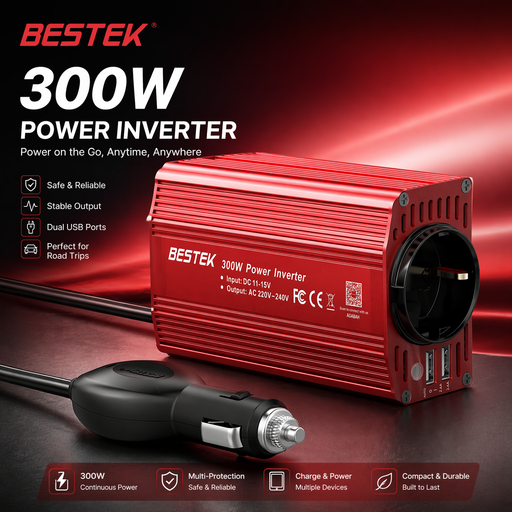
Why this model stands out: This model is a cost-effective and compact solution for basic power needs and non-sensitive devices.
Features at a Glance:
Who is it for? A great choice for drivers who want to power simple devices like lamps, fans, or non-sensitive chargers. Thanks to its USB ports, it's also suitable for charging smartphones and tablets.
A power inverter is ideal when you need a 230V outlet. However, if you only want to charge your USB devices like smartphones, tablets, or power banks in the car, a dedicated adapter is often the more practical and compact solution.
If you just need to charge your USB devices in the car, you can find a selection of suitable solutions in our 12V USB Adapter category.
Yes, with prolonged use while the engine is off, a power inverter can drain the car battery. However, most high-quality models feature low-voltage protection, which automatically shuts off the device before the battery voltage drops to a critical level. This ensures you can still start your vehicle.
A pure sine wave inverter produces electricity of the same quality as a home outlet and is safe for all devices. A modified sine wave model is a cheaper alternative suitable only for simple, non-sensitive appliances, as it can cause interference or damage to sensitive electronics.
Check the nameplate or user manual of your device to determine its power consumption in watts (W). The continuous power (rated power) of the inverter should always be higher than the device's power consumption. For devices with motors (e.g., refrigerators, pumps, tools), the higher starting power must also be considered, for which the inverter's peak power is relevant.