
Lieferung heute & morgen

Qualitätsgarantie

Willkommens-Angebote freischalten: KOSTENLOSE Lieferung | Bis zu 80 % RABATT | Kostenlose 30-Tage-JoyPlus-Testphase
App herunterladen
A custom starlight headliner gives a car's interior a luxurious atmosphere. However, the path to an impressive car roof lighting setup is paved with potential pitfalls. Many aftermarket kits promise more than they can deliver. Before you invest in a starlight headliner retrofit project, it's crucial to know the most common sources of error to avoid disappointment and unnecessary expense.
As your Joybuy Product Recommendation Officer, I have summarised the essential points that are decisive when choosing a kit. We will focus on the technical facts that make the difference between a stunning result and a subpar attempt.
The 3 Most Common Mistakes When Buying a Retrofit Kit:
To avoid the problems mentioned above, you should carefully check three technical aspects before buying. These define the quality and longevity of your new ambient lighting in the car.
The quality of a fibre optic starlight headliner lives and dies by the fibres used. Pay attention to the following values:
The light engine is the heart of the system. Here, the difference between RGB and RGBW is crucial. While RGB LEDs create white by mixing red, green, and blue, an RGBW engine has an additional, dedicated white LED chip. The result is a clear, pure white light, which is essential for a classic starlight headliner look.
Also, pay attention to the power, specified in watts (W). A higher wattage (e.g., 12W or 32W) generally means higher brightness, which is particularly advantageous in daylight or bright environments. For special effects like a starlight headliner with a shooting star, a separate, dedicated light engine or a combination device is required.
Modern kits offer dual control options. A reliable starlight headliner app control via Bluetooth provides the greatest range of functions: precise colour selection from millions of shades, brightness control, speed adjustment for effects, and often a music synchronisation mode. An additional RF (radio frequency) remote is practical for quick adjustments without needing to grab your smartphone. Check if the app is regularly updated and available for your operating system (iOS/Android).
Based on the criteria mentioned above, we have identified some products from our range that are suitable for different user profiles and projects.

Why This Fits Their Persona: Ideal for users starting their first starlight headliner project. With 1000 fibres, the kit provides a solid foundation for a dense result in compact or mid-size vehicles. The 12W power is sufficient for most applications.
Avoids the low-fibre-count trap by offering 1000 strands. The RGBW light source also ensures pure white light, avoiding the typical colour tint of cheap RGB kits.
The split design with 4 separate light sources can simplify cable routing. Control is flexible via app and RF remote control.
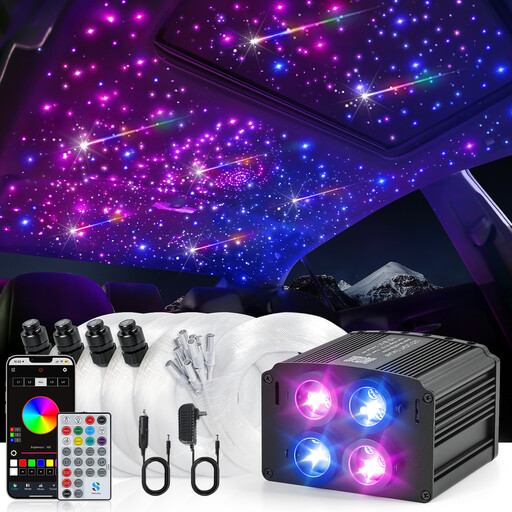
Why This Fits Their Persona: For tuning fans and perfectionists seeking maximum effects and brightness. The 4-metre-long fibres are also suitable for large vehicles, and the high fibre count ensures an extremely dense starfield.
This kit combines a powerful 32W RGBW engine with a dedicated shooting star function. It bypasses the trap of weak or unrealistic effects with a 2-in-1 solution for twinkle and meteors.
The combination of 1000 twinkle fibres and 240 shooting star fibres allows for complex, dynamic light shows. The 4-port engine enables zone-based control for even more customised effects.

Why This Fits Their Persona: For users who want comprehensive interior lighting but want to avoid the complex installation of a fibre optic headliner. This set focuses on uniform line lighting throughout the vehicle.
Instead of poorly imitating a starlight sky, this kit offers a high-quality, standalone solution. The acrylic light strips provide homogeneous and bright illumination without the point-like light sources of fibre optics.
The 22-in-1 kit allows for complete illumination of the dashboard, doors, footwell, and more. The RGB Smart IC (Dreamcolor) technology enables flowing colour gradients along the strips.
We have compiled a complete, real-time list of products that fully satisfy these strict selection criteria and UK safety regulations.
1. How many optical fibres do you need for a good starlight headliner in a car? The required number depends on the vehicle size and the desired density. As a rule of thumb: for a compact car, 500-800 fibres are a good starting point. For a dense, impressive result in mid-size cars or SUVs, 1000 or more fibres are recommended.
2. Is installing a starlight headliner retrofit kit complicated? The installation requires patience and craftsmanship. The headliner usually needs to be removed to insert the optical fibres from behind. This involves drilling many small holes. A complete kit with all the tools and a detailed guide is manageable for DIY enthusiasts but can take several hours.
3. What is the difference between RGB and RGBW for car headliner lighting? RGB systems produce white by mixing red, green, and blue light. The result is often a slightly bluish or yellowish white tone. RGBW systems have an additional, separate white LED chip. This allows for the display of a pure, neutral white light, which is a great advantage for an authentic starry look.