If you can stay close to the microphone while delivering your monologue, a directional dynamic microphone is a sensible starting point. Point it towards your mouth, position the fan as far outside the main pickup direction as possible, and listen back to a test recording. Check the input level during loud punchlines. USB makes connecting to a computer easier, while an XLR-only model needs a suitable recording setup. No pickup pattern or noise processing can guarantee fan-free audio.
Who these options are suited to
Monologue with a fan running
If you’re speaking alone from a fixed position, you can place the microphone close to your mouth and point it towards you. Audio-Technica says the ATR2100x-USB’s cardioid pickup pattern reduces sound coming from the sides or rear, but doesn’t eliminate it completely.
Speakers with loud punchlines
If you alternate between quiet and powerful passages, adjustable input gain and monitoring as you record are important. Shure and Sennheiser describe level control or monitoring features on the MV7+ and Profile USB respectively.
Speakers on camera
When filming, the microphone’s position needs to suit the framing and the recording connection you have available. Sennheiser describes the MKE 600 as a shotgun microphone powered by phantom power or a battery.
What to look for when buying
Directional dynamic USB or USB/XLR microphone
Suitable if: you’re recording alone at a computer and can maintain a short, consistent speaking distance.
Trade-off: Close positioning limits how much you can move. A cardioid pickup pattern reduces certain sounds from the sides or rear, but can’t guarantee that an audible fan will be eliminated.
Dynamic USB/XLR microphone with noise processing
Suitable if: the fan runs steadily and you’d also like to use digital processing. Shure says the MV7+’s switchable real-time denoiser is designed for constant sounds such as fans.
Trade-off: This is the manufacturer’s claim, and results depend on the recording. Shure says the feature is less effective with background voices and keyboard clicks.
Directional USB condenser microphone
Suitable if: a test recording from your chosen position already has little fan or room noise, and you want to adjust the level on the microphone itself. The Profile USB is a documented example.
Trade-off: A cardioid pickup pattern won’t completely remove sounds outside the pickup direction. Check both quiet and loud passages for clipping.
Shotgun microphone for recording on camera
Suitable if: you’re filming and can position the microphone to suit the framing. The Sennheiser MKE 600 is a shotgun microphone powered by phantom power or a battery.
Trade-off: The direction, distance, connection and power supply all need to work with your camera or recorder. Its pickup pattern can’t guarantee complete fan removal.
XLR-only voice microphone
Suitable if: you already have a suitable interface and preamp. For SM7B voice-over, Shure recommends at least 60 dB of preamp gain.
Trade-off: An XLR-only model can’t connect directly via USB. The 60 dB recommendation applies specifically to the SM7B for voice-over.
| What matters |
What to check when buying |
Who it matters most to |
| Clarity with fan noise |
Check the pickup pattern and direction; point the microphone towards your mouth with the fan running, then listen to a test recording. |
If I can speak close to the microphone from a fixed position, I want my voice to be clear even with the fan running. Around 36% of consumers focus primarily on clarity with fan noise. |
| Levels for quiet and loud passages |
Check for a gain control, level display and headphone monitoring; record your quietest and loudest passages as a test. |
If I switch between quiet moments and loud punchlines, I want to control and monitor the input level. Around 29% of consumers prioritise level control. |
| Connection and recording setup |
Check the model’s connection and device compatibility. For XLR, also consider the interface, preamp gain and cables you’ll need. |
If I want to record as simply as possible with my existing device, I need a suitable connection without unnecessary extra equipment. Around 21% of consumers particularly value a straightforward connection. |
| Microphone position when filming |
Decide on the recording distance and framing; check that the connection and phantom or battery power are compatible with your camera or recorder. |
If I’m filming the monologue or want to move while performing, the microphone position needs to work with the framing and recording device. Around 14% of consumers prioritise camera positioning. |
Common misconceptions
-
“Dynamic” or “cardioid” doesn’t mean the fan will disappear
Even a directional microphone picks up sound from within its pickup area, so you may still hear the fan.
Position the microphone in relation to the fan, then check the sound at the actual recording spot with the fan running.
-
Noise processing won’t solve every background noise problem
Shure describes the MV7+ denoiser as suitable for constant sounds such as fans, but notes that it has limitations with background voices and keyboard clicks.
Listen back to a test recording with the setting you plan to use, and distinguish constant fan noise from changing sounds.
-
An XLR-only microphone isn’t a USB microphone you can plug straight in
An XLR-only model needs a suitable recording setup to connect to a computer. Shure’s recommendation of at least 60 dB of preamp gain applies specifically to SM7B voice-over.
Check the connection on the specific model against the inputs you have and the preamp gain you’ll need.
Microphone brands to consider
Audio-Technica
The ATR2100x-USB is an option for recording a single voice at close range, with USB or XLR connectivity.
- Audio-Technica lists a dynamic cardioid capsule, direct headphone monitoring, USB and XLR cables, and a desktop stand.
- According to the manufacturer, sounds coming from the sides or rear are reduced, not eliminated completely.
RØDE
The PodMic USB combines documented close-miking with USB-C and XLR connections.
- RØDE recommends a mouth-to-microphone distance of around 5–10 cm for this model, and lists a headphone output, pop filter and swivel mount.
- The short speaking distance may mean you need a microphone arm and a steady speaking position.
Shure
The MV7+ offers USB-C/XLR connectivity and switchable processing, while the SM7B is a separate XLR option for a suitable recording setup.
- Shure lists fans as one of the situations the MV7+ denoiser is designed for.
- Shure says this processing is less effective with background voices and keyboard clicks. The recommendation of at least 60 dB of preamp gain applies to SM7B voice-over, not the MV7+.
Sennheiser
The Profile USB is a desktop USB-C option, while the MKE 600 is designed for a camera-mounted shotgun setup.
- Sennheiser describes the Profile USB as having a cardioid condenser capsule and level controls.
- The MKE 600 needs a suitable recording connection and phantom or battery power. The features of these two models aren’t interchangeable.
Samson
The Q2U is another USB/XLR cardioid option for recording a single voice.
- Samson describes it as picking up more sound directly in front of the microphone and less from the sides and rear.
- The manufacturer’s claims about clear sound aren’t an independent measurement of fan noise during this monologue.
Microphones for monologues at Joybuy
This selection includes directional dynamic USB/XLR microphones for recording one person from a fixed position, with level control.
 No image available
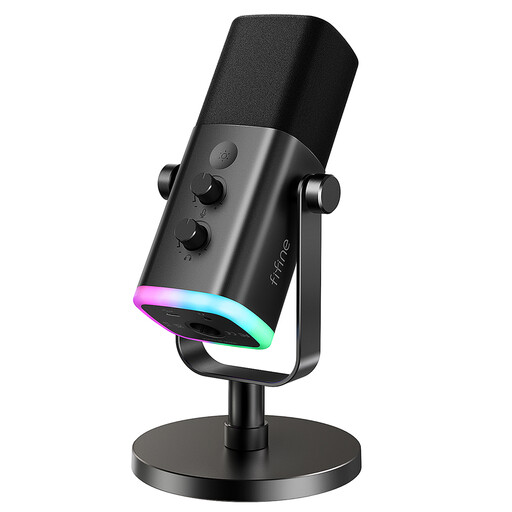
FIFINE AM8 USB/XLR Dynamic Microphone
For recording one person from a fixed position at close range; the product description lists a desktop stand and recommends a distance of 2 to 6 inches.
The product description lists a unidirectional or cardioid pickup pattern, which reduces off-axis noise but doesn’t guarantee complete fan suppression.
In USB mode, gain control and headphone monitoring are described. XLR mode requires a separate XLR cable; according to the product description, the cable and microphone arm aren’t included.
View at Joybuy
Frequently asked questions
Does a cardioid pickup pattern remove the fan completely?
No. Cardioid microphones mainly reduce sound from certain directions. Shure says a microphone can still pick up noise from within its pickup area. Position the specific model carefully and make a test recording with the fan running.
How can I check loud punchlines before recording?
Make a test recording of a quiet passage and a particularly loud one. The Sennheiser Profile USB lets you adjust input gain and headphone volume, while its display helps you monitor the input level.
Do I need an extra device to connect every XLR microphone to a computer?
For a standard analogue XLR connection, you’ll need a suitable recording setup. The RØDE PodMic USB also offers a direct USB connection. Check the requirements for the specific model; Shure’s recommendation of at least 60 dB of preamp gain applies to SM7B voice-over.
Which accessories should I check before buying?
Check that the cables, stand or microphone arm, and any interface you may need are compatible with your planned setup. Audio-Technica lists USB and XLR cables and a desktop stand as included with the ATR2100x-USB. What’s included may vary for other models and bundles.
Can I simply record other people’s conversations during a Carnival recording?
There’s no blanket permission to do so. The German police crime prevention service refers to § 201(1) of the German Criminal Code (StGB), which covers unauthorised recordings of another person’s private speech. Whether other audible contributions or later publication are permitted depends on the specific circumstances.


