
Lieferung heute & morgen

Qualitätsgarantie

Willkommens-Angebote freischalten: KOSTENLOSE Lieferung | Bis zu 80 % RABATT | Kostenlose 30-Tage-JoyPlus-Testphase
App herunterladen
A carpenter’s square is an essential measuring tool for marking out, checking and marking workpieces. It’s used by joiners, carpenters, woodworkers, roofers and keen DIYers alike. However, a poorly made try square can mean cut lines aren’t at right angles, or components don’t fit neatly when assembled.
That’s why it’s worth looking at how a tool is actually made before you buy, rather than relying on general marketing claims. Three issues are particularly likely to lead to the wrong purchase:
For traditional woodworking, you need a 90-degree square or a precise try square. The key is that the stock stays firmly attached to the rule and doesn’t wobble when you position it. Reinforced fixing, such as several points of connection, can help keep it aligned over time.
To check the square, place it against a straight edge and draw a line. Then turn the tool over and place it against the same edge again. If the lines visibly diverge, don’t use the tool for precise marking-out work.
A stainless steel square resists corrosion and is suitable for workshops, building sites and occasional work in damp conditions. Aluminium is lightweight and easy to handle, making an aluminium square a practical choice for roofing, installation and mobile jobs. However, your choice of material doesn’t remove the need for careful handling: dropping, bending or using the tool as a lever can affect its accuracy.
Clear, easy-to-read scales are also important in a try square. Laser-engraved markings may stay legible for longer than markings printed on the surface. Whether the scale is on one or both sides can affect how easy the tool is to use for right- and left-handed users, and when working from different directions.
A 180–200 mm square is suitable for many furniture-making projects, repairs and smaller components. For longer edges or larger boards, a 300 mm try square or combination square is a more practical choice.
A combination square often brings several functions together:
A speed square, on the other hand, is designed for quick marking, guiding saw cuts and working on site. For detailed furniture-making, a traditional precision square with a clean stock edge is often a better fit.
The models below vary in design, measuring range, material and extra features. This makes it easier to choose a carpenter’s square that suits the work you do.
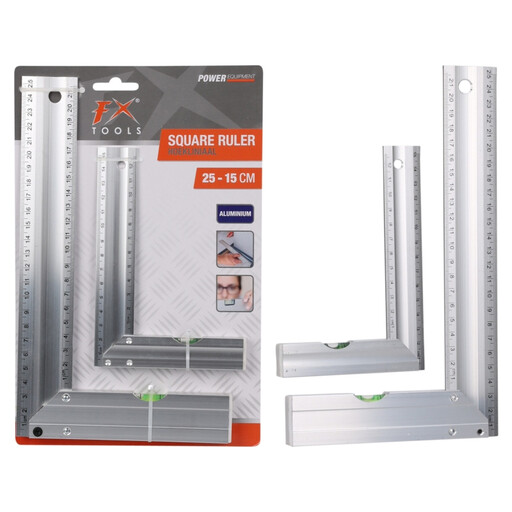
Why this product suits you: The two sizes cover smaller workpieces and slightly longer edges. The built-in spirit levels are useful for basic checks during renovation and DIY projects.
With two lengths in the set, you’re not limited to a single size, reducing the risk of ending up with a measuring range that’s too small.
Aluminium construction, two sizes (15 and 25 cm) and built-in spirit levels.
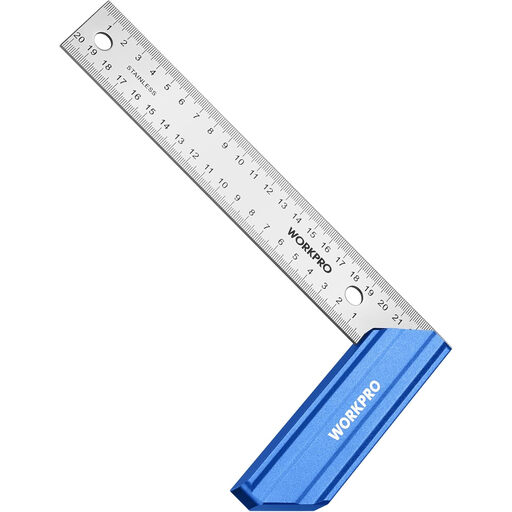
Why this product suits you: This 200 mm try square combines a 2 mm-thick stainless steel blade with an aluminium handle. It’s designed for marking right angles in wood and metal.
The blade and handle are secured at three points to help prevent the alignment from shifting. The blade edges are passivated.
Laser-engraved metric and imperial scales on both sides, a 200 mm blade, and a stainless steel and aluminium construction.
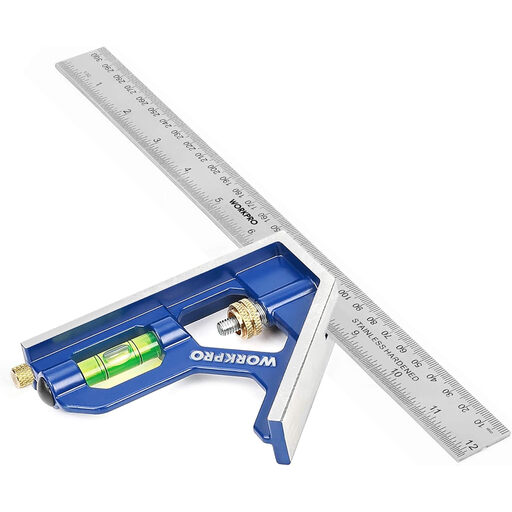
Why this product suits you: This 300 mm combination square is designed for longer workpieces and a range of measuring tasks. The spirit level, scriber and sliding stock add to its versatility.
The longer measuring range means you won’t have to reposition a short square several times to mark out a long edge.
300 mm stainless steel rule, zinc alloy square head, 90- and 45-degree functions, and built-in spirit level.
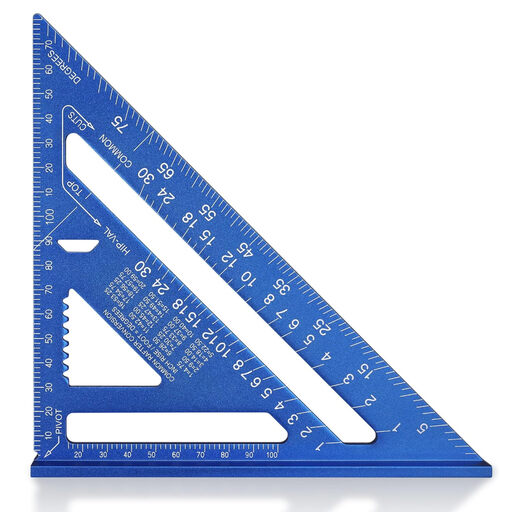
Why this product suits you: Its compact 180 mm design is easy to carry on site and use in tight spaces. It combines an angle finder, ruler and saw guide.
The clearly marked 0–90-degree range and visible metric and imperial scales make its functions easy to understand.
Aluminium alloy construction, 180 mm length, angle measurement up to 90 degrees, and use as a saw guide.
We’ve put together a complete, regularly updated list of products that meet these strict selection criteria and the safety regulations in force in the EU.
A few simple steps can help your carpenter’s square stay accurate for as long as possible:
It’s used to check and mark right angles, mark cut lines and, depending on the design, measure lengths, depths or 45-degree angles. A model with a 300 mm measuring range is a good choice for longer workpieces.
A try square usually has a fixed stock and is mainly used to check 90-degree angles. A combination square typically has a sliding rule and extra features such as a spirit level, marking pin and 45-degree measurement.
Store it somewhere dry and protected from knocks, don’t use it as a lever, and check the stock edge regularly. If you use it frequently, a simple check is to turn the square over against a straight edge and compare the lines.