
Lieferung heute & morgen

Qualitätsgarantie

Willkommens-Angebote freischalten: KOSTENLOSE Lieferung | Bis zu 80 % RABATT | Kostenlose 30-Tage-JoyPlus-Testphase
App herunterladen
A carpet cleaner wet vacuum sprays water or cleaning solution onto a textile surface and then vacuums up the dirty liquid. This can be useful for carpets, sofas, stairs, mattress covers or car seats. However, models vary considerably in suction power, tank capacity, reach and maintenance requirements.
For households, families with children and pet owners, three common purchasing and marketing traps are particularly relevant.
Motor power in watts initially describes electricity consumption or rated power. On its own, it says little about how much suction is generated at the nozzle. A wet vacuum cleaner with a high wattage can still be impractical to use if the nozzle is poorly designed or the filter is blocked.
The manufacturer’s stated suction power, nozzle design, spray-water flow and suitability for specific textiles are more informative. Figures such as 12 kPa, 15 kPa or 17 kPa should therefore be considered alongside tank capacity and accessories.
A compact spot cleaner is easy to store, but needs to be refilled and emptied more often. A small tank is often sufficient for individual stains. However, if you want to clean a large sofa, several steps or a vehicle interior, you should check the capacity of both tanks.
A two-tank system separates clean water from dirty water. This makes the cleaning process easier, but does not eliminate the maintenance required after use.
Water residue, cleaning products and pet hair can build up in the hose, nozzle and dirty-water tank. If these components are not rinsed and dried, unpleasant odours may develop or the airflow may decrease. A carpet cleaner with spray-and-suction function should therefore have easily removable tanks, accessible filters and, ideally, a hose-cleaning function.
Suction power is often stated in kPa. Higher figures can help remove dirty water, but they are not the only indicator of quality. What matters is whether the nozzle sits evenly on the surface and whether the manufacturer approves the appliance for carpets, upholstery or car seats.
The spray function should be adjustable. Using too much liquid can increase drying times. For delicate fabrics, testing the appliance on an inconspicuous area is recommended. A steam cleaner for carpets is not automatically an alternative: steam appliances operate at high temperatures and are not suitable for every fibre, upholstery filling or adhesive joint.
For occasional spot cleaning, a portable appliance with small tanks is sufficient. For larger areas, models with around 1 litre or more of clean water capacity, or with a larger dirty-water tank, are more practical. Large wet and dry vacuum cleaners often offer greater capacity, but are heavier and require more storage space.
You should also consider:
A corded carpet and upholstery cleaner operates independently of battery life. A cordless carpet cleaner, on the other hand, is more manoeuvrable when cleaning car seats or stairs. The stated runtime depends on the operating mode, battery condition and cleaning method. You should therefore check whether the reach is sufficient for the area you plan to clean and how long recharging takes.
The following selection groups specific models according to their intended use. The technical specifications are taken from the relevant product information.
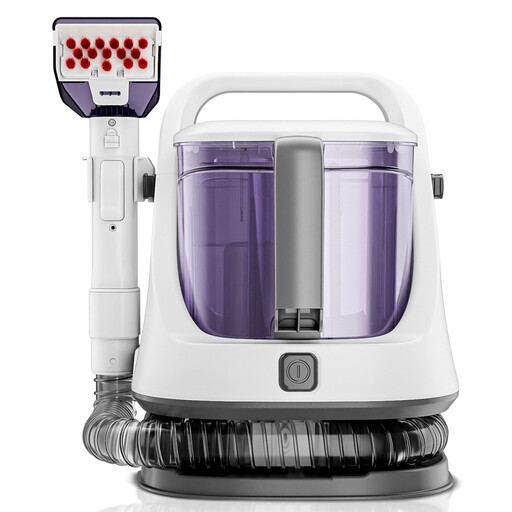
Why this product suits this profile: This compact appliance is designed for individual stains, sofas, stairs and car seats. With 650 W, 12 kPa suction power and separate tanks holding 1,400 ml of clean water and 1,200 ml of dirty water, it offers a clearly defined specification for occasional use.
The tank capacities and 1.1 m hose make it easier to assess the appliance’s actual operating range than wattage alone.
Separate water tanks, a 3 m power cable and stated suitability for upholstery, carpets, stairs and car seats.
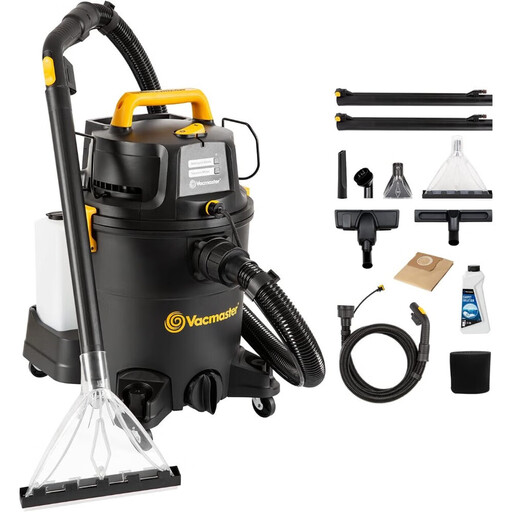
Why this product suits this profile: The 3-in-1 design is intended for wet, dry and carpet cleaning. With 1,300 W, a 23-litre capacity, a HEPA exhaust filter and a stated noise level of 72 dB, this model is aimed at households with larger areas to clean.
The clearly stated filter, mode and container specifications help distinguish the features from vague performance claims.
Wet, dry and carpet modes, a HEPA exhaust filter and a large total capacity of 23 litres.

Why this product suits this profile: Cordless operation makes it easier to clean stairs, upholstery and vehicle interiors. The manufacturer states a runtime of up to 55 minutes, 15 kPa suction power, a 1.6-litre clean-water tank and a 0.8-litre dirty-water tank.
The stated battery runtime and both tank capacities clearly indicate the intended cleaning time and area size.
24 V lithium battery, flexible cordless use and self-cleaning hose tool.
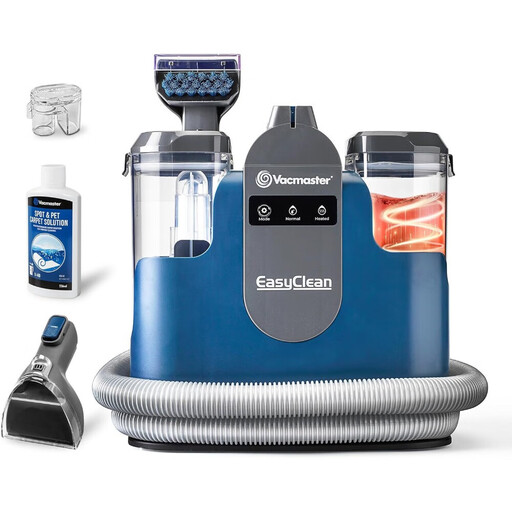
Why this product suits this profile: This model is designed for carpets, sofas, stairs and car seats. According to the product description, it offers 1.6 litres of clean water, 0.95 litres of dirty water and a selectable heating function.
The two cleaning modes are clearly stated. Nevertheless, before use, you should check whether the particular upholstery fabric is suitable for heat and moisture.
500 W motor, heating function, separate tanks and a 180 cm hose with cleaning attachment.
Before washing, the carpet should first be vacuumed dry. This removes loose crumbs, dust and hair. When removing pet hair and stains, it is sensible to pick up the hair mechanically first or use a suitable upholstery nozzle, rather than working it into the fibres with a large amount of water.
Also bear the following in mind:
A wet vacuum cleaner is not a substitute for professional treatment of delicate natural fibres or non-water-resistant upholstery. Flammable liquids, sharp objects and hazardous substances must not be vacuumed up. Disconnect the appliance from the mains before carrying out maintenance; for battery-powered models, follow the manufacturer’s instructions for the charger and battery.
We have put together a complete, regularly updated list of products that fully meet these strict selection criteria and the safety regulations applicable in the EU.
This depends on the material, amount of water used, room temperature and air circulation. Using a modest spray setting and vacuuming slowly reduces residual moisture. Air the room and do not walk on the surface again until it is completely dry.
Many compact appliances are intended for upholstery and sofas according to the product information. However, the sofa must be water-resistant. Check the care label and test the cleaning product on an inconspicuous area. Delicate covers can be damaged by moisture, heat or friction.
In addition to electricity consumption, there are costs for cleaning solution, filters and, where applicable, replacement nozzles or batteries. An appliance with reusable, easy-to-rinse components may require less maintenance in everyday use. For a realistic assessment, tank capacity, cleaning frequency and the products recommended by the manufacturer should be considered together.