
Lieferung heute & morgen

Qualitätsgarantie

Willkommens-Angebote freischalten: KOSTENLOSE Lieferung | Bis zu 80 % RABATT | Kostenlose 30-Tage-JoyPlus-Testphase
App herunterladen
A carpet cleaner wet vacuum combines three cleaning steps: spraying on cleaning solution, loosening dirt with a brush and vacuuming the liquid back up. This is particularly practical for households with children, pets or frequently used sofas and car seats. However, models vary considerably in terms of tank configuration, reach, maintenance requirements and intended use.
Figures such as 12 kPa, 15 kPa or 18 kPa describe the stated vacuum pressure, but on their own they say little about the cleaning results. Airflow, the nozzle, the system’s seal and the way dirty water is collected are also crucial. Suction figures from different manufacturers are therefore not always directly comparable.
A compact spot cleaner is easy to store, but larger areas may require several refills and emptying cycles. It is important for the clean-water and dirty-water tanks to be separate. A combined or difficult-to-access tank can make cleaning and maintenance more complicated.
Always check the care label and the material before use. Delicate natural fibres, non-colourfast textiles, leather and coated surfaces are not automatically suitable for a wet vacuum. A steam cleaner for upholstery also operates at a high temperature and is therefore not suitable for every type of upholstery. Test the appliance on an inconspicuous area first.
A wet vacuum for carpets and upholstery should apply the cleaning solution in a controlled manner and then recover as much moisture as possible. A wide nozzle is suitable for carpets and seating areas, while a narrow brush is easier to guide on stairs, in gaps or on car seats.
Pay attention to the capacity of both tanks and to whether components can be removed. After use, empty the dirty water immediately, then rinse the tank, hose, brush head and filter and allow them to dry completely. This helps to reduce build-up and unpleasant odours. Only use cleaning products that are suitable for the appliance and the fabric in question.
For sofas, stairs and cars, hose and cable length are important practical specifications. Mains-powered appliances provide continuous power, while cordless vacuums offer greater freedom of movement but have a limited run time. A portable carpet cleaner should stand securely, be easy to handle and be transportable without excessive effort.
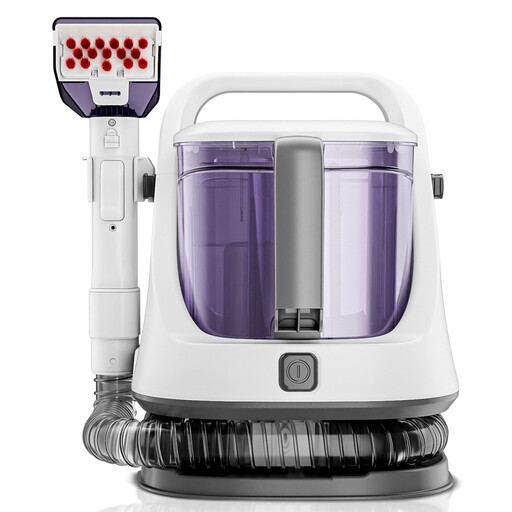
Why this product suits this profile: This mains-powered appliance is designed for occasional stains on sofas, carpets, stairs and car seats, with no need to plan around battery charging.
Separate tanks holding 1,400 ml of clean water and 1,200 ml of dirty water make water management straightforward. The hose and cable are specified as 1.1 m and 3 m respectively.
650 W motor power, a stated vacuum pressure of 12 kPa and removable tanks for cleaning and emptying.

Why this product suits this profile: This model is aimed at users who value noise levels, tank specifications and a compact design.
The product specifications state a maximum noise level of 69 dB, a 1,200 ml clean-water tank, a 1,300 ml dirty-water tank and a 4.5 m cable.
Stated suction power of 12,000 Pa, a weight of 3.5 kg and a 14 cm-wide brush for textile surfaces.
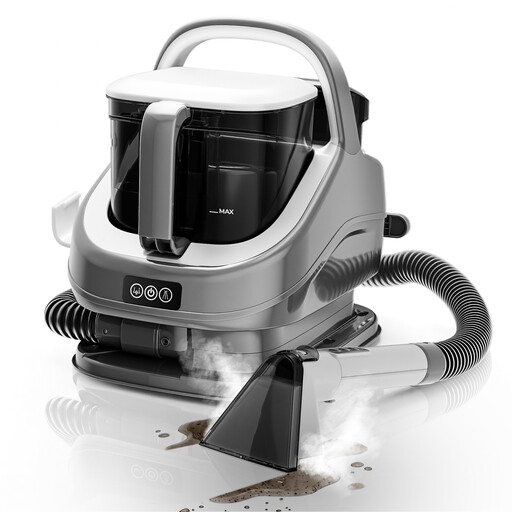
Why this product suits this profile: If you regularly clean a range of textile surfaces, you can choose between cold-water, hot-water and steam modes.
The three cleaning modes make it easier to tailor use to the material. However, you must still check the fabric’s water resistance and approved temperature range beforehand.
1,300 W power consumption, a stated vacuum pressure of 13 kPa, separate tanks and a 3 m power cable.

Why this product suits this profile: This handheld appliance is designed for targeted wet cleaning of carpets, sofas, car seats and pet areas.
The spray, brush and suction functions are designed for dealing with individual stains. Before using it over a larger area, test a small section for colourfastness.
600 W motor power, stated suction power of 17 kPa and a dual-tank system for clean and dirty water.
We have put together a complete, regularly updated list of products that fully meet these strict selection criteria and the safety regulations applicable in the EU.
A wet vacuum is not automatically suitable for dry building rubble, liquids containing chemicals or flammable substances. Follow the operating instructions, use a socket with a suitable power supply and keep children away while the appliance is in operation.
Drying time depends on the material, amount of liquid, room temperature and air circulation. Using only a small amount of spray and vacuuming thoroughly can shorten it. Carpets and upholstery should not be used again until they are completely dry.
A wet vacuum can remove liquid and visible dirt from water-safe textiles. For odours or deeply embedded residue, it is important to choose a suitable, low-foaming cleaning product. Complete removal cannot be guaranteed for every material and every type of soiling.
Electricity costs depend on the power consumption and the actual operating time. A 600 W appliance uses 0.6 kWh when operated for one hour; water and, where applicable, cleaning solution are additional costs. Cleaning and replacing filters or wear parts also affect the ongoing running costs.