
Lieferung heute & morgen

Qualitätsgarantie

Willkommens-Angebote freischalten: KOSTENLOSE Lieferung | Bis zu 80 % RABATT | Kostenlose 30-Tage-JoyPlus-Testphase
App herunterladen
Spilled drinks on the carpet, paw prints on the sofa or dirty car seats can be tackled effectively with a suitable carpet and upholstery cleaner. Unlike a conventional vacuum cleaner, a carpet cleaner sprays water or cleaning solution onto the textile surface and then vacuums up the loosened dirt.
The choice may seem straightforward at first glance. In practice, however, some common marketing claims can lead to the wrong purchase. What matters is not just the wattage or amount of included accessories, but how the tank layout, suction power, hose length, cleaning width and maintenance requirements work together.
Motor power in watts initially indicates electricity consumption or rated power. On its own, it says little about how effectively a machine removes dirty water from a carpet or car upholstery. In practice, a wet vacuum cleaner with well-directed airflow, a suitable nozzle and sufficient suction power may be more useful than a model with a higher wattage.
Steam can loosen dirt, but it does not automatically remove the loosened water. A carpet cleaner, on the other hand, sprays and extracts. If you want to clean a sofa or remove carpet stains, check that the machine actually provides spray extraction. For delicate fabrics, always follow the manufacturer’s care instructions.
A portable carpet cleaner is well suited to individual stains, stairs or car seats. Smaller tanks reduce weight and storage space, but need to be emptied and refilled more often when cleaning larger areas. For an entire suite or several carpets, a model with a larger tank may be more practical.
A dual-tank system keeps clean water separate from the extracted liquid. Pay attention to the capacity of each tank and check whether both containers can be removed. This makes filling, emptying and rinsing easier. A larger clean-water tank is useful for bigger areas, while an easily accessible dirty-water tank reduces the effort required to clean the machine after use.
Manufacturers sometimes state suction power in kPa, while others only list the motor power. Figures above 15 kPa can provide a useful point of comparison, but they are not the only deciding factor. It is also important to consider the width of the cleaning nozzle and whether it is suitable for narrow spaces.
A smaller upholstery nozzle is easier to handle on sofas, mattresses and car seats. A wider nozzle can save time on carpets. For treating stains, the machine should allow the three steps of spraying, brushing and extracting to be carried out as precisely as possible.
A long hose and a sufficiently long power cable are useful for stairs and car interiors. Also check the weight, dimensions and storage options. An integrated or included hose-cleaning tool can make maintenance easier.
After every use, rinse the dirty-water tank, nozzle, hose and filter according to the instructions, then allow them to dry completely. This helps prevent residual moisture from remaining inside the machine. Only use approved cleaning products, and always test textile surfaces first in an inconspicuous area.
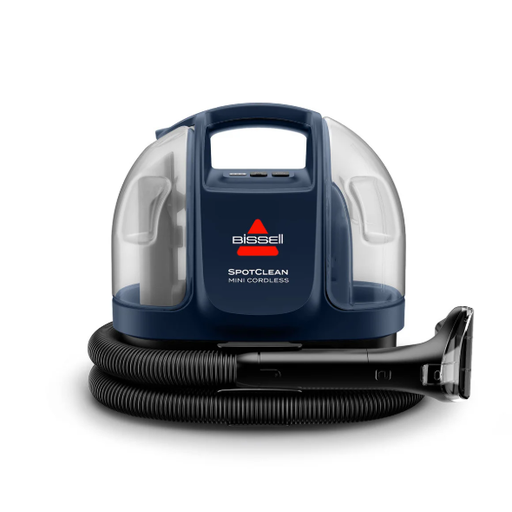
Why this product suits this profile: Its compact design and weight of 4,077 kg make it suitable for individual stains, stairs, upholstery and car interiors.
The product description clearly highlights portable use and its spray, scrub and extraction functions, rather than promising to clean large areas.
Compact dimensions of 332 × 329 × 221 mm; suitable for upholstery, stairs and vehicle interiors.
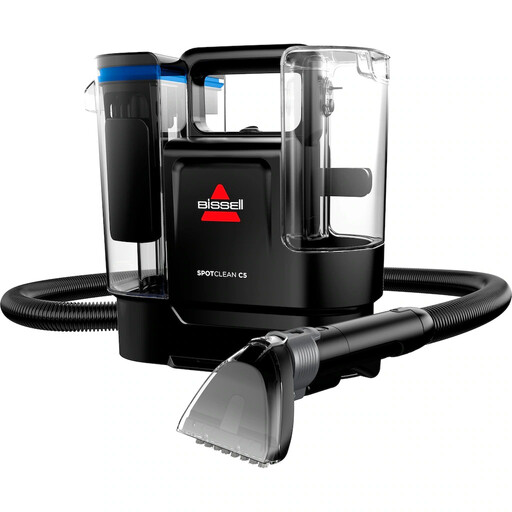
Why this product suits this profile: This model combines 15 kPa suction power, a dual tank, a 1.7 m hose and a HydroRinse function for cleaning the machine.
The technical specifications state the suction power, tank capacities and hose length clearly. This makes it easier to compare the machine objectively with other spot cleaners.
400 W, over 15 kPa, 0.9 l clean-water tank and 0.8 l dirty-water tank; 4.3 m power cable.
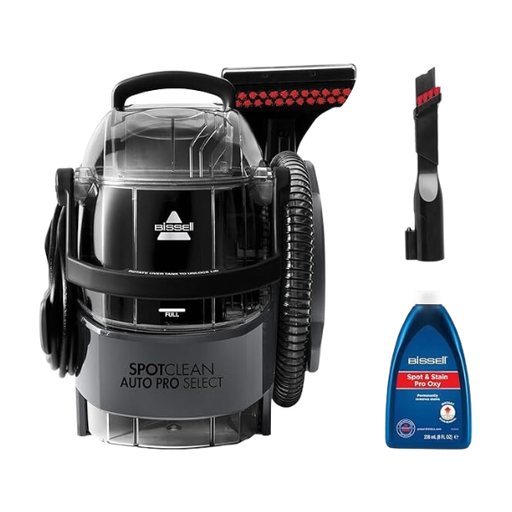
Why this product suits this profile: For a carpet cleaner for cars used regularly, 750 W, a 6.7 m cable and a 15 cm cleaning nozzle are important features.
The XL sliding brush and stated hose length are designed for hard-to-reach areas inside the vehicle.
2.8 l total dual-tank capacity; 1.5 m hose and 15 cm cleaning head.
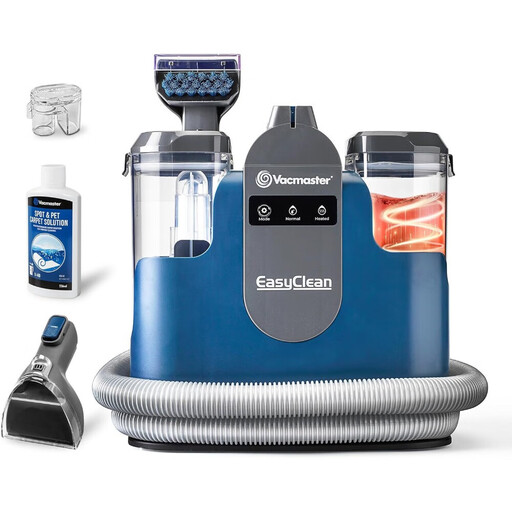
Why this product suits this profile: Two cleaning modes and a 1.6 l clean-water tank provide flexibility for carpets, upholstery, stairs and car seats.
The heating function is specified as a switchable mode and does not replace checking material compatibility. This keeps use limited to suitable textiles.
500 W motor; 1.6 l clean-water tank and 0.95 l dirty-water tank; 180 cm cleaning hose.
We have put together a complete, regularly updated list of products that fully meet these strict selection criteria and the safety regulations applicable in the EU.
For leather surfaces, a conventional carpet cleaner is usually not the first choice. Use suitable care products instead and follow the instructions for the specific material. You can find more information about vehicle care in the linked category.
Drying time depends on the material, amount of water, room temperature and air circulation. Use as little liquid as possible, extract it slowly and ventilate the room. The carpet should not be returned to normal use until its surface is completely dry.
Yes, provided the manufacturer states that the upholstery is water-safe. A narrow spray attachment, longer hose and compact design make cleaning inside the vehicle easier. Electrical parts, switches and safety components must not be treated with water.
In addition to electricity consumption, there are costs for water, cleaning products and, where applicable, filters or replacement nozzles. A dual-tank system and reusable, washable components can make ongoing use easier. The key consideration is whether the machine suits the amount of cleaning you actually need to do: a compact model is often sufficient for occasional stains, while larger tanks can save time when cleaning multiple areas.