Who should take care when choosing?

Families with a busy morning schedule

If you need to make several portions before breakfast, quick preparation and the size of the feed chute and containers matter. ETM TESTMAGAZIN finds that centrifugal juicers tend to be faster when processing larger quantities of ingredients.

People who juice regularly and have little time for washing up

If you juice often, remember to factor in the time it takes to dismantle the juicer and clean the sieve. A dishwasher-safe claim applies only to the parts specified by the manufacturer; Severin, for example, lists certain individual parts of the ES3571 as dishwasher-safe.

Households that prefer quieter juicing

If you have more time to prepare your juice, you can give greater weight to noise, how well the juicer handles hard carrots and juice yield. ETM TESTMAGAZIN describes differences between the types of juicer; for carrots, the results of tests on the specific model also matter.

What to look for when buying

Centrifugal juicer

A good fit if: you need to make several portions as quickly as possible in the morning.

The trade-off: ETM TESTMAGAZIN says these juicers tend to be faster with larger quantities, but they can also be noisier.

Slow juicer

A good fit if: quieter operation matters more than the shortest preparation time.

The trade-off: Juicing tends to take longer. In a 2023 hands-on test, DAS HAUS reported that the Severin ES3571 struggled with hard ingredients.

What matters What to check when buying Who should prioritise this
Speed and preparation Compare the feed chute and guidance on the size of carrot pieces. Even with a wide chute, washing the carrots and using the pusher safely are important. If I’m short of time in the morning, I want to juice carrots for several glasses with as little preparation as possible. That’s why around 33% of consumers put speed and preparation first.
Cleaning Check which parts need cleaning, how easy the sieve is to access and whether the specific model is explicitly listed as dishwasher-safe. If I juice regularly, I want to be able to clean the sieve after breakfast without having to dismantle everything. That’s why around 27% of consumers prioritise ease of cleaning.
Yield and noise Where possible, look at hands-on tests using comparable ingredients. Don’t rely on the type of juicer or its wattage alone to predict the results. If I can allow more time for quieter operation or a suitable yield, I compare specific models. Around 20% of consumers say yield and quiet operation are their main concerns.
Several portions Compare the juice jug and pulp container separately. Container capacity doesn’t tell you how much juice a particular quantity of carrots will produce. If I’m juicing for several people, I want to avoid having to pour out the juice or empty the pulp container too often. Around 20% of consumers put portion size first.

Common buying and usage mistakes

  • Choosing based only on wattage or the promise of a “slow juicer”

    Speed, noise, yield and cleaning requirements vary from model to model. The type of juicer alone doesn’t tell you how well a particular machine will handle hard carrots.

    Decide what matters most at family breakfast, then check the model specifications and relevant hands-on tests.

  • Confusing the ingredient hopper with the amount of juice produced

    A large ingredient hopper doesn’t tell you how much finished juice the machine will collect. For example, Kuvings lists a 3-litre ingredient hopper for the AUTO10S.

    Compare the feed chute, juice jug and pulp container as separate specifications.

  • Leaving cleaning and safe use until after you’ve bought it

    Regular juicing also involves cleaning the sieve and the parts you use. When processing hard ingredients, it’s important to follow the instructions for your specific model.

    Check which parts can be dismantled and are dishwasher-safe. Wash your vegetables and use only the pusher to feed them into the machine, as described in the instruction manual.

Brands to consider

WMF

The Kult X is a centrifugal option whose container sizes may suit households making several portions for breakfast.

  • WMF lists a 74 mm feed chute, a 1.2-litre juice jug and a 1.8-litre pulp container.
  • These manufacturer specifications don’t guarantee a particular carrot juice yield. Check the cleaning requirements and noise levels of the specific model.

Kenwood

The JE850 is a centrifugal juicer with two speed settings.

  • Kenwood lists 1,000 W, two speeds and a drip-stop feature.
  • An older review by DAS HAUS describes the juicer as cumbersome; this doesn’t indicate whether it’s currently available.

Severin

The ES3571 is a slow juicer for which the sieves and cleaning requirements are important factors to consider.

  • Severin lists two sieves and individual parts that are dishwasher-safe.
  • A 2023 hands-on test by DAS HAUS reports that the ES3571 struggled with hard foods. This limitation applies to this model.

Panasonic

The MJ-L700 is a slow juicer alternative with a specified 75 mm feed chute.

  • Panasonic lists a safety feature for the MJ-L700KXE variant.
  • When comparing models, check the exact variant and its specific product specifications.

Kuvings

The AUTO10S is a slow juicer with a large ingredient hopper, which may be useful when preparing larger quantities.

  • Kuvings lists a 3-litre ingredient hopper and automatic chopping.
  • The 3 litres refers to the ingredient hopper, not the volume of finished juice. Claims about maximum yield or nutrients are not independently verified comparisons for carrots.

Juicers at Joybuy

This selection includes centrifugal and slow juicers for making carrot juice for family breakfast.
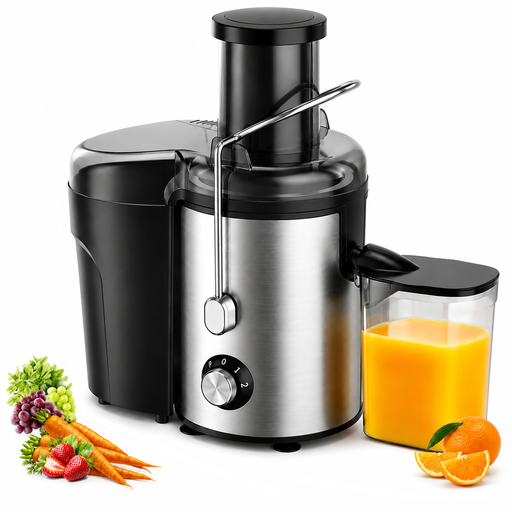
Centrifugal juicer with 75 mm feed chute

Centrifugal juicer with 75 mm feed chute

An option to consider if you’re comparing centrifugal juicers for carrots with two speed settings.

75 mm feed chute; two speed settings. The product description recommends the higher setting for carrots.

View at Joybuy
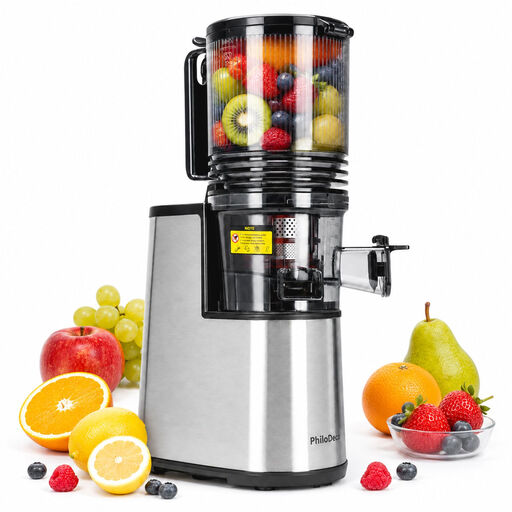
PhiloDeco JE-06 Cold Press Slow Juicer

PhiloDeco JE-06 Cold Press Slow Juicer

A slow juicer option to consider if you want a wide feed chute and separate containers for juice and pulp.

250 W; 145 mm feed tube; REV function; 1,000 ml juice container and 1,000 ml pulp container. The description says the REV function can help clear blockages caused by carrots.

View at Joybuy
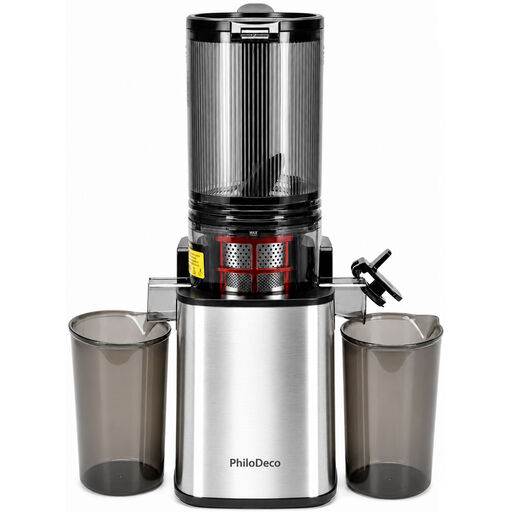
Cold Press Slow Juicer with 110 mm feed chute

Cold Press Slow Juicer with 110 mm feed chute

A slow juicer option to consider if a large feed chute and reverse function to clear potential blockages matter to you.

110 mm feed chute; dual filter; reverse function; 40 Nm according to the product name. The description says the reverse function can clear blockages without dismantling the machine.

View at Joybuy
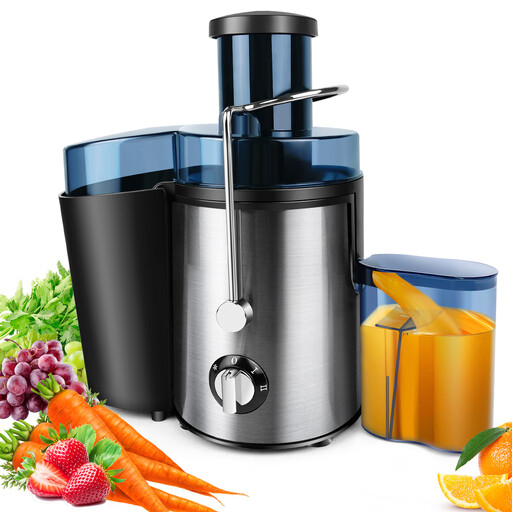
DayPlus centrifugal juicer with 65 mm feed chute

DayPlus centrifugal juicer with 65 mm feed chute

A centrifugal option to consider if you want to compare two speed settings for ingredients of different levels of hardness.

1,000 W; 65 mm feed chute; two speed settings. The description lists one setting for harder ingredients, as well as removable parts and a cleaning brush.

View at Joybuy
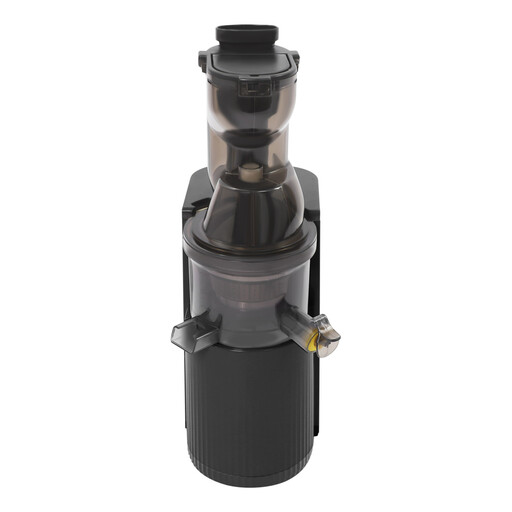
Slow cold-press juicer with 8 cm feed chute

Slow cold-press juicer with 8 cm feed chute

A slow juicer option to consider if you want to compare a wide feed chute and removable parts for cleaning.

800 W; 48 rpm; 8 cm feed chute; reverse function. The description lists removable parts and says the juicer can process hard vegetables such as ginger and celery.

View at Joybuy

Frequently asked questions

Do I need to cut carrots before putting them in a juicer?

It depends on the feed chute and the instructions for your model. For the Severin ES3571, the manufacturer recommends washing the vegetables and cutting them to fit the chute. Use only the pusher to feed them into the machine.

How can I make juice hygienically for the family?

Wash the ingredients, your hands and the kitchen utensils you use. The consumer advice centre recommends cleaning kitchen utensils and washing your hands before and between each stage of preparation. The German Federal Institute for Risk Assessment recommends that people in at-risk groups prepare freshly cut raw fruit and vegetables from fresh, thoroughly washed ingredients shortly before eating.

Is a long motor warranty the same as your statutory rights?

No. A manufacturer’s warranty is voluntary and subject to its terms and conditions; your statutory rights are with the retailer. The consumer advice centre explains that, in general, retailers are liable for two years for goods that were faulty when supplied. For sales contracts from 31 July 2026, it also describes a one-off 12-month extension if you choose a repair when a fault arises.

What should I look for on the labelling of an electric juicer in Germany?

When carrying out market surveillance of electrical household products, the German Federal Network Agency checks criteria including correct CE marking, an identifiable product and manufacturer, and German-language instructions with the required warnings. According to the European Union, CE marking is a declaration for which the manufacturer is responsible; it is not a blanket approval from a central EU certification body.