If you regularly want to bake several trays of muffins for lunchboxes and have a suitable built-in space, a built-in oven that specifically states it can bake on multiple levels may be a good option. For smaller batches and kitchens without room for a built-in appliance, a fan-assisted mini oven may be enough, provided your tins fit and the heating function suits the recipe. Fan assistance alone doesn’t guarantee that several trays will fit at once or that every recipe will work unchanged.
Which type of oven suits you?
Batch bakers
If you prepare muffins for several lunchboxes, check your tin size and usable shelf space against the oven’s stated multi-level baking capability. Bosch lists this feature for the HBA514BS3, but you’ll still need to check whether your own trays fit.
Bakers with a small kitchen
With a freestanding oven, you’ll need to allow for the required clearances as well as the appliance itself. For the TO 2068, Severin specifies 12 cm of clearance at the sides and rear, and 30 cm above.
Occasional bakers who follow recipes closely
If you want to use the heating function specified in a recipe, check the settings on the particular oven. Familienkost specifies 180 °C using top and bottom heat for carrots in the batter; the Dr. Oetker recipe uses 160 °C fan heat and marzipan carrots as decoration.
What to look for when buying
For carrot muffins to take with you, the main things to consider are how many you want to bake, the space available, the heating function required by the recipe, and the effort involved in using and cleaning the oven.
| Priority |
What to check when buying |
Who it matters most to |
| Batch size and tin fit |
Measure your muffin tin, including its rim, and compare it with the usable shelf space and what’s included. Having several shelf positions doesn’t automatically mean you can bake on several trays at once. |
If I’m preparing muffins for several lunchboxes, I want to know whether my tin will fit and how many batches I’ll need to bake. Around 33% of consumers prioritise batch size and tin fit. |
| Space |
For mini ovens, check the external dimensions and model-specific clearances; for built-in appliances, check the housing space. |
If my kitchen has little spare worktop space, the oven needs to fit safely with the required operating clearances. Around 25% of consumers prioritise finding a suitable place for their oven. |
| Heating function and recipe |
Check whether the oven offers the heating function specified in the recipe; set the temperature and time according to the recipe and appliance instructions. |
If I want to follow a particular carrot muffin recipe, I need settings that suit its ingredients and heating function. Around 25% of consumers prioritise finding an oven that suits their recipes. |
| Energy use and cleaning |
Compare energy figures only when they’re based on the same test method; check how easy the oven is to clean and whether parts can be removed. |
If I use the oven regularly, I want to keep an eye on running costs and cleaning. Around 17% of consumers prioritise these aspects over batch size, space and recipe flexibility. |
Avoid common buying mistakes
-
Assuming the litre capacity or number of shelf positions tells you how many trays will fit
The oven’s internal capacity doesn’t tell you whether your muffin tin will fit or whether you can use several trays at once. An included baking tray also doesn’t guarantee that other trays will fit.
Measure your tin, its rim and the clearance it needs, then compare these with the usable shelf space. Check which trays are included with the specific model and whether it’s designed for baking on several levels at once.
-
Allowing for the appliance dimensions alone when choosing where to put it
Freestanding ovens may need extra clearance. For the TO 2068, Severin specifies 12 cm at the sides and rear, and 30 cm above; these requirements don’t automatically apply to other models.
Check the planned location against the instructions for the specific appliance. Don’t assume the clearances for another model will apply.
-
Applying settings from one carrot muffin recipe to another
The Familienkost recipe specifies 180 °C using top and bottom heat, and around 25 minutes, for grated carrots in the batter. The Dr. Oetker recipe uses around 160 °C fan heat and marzipan carrots as decoration; the settings are for different recipes.
Check the ingredients and heating function in the recipe you want to use. Set the temperature and baking time accordingly, and follow the appliance instructions.
-
Assuming an energy rating or wattage tells you the cost of baking a batch of muffins
The EU energy label is based on standardised baking cycles, so it doesn’t directly show how much energy your own recipe will use. The European Commission excludes small and portable ovens from the scope of its oven energy labelling rules.
Compare figures only when they’re based on the same test method. To work out the cost of baking your own batch, you’ll need a measured energy use in kWh and your electricity tariff.
Brands and suitable oven ranges
Bosch
Built-in appliances for kitchens with a suitable housing space and a regular need to bake larger batches or use several trays.
- Bosch Home Appliances Germany lists 3D Hotair baking on up to three levels for the HBA514BS3.
- This is the manufacturer’s claim for this model, not an independent muffin test; check the housing space and whether your trays fit.
Rommelsbacher
Freestanding ovens with a range of internal capacities, for smaller or larger batches when a built-in appliance isn’t an option.
- Rommelsbacher lists fan assistance for the BGE 1580/E and BG 1805/E; the models have internal capacities of 30 and 42 litres respectively.
- The larger appliance needs more space. Its internal capacity and shelf positions don’t tell you whether several muffin trays will fit at once.
Severin
Freestanding mini ovens for smaller batches and kitchens where a built-in appliance isn’t an option.
- Severin lists an internal capacity of 20 litres and four shelf positions for the TO 2068.
- Four shelf positions don’t mean you can bake on four trays at once. This model also has specific clearance requirements.
Steba
Compact freestanding ovens for smaller quantities, where the actual internal dimensions are key.
- Steba lists a 19-litre internal capacity, switchable fan assistance and internal dimensions of 23.5 × 31 × 25.5 cm (H × W × D) for the KB M19.
- Whether a muffin tin will fit depends on its actual dimensions, so check before you buy.
Suitable ovens at Joybuy
This selection includes built-in and freestanding ovens for larger and smaller batches of carrot muffins. The key things to check are whether your tin fits and whether you have enough space for a built-in appliance or a freestanding oven.
 No image available
Comfee built-in oven, 60 cm, 70 L, 3 kW
For larger batches in a suitably fitted kitchen; check that your muffin tin and trays are suitable for the planned multi-level baking.
Features listed in the product name: 70 L, 3 kW, grill and pizza functions, AquaClean steam cleaning, LED display with timer, ECO mode and energy class A.
View at Joybuy
 No image available
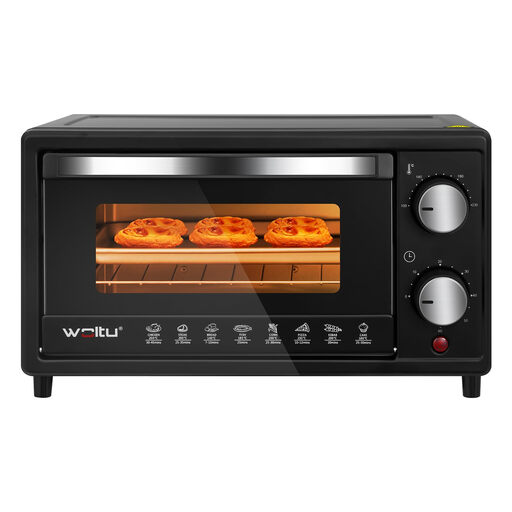
Woltu mini oven, 10 L
For smaller batches and limited space; check that your muffin tin and the clearance it needs will fit inside.
Features listed in the product name: 10 L, adjustable temperature from 100 to 230 °C and a pizza function.
View at Joybuy
 No image available
Woltu mini fan oven, 28 L
For a larger batch than the 10-litre model, provided your muffin tin fits and you have enough space; several shelf positions don’t automatically mean you can bake on several trays at once.
Features listed in the product name: 28 L, temperature control and timer.
View at Joybuy
 No image available
Haier H6 ID23T3HTB built-in oven, 78 L
For larger batches if you have a suitable built-in space; the oven’s capacity alone doesn’t tell you whether you can use several muffin trays at once.
Features listed in the product name: 78 L, nine cooking functions and energy class A+.
View at Joybuy
Frequently asked questions
Can I simply switch from top and bottom heat to fan heat when baking carrot muffins?
Don’t automatically use the temperature from another recipe. Familienkost specifies 180 °C using top and bottom heat, and around 25 minutes, for carrots in the batter; the Dr. Oetker recipe uses 160 °C fan heat and marzipan carrots as decoration. Follow your chosen recipe and the appliance instructions, and check whether the muffins are baked through.
How do I set up a mini oven safely?
Check the instructions for your particular model to find out how much clearance it needs. For the Severin TO 2068, the manufacturer specifies 12 cm at the sides and rear, and 30 cm above; these figures don’t automatically apply to other appliances.
How can I assess energy use and a fault?
For ovens that require an energy label, the EU label shows energy use per standardised baking cycle, not the energy used for your own batch of muffins. The Verbraucherzentrale distinguishes between the statutory guarantee and a voluntary warranty, and says that when there’s a fault, repair or replacement should initially be offered as a remedy.
Does a small mini oven in Germany need an EU oven energy label?
Not every small or portable oven is covered by this energy labelling scheme: the European Commission lists these ovens as outside its scope. Check the information for the specific appliance rather than assuming that the absence of an energy rating means it’s faulty.
How should I store carrot muffins for lunchboxes later on?
Leave the muffins to cool as directed in the recipe, then choose a storage method that suits the ingredients and topping. The Bundeszentrum für Ernährung points out that unsuitable storage can encourage food to spoil; without knowing what the toppings are, it’s not possible to give a general shelf life for storing the muffins unrefrigerated.


