Bakers with a muffin tin already to hand
You want to use a particular muffin tin in your holiday cottage. So you’ll need to compare its external dimensions with the oven’s internal dimensions and usable shelf height.


Choose an oven first by checking whether your muffin tin fits inside and whether you can safely place the appliance in the space available. A fan setting is versatile for cooking other dishes, but it isn’t essential for carrot muffins: Dr. Oetker recommends conventional top and bottom heat for evenly risen muffins, while its carrot muffin recipe also gives a fan-oven setting. A model with both heating functions gives you a choice, provided your tin and the space for the oven are suitable.
You want to use a particular muffin tin in your holiday cottage. So you’ll need to compare its external dimensions with the oven’s internal dimensions and usable shelf height.
You’re looking for a freestanding appliance, but space is limited. As well as the appliance’s dimensions, it’s important to check the placement instructions for the specific oven.
You want to make carrot muffins as well as other dishes. Being able to choose between a fan setting and conventional top and bottom heat may be important.
A good choice if: There’s already a working oven in the holiday cottage with enough room for your muffin tin.
Consider: Check the features and condition of the existing appliance. This alone doesn’t establish any energy or cost advantage over a countertop oven.
A good choice if: There’s no suitable oven and you’d like to cook other dishes as well as muffins.
Consider: The appliance takes up worktop space and needs the clearances specified in its instructions. Its stated capacity in litres alone doesn’t confirm that your tin will fit.
| Priority | What to check before buying | Who it matters to |
|---|---|---|
| Muffin tin and batch size | Compare the tin’s external dimensions with the oven’s internal dimensions or the tin sizes specifically approved for that model. | If I want to use my existing muffin tin, I need to know that it will fit inside the oven. For around 33% of consumers, fit is the top buying priority. |
| A safe place to put it | Measure the available floor space and height, and follow the placement and connection instructions in the manual. | If I have limited worktop space in my holiday cottage, I want to know in advance whether the appliance can be placed there safely. For around 27% of consumers, placement comes first. |
| Heating function and muffin results | Check whether conventional top and bottom heat and the fan setting can be selected separately on the specific model. Choose the setting to suit the recipe you’re using. | If I bake other dishes as well as muffins, I want to be able to choose the heating function to suit each recipe. For around 27% of consumers, the heating function is the top buying priority. |
| Cleaning and running costs | Check which trays and racks are included, as well as any removable parts for cleaning. Only compare energy consumption figures when they’re based on the same measurement method. | If easy cleaning and transparent running costs are particularly important to me, I want to assess the accessories and energy consumption figures separately. For around 13% of consumers, cleaning and running costs are the main priorities. |
The oven’s internal capacity alone won’t tell you whether a particular tin will fit on the rack or whether there’ll be enough room above it. Manufacturers specify different internal dimensions and size limits for each model.
Measure the outside of your tin and compare it with the internal dimensions and usable shelf height of the specific oven.
Dr. Oetker recommends conventional top and bottom heat for evenly risen muffins, although its carrot muffin recipe also gives a fan-oven setting.
If you want to use both methods, check whether the model you’re considering lets you select conventional top and bottom heat and the fan setting separately.
The external dimensions don’t show all the clearances required in the manual for safe placement. The instructions for the Severin TO 2068 also warn that accessible surfaces can get very hot.
Measure the intended space and check the placement and connection requirements in the manual for the exact model.
Steba states that the KB M19 has a rated power of 1,400 W; this doesn’t tell you how much energy it uses to bake a batch of muffins. The Verbraucherzentrale describes consumption figures per standard baking cycle and heating function.
Don’t work out running costs from the wattage alone. Only compare energy consumption figures when the measurement method and heating function are the same.
The BGE 1580/E is a freestanding oven with a 30 l capacity and several selectable heating functions.
According to Caso, the TO 26 SilverStyle has a 26 l capacity and published internal dimensions to help you check whether your tin will fit.
With a capacity of 19 l, the KB M19 is a more compact option for smaller tins and portions.
The TO 2068 is a 20-l baking and toasting oven with a fan function and conventional top and bottom heat that can be switched on separately or together.
This selection features freestanding mini fan ovens designed for use on a worktop. Before buying, check your muffin tin and the space available against the specifications for the specific model.
 No image available
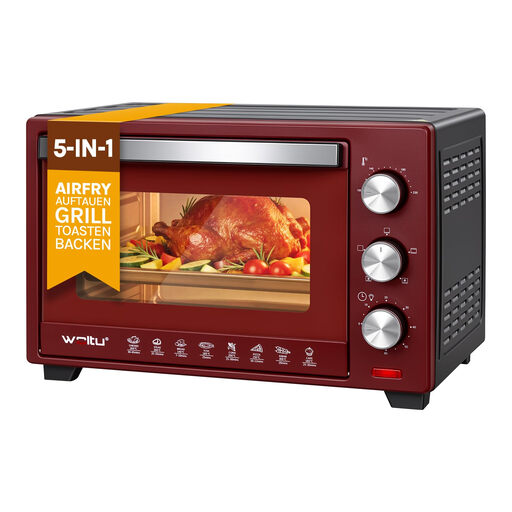
This freestanding countertop oven could be an option if you’re looking for a separate appliance for your holiday cottage. Check first that your muffin tin will fit inside.
The product name specifies a 28-litre capacity, a temperature control and a timer. Check the model specifications for the available heating functions and settings.
No, you don’t have to bake carrot muffins using the fan setting. Dr. Oetker’s carrot muffin recipe gives a temperature of about 180 °C for conventional top and bottom heat, or about 160 °C for a fan oven. Dr. Oetker recommends conventional top and bottom heat for evenly risen muffins. Follow the temperature and baking time in the recipe, adjusting for your appliance.
Compare the appliance’s dimensions and the placement requirements in its manual with the space you have in mind. For the TO 2068, Severin also requires a properly installed earthed socket and warns that surfaces can get very hot. Don’t assume these requirements apply to other appliances without checking their instructions.
For the TO 2068, Severin says to unplug the appliance and let it cool down before cleaning. It must not be immersed in liquid. For other models, follow the instructions for that specific appliance.