
Lieferung heute & morgen

Qualitätsgarantie

Willkommens-Angebote freischalten: KOSTENLOSE Lieferung | Bis zu 80 % RABATT | Kostenlose 30-Tage-JoyPlus-Testphase
App herunterladen
As a Joybuy Product Recommendation Officer, my goal is to provide you with clear, objective information. This guide is designed to help you find a travel stroller that is not only compact and lightweight but also meets the carry-on requirements for air travel.
Travelling with small children presents unique challenges for parents, especially when it comes to packing. A bulky stroller can quickly become a burden at the airport. A travel stroller that qualifies as carry-on luggage offers a practical solution. These models are specifically designed to simplify transport and give you maximum flexibility on your travels and in daily life.
Choosing the right model depends on several factors. To make an informed decision, you should consider the following criteria.
The most crucial feature of a carry-on stroller is its folded size. Most airlines follow the IATA recommendations for carry-on luggage, which are often around 55 x 40 x 20 cm. However, these dimensions can vary depending on the airline and fare.
Recommendation: Check your airline's current carry-on regulations before every flight. A stroller that folds down small not only fits in the plane's overhead compartment but also slides effortlessly into the boot of a small car or a train's luggage rack.
A lightweight stroller is invaluable when travelling. Models under 7 kg are easy to carry, even while holding your child. Look for a one-hand folding mechanism. This feature allows you to collapse the stroller with a single motion, making daily life and airport boarding significantly easier.
Even a compact stroller should offer sufficient comfort for your child. An adjustable backrest, ideally with a flat recline position, allows for naps on the go. An extendable sun canopy with UV protection is essential for a holiday stroller.
Some models can also be converted into a travel system. Compatibility with an infant car seat allows the stroller to be used from birth, which can make a separate pram for the early months redundant.
Based on the criteria mentioned, we have compiled a selection of models that are well-suited for air travel due to their specific features.
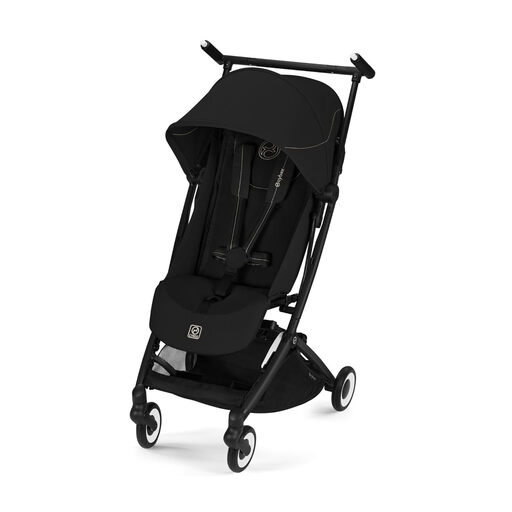
Why it stands out: The Cybex LIBELLE is designed for maximum compactness. Its folded dimensions are among the smallest on the market, making it ideal for parents who travel frequently by plane and need a space-saving solution.
Pros:
Who is it for? For parents who fly regularly and are looking for an extremely compact, lightweight stroller for air travel that can be stowed away in seconds.

Why it stands out: The Chicco WE stands out for its exceptionally low weight of just 5.5 kg. It offers a fully flat recline, making it suitable from birth (when combined with a compatible infant car seat). The included travel bag further enhances portability.
Pros:
Who is it for? For parents seeking maximum lightness and flexibility, who want to use the stroller from birth (as a travel system) up to the toddler years.
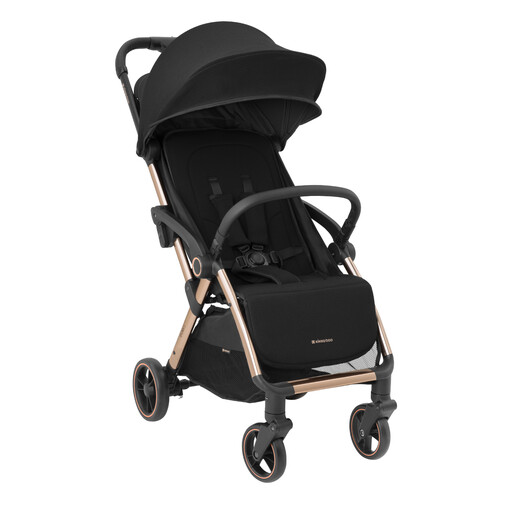
Why it stands out: The key feature of the Kikka boo Eden is its automatic folding mechanism. At the push of a button, the stroller collapses on its own, which is a huge relief in hectic situations. The high-quality finish with chrome accents and eco-leather details also gives it an appealing look.
Pros:
Who is it for? For tech-savvy parents who appreciate maximum convenience in handling and prefer a stroller with practical automatic functions and a modern design.
The models presented here are tailored to the specific needs of air travel. If you are looking for a different colour or other features, you can find more alternatives in our range.
Discover more models in our Strollers category.
No, not every stroller labelled as a "travel stroller" meets carry-on size requirements. Whether it's allowed depends on the stroller's specific folded dimensions and the individual airline's policies. It is essential to check the dimensions before you travel.
Most compact travel strollers are designed for children from around 6 months of age who can already sit up independently. However, some models offer a lie-flat position or can be combined with an infant car seat to form a travel system, making them usable from birth.
The main difference lies in the features optimised for travel. A travel stroller is typically much lighter, has a significantly smaller folded size, and is often equipped with features like a one-hand folding mechanism. Regular strollers often offer more comfort and storage space, but are heavier and bulkier in return.