
Lieferung heute & morgen

Qualitätsgarantie

Willkommens-Angebote freischalten: KOSTENLOSE Lieferung | Bis zu 80 % RABATT | Kostenlose 30-Tage-JoyPlus-Testphase
App herunterladen
A cast iron casserole can simmer, sear, bake and keep food warm for a long time. At the same time, its weight, coating and unclear manufacturer specifications often lead to unsuitable purchases. This is why it is particularly important to look closely at the technical details when shopping online, rather than relying solely on design promises.
A casserole with a capacity of 3 litres does not automatically offer 3 litres of usable cooking space. The lid, curved sides and recommended filling level reduce the amount that can actually be used. For two to three people, around 2 to 3 litres is often sufficient. Families should generally consider models from 3.3 to 3.8 litres upwards.
The diameter must also match your hob. A 28-cm casserole may heat up more slowly on a small induction zone or extend beyond it. Always check the base and hob diameters, not just the product size.
The product description should explicitly mention induction, gas, electric and ceramic hobs. For an induction-compatible cooking pot, a flat base that sits flush is also important. Not every casserole or Dutch oven is suitable for direct heat: ceramic models may be intended for use in the oven and microwave, but still must not be used on a hob or over an open flame.
Enameled cast iron requires less maintenance than uncoated cast iron, but it is still sensitive to sudden temperature changes, abrasive cleaners and hard metal utensils. A dishwasher-safe casserole is convenient, although frequent washing can alter the appearance of the surface. The key question is whether the care requirements suit your everyday routine.
A cast iron Dutch oven retains heat for longer because of its high material mass. This supports slow cooking and braised dishes, but also makes the pot heavy. Enameled cast iron generally does not require seasoning and is suitable for acidic ingredients such as tomatoes or wine, provided the enamel is undamaged.
An enameled cast iron pot is particularly versatile for use on the hob and in the oven when the manufacturer approves both applications. Cast iron casseroles with dark interiors are often designed for high-temperature searing. Ceramic cocottes follow different rules: they are usually lighter, but more susceptible to impact and sudden temperature changes.
Cast or forged aluminium is considerably lighter and heats up more quickly. However, it does not have the same heat-retention properties as cast iron. Choose according to your cooking style: frequent braising is better suited to cast iron, while easy everyday handling favours a lighter material.
As a practical guide:
A 22- to 24-cm casserole is a well-balanced size for many kitchens. Also consider the weight: a cast iron casserole with its lid can already weigh several kilograms when empty. Large handles make it easier to carry the casserole safely from the hob to the oven and then to the table.
A well-sealed lid reduces moisture loss during braising. Some models feature dimples or special drip structures that direct condensation back onto the food. This is a useful design feature, but it is no substitute for the correct temperature and cooking time.
For a Dutch oven intended for use in the oven, follow the maximum temperature specified by the manufacturer. Check whether this applies equally to the pot, lid and knob. Stainless steel knobs may have different limits from plastic or decorative knobs.
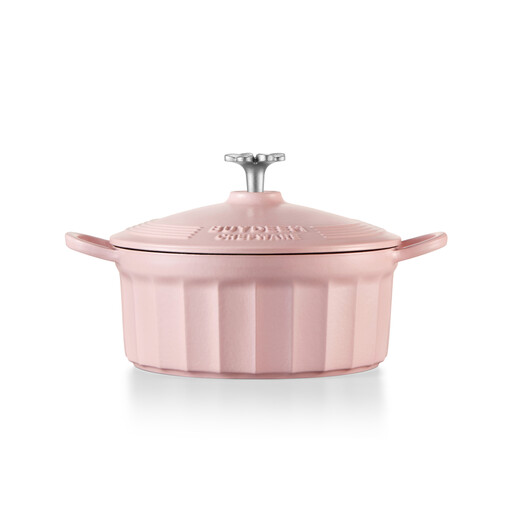
Why this product suits this profile: With a capacity of 2.9 litres, a diameter of 22 cm and an enamelled interior and exterior, this model is designed for everyday braised dishes, soups and smaller family portions.
The specific details on capacity, diameter and hob types make it easier to check compatibility with your hob and household size. The care instructions recommend hand washing and soft sponges.
Enameled cast iron, a tightly sealing domed lid, and compatibility with gas, induction, electric, halogen and ceramic hobs.
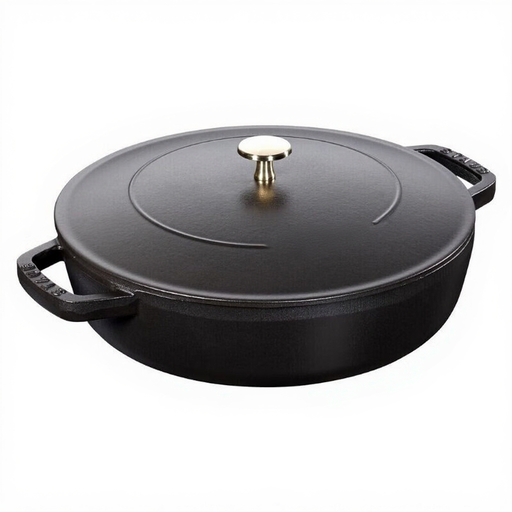
Why this product suits this profile: This 28-cm casserole with a capacity of 3.7 litres is intended for households wishing to prepare larger braised dishes, roasts or portions of vegetables on several types of hob.
The product details state a weight of 5.4 kg and a temperature limit of 260 °C. This allows you to check before buying whether your oven, storage space and preferred handling are suitable.
Enameled cast iron, suitability for all hob types including induction, and a lid with a Chistera structure that returns condensation to the food.
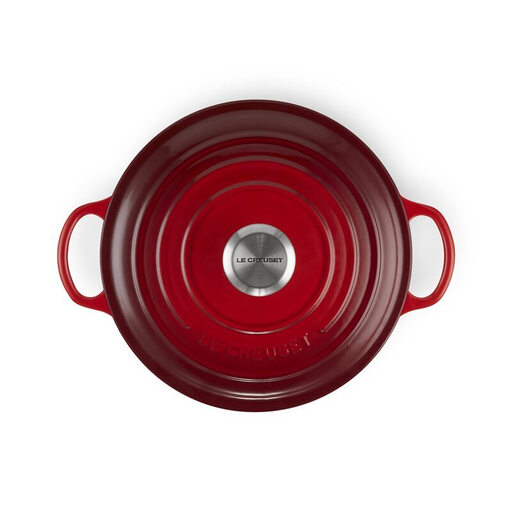
Why this product suits this profile: The round La Marmite shape, with a diameter of 24 cm and a capacity of 3.1 litres, is suitable for braised dishes, slow cooking, searing and serving food directly at the table.
The product description explicitly states compatibility with electric, gas and induction hobs. The interior has no corners, making stirring and cleaning easier.
Enameled cast iron, a capacity of 3.1 litres and a shape designed for even stirring when preparing soups, sauces and stews.
We have put together a complete, regularly updated list of products that fully meet these strict selection criteria and the safety regulations applicable in the EU.
For four people, 3 to 4 litres is usually a practical capacity. A model with a diameter of 22 to 24 cm provides enough room for stews, braised dishes and smaller roasts without taking up unnecessary space.
Yes, provided the manufacturer explicitly confirms induction compatibility and the base sits flat. Lift the casserole when moving it rather than sliding it across the glass hob, to avoid scratches.
Its lifespan depends on the quality of the material, temperature control and care. Enamel can be damaged by impacts, sudden temperature changes or abrasive cleaning. With careful handling, an enamelled cast iron pot can be used in the home for many years.