
Lieferung heute & morgen

Qualitätsgarantie

Willkommens-Angebote freischalten: KOSTENLOSE Lieferung | Bis zu 80 % RABATT | Kostenlose 30-Tage-JoyPlus-Testphase
App herunterladen
Cast-iron cookware retains heat for a long time, is suitable for hobs and ovens, and can be used for many years with the right care. At the same time, heavy pans, enamelled surfaces and large casserole dishes come with specific requirements. If you focus only on the brand name, appearance or advertising claims, you may end up buying a product that does not suit your kitchen.
This buying guide explains which technical details matter before you buy and which models are suitable for different usage profiles.
Cast iron is generally magnetic and therefore often suitable for induction hobs. However, the specific design of the base is what matters. Uneven undersides can scratch delicate glass surfaces or fail to sit flat. When choosing an induction grill pan, make sure it is explicitly stated to be suitable for induction hobs.
Size also matters: a large pan may extend beyond the usable induction zone. As a result, the heat may not be distributed evenly.
Enamelled cast iron has a glass-like surface. This can reduce sticking, but it does not replace proper preheating and the use of a little oil or fat. A cast-iron grill pan with high ridges also needs sufficient time to heat up evenly.
Uncoated cast iron generally requires a seasoned patina. Enamelled cast iron is often easier to handle, but it should not be cleaned with wire wool or harsh abrasive cleaners.
Cast-iron cookware is considerably heavier than many aluminium or stainless-steel pans. A 26 cm grill pan can already weigh several kilograms. Once filled with food, moving it from the hob to the oven or table becomes even more demanding.
Before buying, you should therefore check the handle design, weight, footprint and storage space. Two side handles often provide better control with heavy pots than one long handle.
With a cast-iron roasting pan or a cocotte, the interior surface is crucial:
The description “dishwasher-safe cookware” does not automatically mean that using a dishwasher will preserve its appearance in the long term. Despite dishwasher suitability, manufacturers often recommend washing many enamelled products by hand.
For one or two people, a smaller steak pan or casserole dish with a capacity of around 2 to 3 litres is often sufficient. For family meals or larger cuts of meat, 5 to 8 litres is a sensible choice. An oval shape can be more practical for elongated ingredients such as roasts, poultry or fish.
With grill pans, you should consider the actual grilling surface as well as the external dimensions. High ridges create grill marks and can drain away liquid or fat, but they reduce the area in direct contact with the food.
Look for three separate details:
Sudden changes in temperature should be avoided. Never place a hot pan in cold water or directly on a cold stone or glass surface.
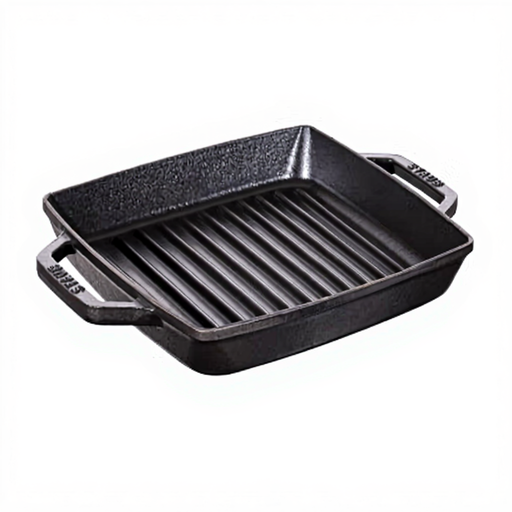
Why this product suits the profile: The compact square shape is ideal for smaller households and anyone trying indoor grilling for the first time.
Two handles make lifting safer and easier. The product details specify enamelled cast iron, oven suitability and dishwasher suitability.
23 × 23 cm grilling surface, two handles, 0.6-litre capacity and a weight of 2.5 kg.
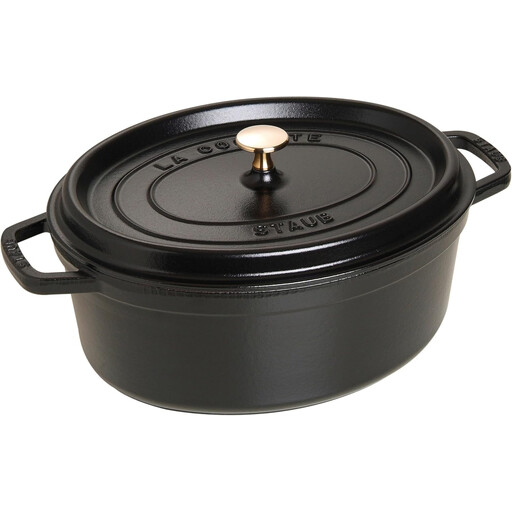
Why this product suits the profile: This large casserole dish is designed for meals that are seared on the hob and then finished in the oven.
The capacity and dimensions are clearly stated. According to the product details, the pot is suitable for induction, other hob types and oven use up to 250 °C.
8-litre capacity, enamelled cast iron, lid with condensation effect and made in France according to the product description.
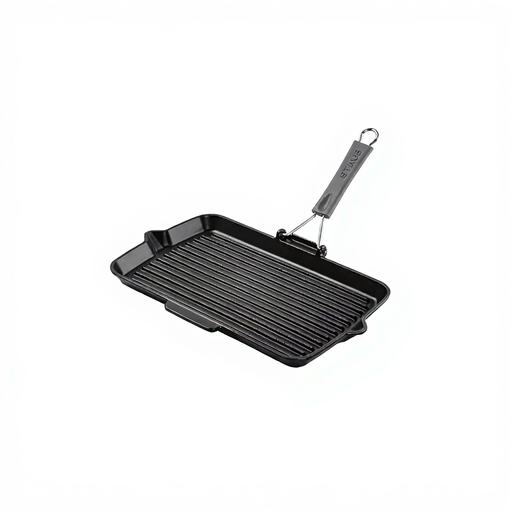
Why this product suits the profile: The elongated grilling surface is practical for steaks, vegetables and multiple portions on different types of hob.
The manufacturer’s details explicitly state induction suitability, oven suitability, a pouring spout and a folding silicone handle. This makes it easier to assess how much storage space you need.
34 × 21 cm, 1-litre capacity, grill ridges, pouring spout and a weight of 2.04 kg according to the product details.
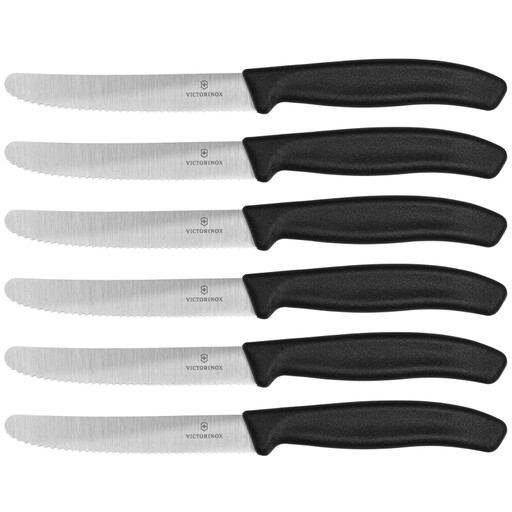
Why this product suits the profile: Six serrated steak knives are ideal for households that regularly serve meat dishes at the table.
The number of knives, the 11 cm blade length and dishwasher suitability are clearly specified, making comparisons easier.
Six-piece set, stainless-steel serrated blades, ergonomic handles and dishwasher suitability according to the product description.
Preheat cast-iron cookware slowly over a medium heat. With an enamelled grill pan, a thin layer of oil is usually all that is needed afterwards. Do not use metal utensils if the manufacturer advises protecting the surface from scratches.
Once cool, clean the cookware with warm water and mild washing-up liquid. Dry it thoroughly before putting it away in the cupboard. Damaged enamel, cracks or chips are reasons to stop using the product.
For serving, keep suitable trivets and heat-resistant gloves close at hand. A steak knife set should also be kept out of children’s reach. Serrated knives are intended for use at the table; a separate carving knife should be washed by hand in accordance with the manufacturer’s instructions if it is not dishwasher-safe.
We have put together a complete, regularly updated list of products that fully meet these strict selection criteria and the safety regulations applicable in the EU.
Many cast-iron pans and cocottes work on induction hobs. However, the specific manufacturer’s information is what matters. You should also check that the base is flat and that the diameter and weight are suitable for your hob.
With careful use, cast-iron cookware can remain usable for a long time. Its lifespan mainly depends on the enamel, how it is handled during temperature changes, cleaning and storage. Impacts against hard surfaces can cause chips.
Some products are described by the manufacturer as dishwasher-safe. Nevertheless, hand washing with a soft sponge is often recommended for the gentlest possible care. Always follow the specific care instructions for the model in question.