
Lieferung heute & morgen

Qualitätsgarantie

Willkommens-Angebote freischalten: KOSTENLOSE Lieferung | Bis zu 80 % RABATT | Kostenlose 30-Tage-JoyPlus-Testphase
App herunterladen
A cast iron frying pan retains heat for a long time, is ideal for searing and, depending on its design, can go straight from the hob to the oven or table. But your choice shouldn’t be based on the brand name or rustic looks alone. The key factors are the coating, handle, diameter, weight and whether the pan is suitable for your hob.
An uncoated cast iron pan doesn’t have a conventional non-stick coating. Its cooking performance depends on a well-developed seasoning, enough fat and the right temperature. If the pan is stored while damp or isn’t seasoned regularly, rust and food sticking can become problems.
An enameled cast iron pan, on the other hand, doesn’t need to be seasoned separately. The enamel protects the cast iron and makes the pan easier to clean. However, it isn’t indestructible: metal utensils, abrasive cleaners and sudden temperature changes can damage the surface.
Cast iron is magnetic, so cast iron pans for induction are generally suitable for induction hobs. Even so, you should check the manufacturer’s information. The base needs to sit flat on the hob for efficient cooking. A rough or uneven base can scratch a glass-ceramic surface if you slide the pan across it.
The speed at which cast iron heats up is also often underestimated. On an induction hob, it can reach a high temperature very quickly. It’s best to use medium heat and warm the pan gradually rather than immediately turning the hob up to maximum.
A 26 cm cast iron pan gives you more room for steaks, vegetables or meals for several people. But it’s also heavier and takes up more storage space. For individual portions, fried eggs, side dishes or tapas, a small cast iron pan measuring 10 to 16 cm is often enough. A larger pan may also heat unevenly on a small cooking zone.
Enameled cast iron is a practical choice if you’d like easier cleaning or often cook with acidic ingredients. According to the product information, the surfaces of the models mentioned are suitable for contact with food and don’t need seasoning. Even so, you should use wooden, plastic or silicone utensils.
With uncoated cast iron, care is part of the way you use the pan:
The right size depends on your portions and hob zone:
The cooking surface isn’t the same as the top diameter. A 26 cm model may have a much smaller base. If you’re using an induction hob, check the base diameter too.
An oven-safe frying pan isn’t necessarily safe to put in the oven with every type of handle. Cast iron handles are generally designed for oven use, while wooden handles may limit how you can use the pan. The product information for the STAUB model with a wooden handle explicitly states that it isn’t suitable for oven use. Before moving a pan from the hob to the oven, check the stated maximum temperature and any guidance on sudden temperature changes.
Cast iron retains heat for a long time, so the handle and pan body stay hot even after you’ve switched off the heat. Always use a tea towel or oven gloves when handling the pan.
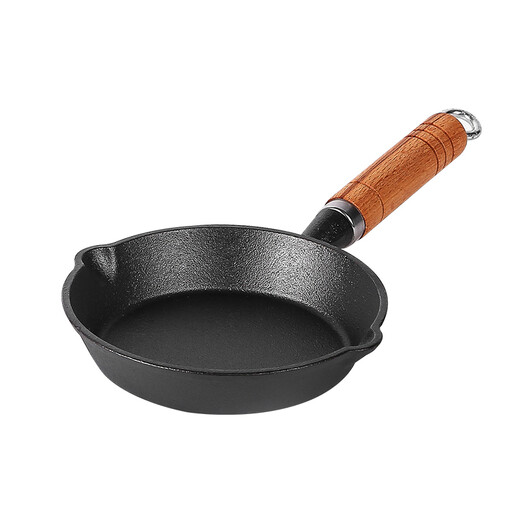
Why this product suits this profile: This compact mini pan is ideal for individual portions, butter, eggs, sauces and side dishes. According to the product information, it’s suitable for gas, electric, ceramic, induction and oven use.
The product description clearly states that the pan is uncoated, needs seasoning and should be hand-washed. This means you know what care it requires before you buy.
10 cm diameter, wooden handle and induction compatibility; at 1.7 kg, it’s a compact pan for cooking and serving.
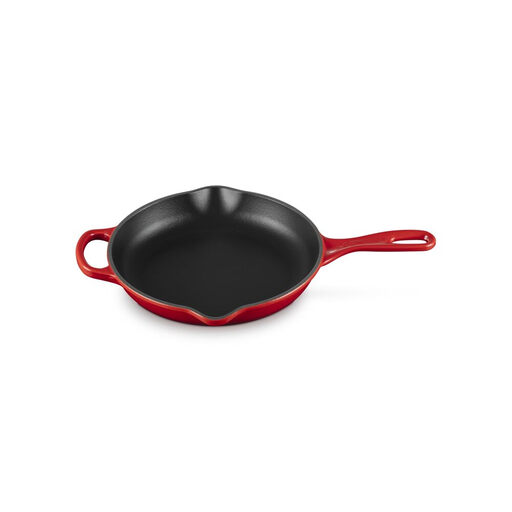
Why this product suits this profile: This 23 cm enameled pan is designed for both cooking and serving. It has an extra handle, pouring spouts and a 1.2-litre capacity. According to the product information, it’s suitable for all hob types, including induction, as well as oven use.
The enamel means there’s no need to season the pan. The product information also gives clear care instructions: use a soft sponge, avoid abrasive cleaners and take care when using metal utensils.
23 cm diameter, extra handle, pouring spouts, induction compatibility and oven suitability; according to the product information, the pan is dishwasher-safe.
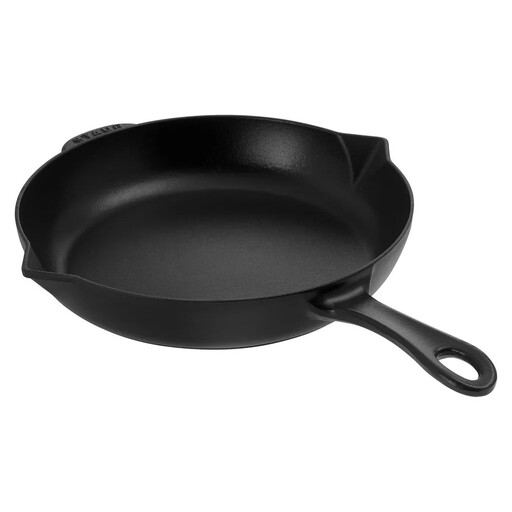
Why this product suits this profile: This 26 cm model is designed for larger portions and slow-cooked dishes. The product information highlights a self-basting lid, matt black enamel and induction compatibility, as well as use on the hob, barbecue and in the oven.
The lid and enamel are clearly listed as specific features. This makes it easy to tell the difference between an open steak pan and a pan designed for roasting and slow cooking.
26 cm diameter, 2.58 kg weight, matt black enamel and a lid system; according to the product information, it’s suitable for induction, oven and barbecue use.
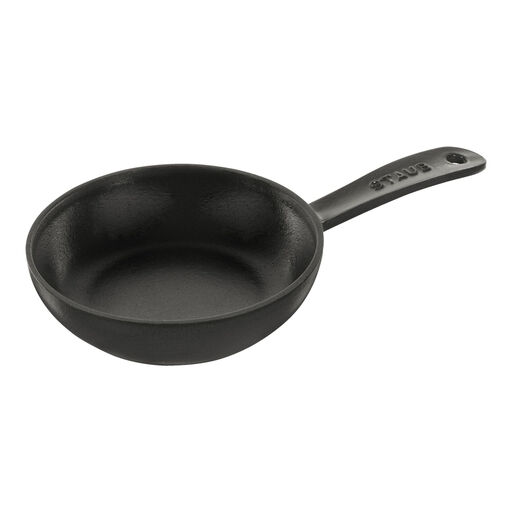
Why this product suits this profile: With a compact 0.60-litre capacity, this pan is ideal for tapas, side dishes and individual portions. According to the product information, it can be used on all hob types, in the oven and on the barbecue.
The product details include the diameter, base size, capacity and weight. This helps you check before buying whether the hob zone, portion size and storage space are a good fit.
16 cm diameter, 0.60-litre capacity, matt black enamel and heat retention for serving; according to the product information, it’s stackable and heat-resistant up to 260 °C.
We’ve put together a complete, regularly updated list of products that meet these strict selection criteria and the safety regulations applicable in the EU.
For an enameled cast iron pan, warm water, a mild washing-up liquid and a soft sponge are usually all you need. Let the pan cool before cleaning it. Pouring cold water into a hot pan can cause thermal shock.
After hand-washing an uncoated pan, dry it straight away and apply a thin layer of oil. Rust doesn’t necessarily mean you need to throw the pan away: clean the affected area and season it again. However, don’t use the product if the enamel has chipped.
Many models are suitable for induction because cast iron is magnetic. The manufacturer’s information is still the best guide. Also check that the base diameter is a good fit and as flat as possible. Lift the pan when moving it rather than sliding it across the hob.
Its lifespan depends on the material, coating and care. Cast iron itself is durable and can last a long time if you look after it properly. Uncoated pans need to be dried completely and oiled regularly. Enameled pans don’t need seasoning, but should be protected from scratches and sudden temperature changes.
It depends on the model. According to the product information, some enameled versions can go in the dishwasher, although hand-washing may help protect the surface. Uncoated cast iron pans should always be washed by hand, as the dishwasher can damage the seasoning and encourage rust.