
Lieferung heute & morgen

Qualitätsgarantie

Willkommens-Angebote freischalten: KOSTENLOSE Lieferung | Bis zu 80 % RABATT | Kostenlose 30-Tage-JoyPlus-Testphase
App herunterladen
A cast iron griddle pan can give steaks, poultry, fish and vegetables distinctive chargrilled lines. But its weight, heat retention and delicate enamel can quickly become a source of frustration if you choose the wrong pan. If you’re looking to buy a cast iron griddle pan, don’t focus solely on the brand or colour. Consider the material, ridges, hob compatibility and cleaning requirements too.
Cast iron is naturally magnetic, so it’s often suitable for induction hobs. But that alone doesn’t tell you much about how the pan will perform in practice. A flat base, the right size for your induction zone and gradual heating are what matter. An uneven base can reduce heat transfer and scratch delicate hobs.
Griddle ridges create visible lines, but their height and spacing affect how the food sits on the pan. Very narrow or uneven ridges can make small foods such as fish or courgette slices unstable. If you’re choosing a griddle pan for vegetables and fish, look for sufficiently wide contact areas and a practical square or rectangular cooking surface.
An enameled griddle pan usually doesn’t need the traditional seasoning routine. But that doesn’t mean it’s indestructible. Metal utensils, wire wool, harsh scouring products and sudden temperature changes can damage the enamel. Cast iron also stays hot for a long time and is considerably heavier than aluminium or stainless steel.
Cast iron retains heat for a long time and transfers it evenly to food. This is useful for searing steaks or grilling vegetables, but it does mean you’ll need to be patient while the pan heats up. An enamelled interior makes it easier to get started, as it doesn’t need to be seasoned regularly like bare cast iron.
With black satin enamel, food may release more easily as the pan is used. However, this isn’t the same as a modern non-stick coating. We recommend using wooden, silicone or heat-resistant plastic utensils.
A square griddle pan makes efficient use of the hob and, with sides of around 23 to 26 cm, offers enough room for individual steaks, chicken fillets or several pieces of vegetables. Before buying, check:
A rectangular griddle pan measuring around 34 × 21 cm can be a good choice if you want to cook long foods or several portions at once.
A good induction griddle pan should be explicitly listed by the manufacturer as suitable for induction, gas, ceramic or electric hobs. Many enamelled models are also suitable as an oven-safe griddle pan and for use on a BBQ. Always follow the instructions provided by the manufacturer.
“Dishwasher-safe” and “recommended for everyday dishwasher use” don’t mean the same thing. For enamelled cast iron, hand-washing with warm water, mild washing-up liquid and a soft sponge is often gentler on the material. Don’t plunge a hot pan into cold water or place it on a cold or wet surface.
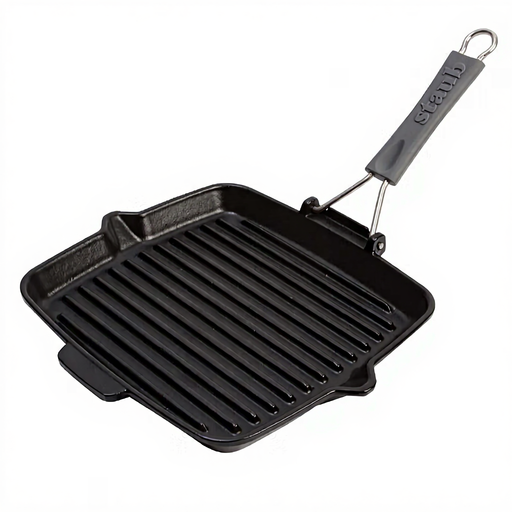
Why this product suits this profile: The 24 × 24 cm square surface is ideal for typical household portions. The enamelled cast iron is designed for a range of hob types, including induction, and for use in the oven.
The griddle ridges, pouring spout and heat-resistant silicone handle help with common handling and fat-draining issues. Bear in mind that the pan weighs around 2,035 kg before you buy.
Enamelled cast iron, a 24 × 24 cm grilling surface, suitability for induction and oven use, plus a handle with extra heat insulation.
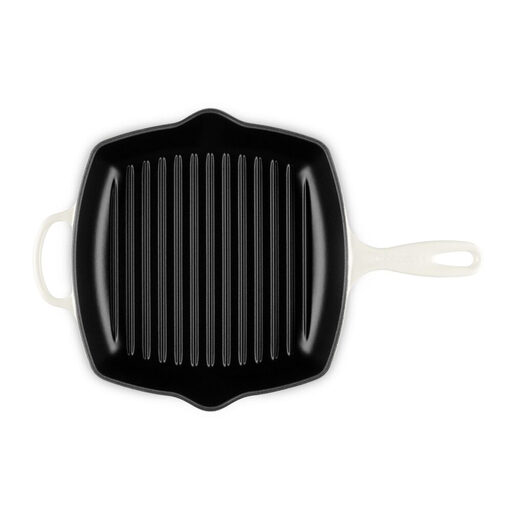
Why this product suits this profile: The 26 cm grilling surface, black satin enamel and combination of a long handle and helper handle make this a good choice for households looking for a versatile cast iron griddle pan.
The specifications explicitly list compatible hob types, oven use and BBQ suitability. The care instructions advise against metal utensils, scouring products and sudden temperature changes.
26 cm grilling surface, raised griddle ridges, two pouring spouts, enamelled cast iron and a stated weight of around 2.9 kg.
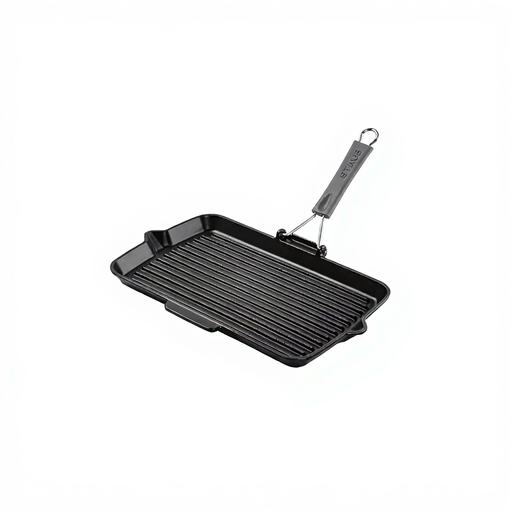
Why this product suits this profile: The elongated shape is ideal for asparagus, fish fillets, several pieces of vegetables or longer cuts of meat. It’s listed as suitable for all common hob types, including induction, and for oven use.
The dimensions are clearly stated, so you’re less likely to choose the pan by mistake only to find the cooking surface is too small. The foldable silicone handle makes it easier to store.
21 × 34 cm cooking surface, pouring spout, foldable handle, enamelled cast iron and a stated capacity of 1 litre.
We’ve put together a complete, regularly updated list of products that meet these strict selection criteria and the safety regulations in force in the EU.
Many models are suitable for induction because cast iron is magnetic. However, always check the manufacturer’s specifications. Also look for a flat base and make sure the pan fits the size of your induction zone.
With careful use, it can last for many years. Its actual lifespan depends on temperature changes, knocks, metal utensils and how it’s cleaned. Don’t ignore chips or cracks in the enamel.
Cast iron takes longer to heat up than pans with thinner walls, but it retains heat for longer. Choosing the right hob zone, using a medium setting and turning the heat down in good time can help you avoid using more energy than necessary.