
Lieferung heute & morgen

Qualitätsgarantie

Willkommens-Angebote freischalten: KOSTENLOSE Lieferung | Bis zu 80 % RABATT | Kostenlose 30-Tage-JoyPlus-Testphase
App herunterladen
A high-quality cast iron grill pan promises perfect grilling results all year round, right in your own kitchen—from a juicy steak with precise grill marks to aromatic vegetables. However, the market is flooded with models whose real-world performance often fails to live up to their marketing promises. Before you make a decision, it's crucial to understand the typical pitfalls that can quickly turn a promising purchase into a source of frustration.
This guide will help you identify the key features and find a cast iron pan that meets your standards for quality and durability.
Many grill pans look robust at first glance but reveal their weaknesses after just a few uses. Pay close attention to these three problem areas to avoid a bad purchase.
To avoid these traps, you should base your choice on objective technical parameters. These three features separate a durable, high-performance pan from a short-lived product.
Due to its excellent heat retention and distribution, cast iron is the material of choice for a steak pan. There are two main types: raw and enamelled cast iron.
For those with an induction hob, the construction of the pan's base is the most important criterion. The pan must have a ferromagnetic base that makes full contact with the hob. A thick, solid base (often 4 mm or more) not only ensures optimal energy transfer but also prevents the pan from warping at high temperatures and guarantees absolutely even heat distribution.
The shape significantly affects practical usability. A square grill pan offers a larger usable cooking surface compared to a round pan of the same diameter—ideal for multiple steaks or long pieces of vegetables. Also, pay attention to functional details:
Instead of making a one-size-fits-all recommendation, we have selected models that meet specific needs and adhere to the quality criteria mentioned above.
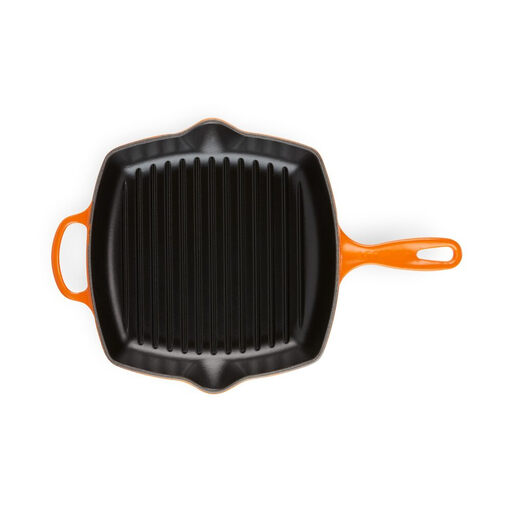
Why This Fits Their Persona: Ideal for quality-conscious cooks who value durability, outstanding searing results, and proven brand quality. This is cookware designed to last for generations.
The solid, flat base ensures excellent and even heat distribution on induction hobs. The high-quality enamel is extremely resistant to chipping and simplifies cleaning.
Superb heat retention for consistent temperatures and perfect grill marks. The large helper handle ensures safe handling.
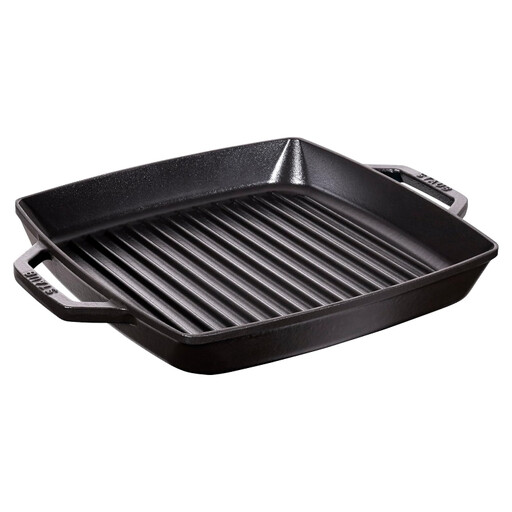
Why This Fits Their Persona: Perfect for anyone who prepares larger quantities and wants the flexibility to move the pan from the hob to the oven. The dual handles offer maximum control and safety.
The two ergonomic handles solve the problem of unsafely handling heavy pans. Its robust construction and 28 cm size are designed for intensive use.
Large grilling surface and high oven-safe temperature. The dual handles allow for space-saving storage compared to models with a long stick handle.

Why This Fits Their Persona: Ideal for those who value efficiency in the kitchen and want to cook a full breakfast or multiple components of a meal simultaneously in one pan.
This die-cast aluminium model solves the efficiency problem: only one pan is needed instead of several. The thick base with a stainless steel bottom is explicitly designed for induction and ensures even heat.
3-in-1 design for maximum versatility. The non-stick coating allows for low-fat cooking and very easy cleaning.
We have compiled a complete, up-to-date list of products that fully meet these strict selection criteria and local safety regulations.
1. How do I properly clean an enamelled cast iron grill pan? Always let the pan cool down completely after use before it comes into contact with water to avoid thermal shock and cracks in the enamel. Use warm water, mild washing-up liquid, and a soft sponge. Stubborn residues can be loosened by soaking briefly. Avoid steel wool or abrasive cleaners, as these can damage the enamel. Dry the pan thoroughly after cleaning.
2. Why am I not getting clear grill marks on my steak? High, even heat is crucial for pronounced grill marks. Preheat the dry ridged pan over medium-high heat for at least 5–8 minutes. Pat the meat dry before searing. Place it in the hot pan and do not move it for the first few minutes to allow the Maillard reaction to occur undisturbed and create the characteristic marks.
3. Is a heavy cast iron pan always the better choice? The weight of a cast iron pan is directly correlated with its ability to retain heat. A heavy, solid pan keeps the temperature stable even when cold food is added—a prerequisite for a good sear. However, a heavy weight can make handling difficult. A good compromise is a pan with a solid weight (e.g., 2.5–3.5 kg for a 26 cm pan) and thoughtful handles, such as a helper handle, to make it easier to manage.