
Lieferung heute & morgen

Qualitätsgarantie

Willkommens-Angebote freischalten: KOSTENLOSE Lieferung | Bis zu 80 % RABATT | Kostenlose 30-Tage-JoyPlus-Testphase
App herunterladen
A cast-iron grill pan can prepare steaks, vegetables and fish with distinctive grill marks. However, not every model delivers good results in everyday use. High weight, unclear information about hob compatibility or a delicate coating can make your purchase impractical after only a short time.
This guide from the Joybuy Product Recommendation Officer explains what households in Germany should look out for before buying. It focuses on material, size, grill ridges, cleaning and use on induction hobs, in the oven or on the barbecue.
The term non-stick grill pan does not automatically describe the same technology. An enamelled grill pan has a glass-like protective layer, while untreated cast-iron models need to be seasoned. Aluminium grill pans often use a separate non-stick coating, which can be damaged by high temperatures or incorrect cleaning.
Before buying, you should therefore clarify:
An enamelled surface generally does not need traditional seasoning. However, it should not be treated with wire wool, sharp metal objects or harsh scouring agents.
A ridged grill pan creates visible marks, but it does not automatically produce even browning across the entire surface. The raised ridges reduce the direct contact area and allow fat or liquid to drain into the gaps. Thorough preheating is therefore essential for a substantial crust.
Cast iron retains heat for a long time. This is helpful when searing, but it also means that excessively high heat cannot be corrected immediately. Particularly on a delicate hob, the pan should be heated slowly and moved carefully.
A square grill pan with a 26 cm cooking surface may be suitable for one or two portions. A 30 cm cast-iron grill plate offers more space, but also needs more storage room and can weigh more than 3 kg. If it has a long handle, you must also take the total space it occupies on the hob into account.
Check the following before buying:
A cast-iron grill pan without enamel can develop a durable patina with regular care. After cleaning, it must be dried completely and, depending on the model, lightly oiled to prevent rust from forming.
With an enamelled grill pan, the enamel provides surface protection. It is easier to care for when first used, but remains sensitive to sudden changes in temperature. A hot pan should not be placed in cold water or on a cold stone surface, as this can damage the enamel.
An induction grill pan needs a magnetic base that is sufficiently large and lies as flat as possible on the hob. If there are ribs on the underside, the contact area may be smaller than the advertised pan size. The manufacturer’s specifications should therefore explicitly mention induction.
Compatibility with ceramic, gas and halogen hobs should also be checked separately. Heavy cast-iron pans should not be slid across glass surfaces, but carefully lifted instead.
Calling a grill pan oven-safe assumes that every component – including the handle, silicone sleeve or coating – is suitable for the stated temperature. Coated aluminium models may have significantly lower limits. According to the product specifications, for example, the Tefal Unlimited Grill Pan is oven-safe up to 175 °C, while the Ballarini version is specified as suitable up to 160 °C.
Cast-iron models usually withstand higher temperatures, but handles and coatings must still be taken into account. The pan remains hot for a long time after being removed from the oven. Heat-resistant oven gloves and a fireproof surface should therefore be used for safe handling.
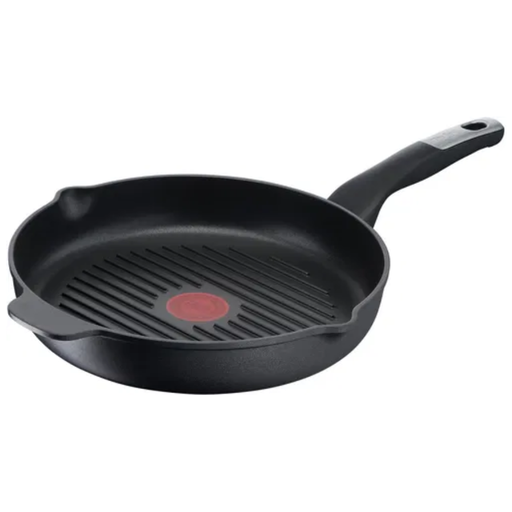
Why this product suits the profile: This 26 cm aluminium pan with a non-stick coating is specified as suitable for electric, gas, ceramic and induction hobs. It is suitable for everyday portions and, according to the product specifications, can be cleaned in the dishwasher.
The stated hob compatibility reduces the risk of making the wrong purchase for induction cooking. The temperature limit of 175 °C should be observed when using it in the oven.
Lighter than typical cast-iron models, with a ridged grill surface and stated suitability for all common hob types.
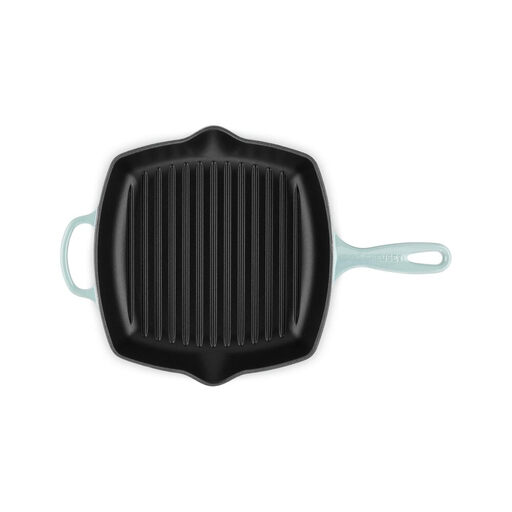
Why this product suits the profile: This square grill pan is made from enamelled cast iron and features raised ridges, pouring spouts, a long handle and an additional helper handle. According to the product description, it is suitable for induction, other hob types, the oven and the barbecue.
According to the specifications, the enamelled interior does not require traditional seasoning. At the same time, hand washing is recommended to protect the surface from scratches and abrasion.
26 cm grill surface, 2.9 kg weight, fat drainage through ridges and pouring spouts, plus use on induction hobs and in the oven.
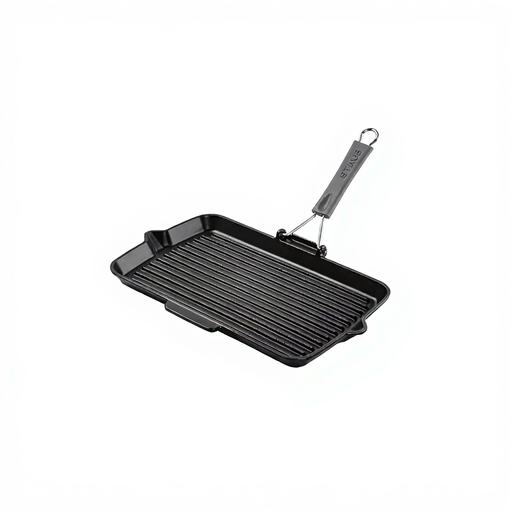
Why this product suits the profile: Measuring 34 × 21 cm, this elongated grill pan provides room for several ingredients. According to the product specifications, it is suitable for all hob types, including induction, as well as for the oven, and features a folding silicone handle.
The precise base and external dimensions help with kitchen planning. The folding handle reduces storage requirements; however, the temperature should still be increased gradually.
Enamelled cast iron, 2.04 kg weight, pouring spouts, grill ridges and stated dishwasher suitability.
We have put together a complete, regularly updated list of products that fully meet these strict selection criteria and the safety regulations applicable in the EU.
Many models are designed for induction, but not every grill pan is suitable automatically. The manufacturer’s specifications and a sufficiently flat base are decisive. With enamelled cast-iron models, you should also check whether the size matches the induction zone.
Its service life depends on the material, coating and care. With correct drying and oiling, raw cast iron can be used for a very long time. With enamelled pans, sudden changes in temperature, impacts and abrasive cleaning products should be avoided, as they can otherwise damage the enamel.
Energy consumption cannot be compared universally. A cast-iron pan needs a certain amount of preheating time because it retains heat, and can then continue cooking at a reduced temperature. Actual consumption depends mainly on cooking time, the hob’s power, portion size and preheating habits.