
Lieferung heute & morgen

Qualitätsgarantie

Willkommens-Angebote freischalten: KOSTENLOSE Lieferung | Bis zu 80 % RABATT | Kostenlose 30-Tage-JoyPlus-Testphase
App herunterladen
A cast-iron grill pan can prepare steaks, fish and vegetables with distinctive grill marks. At the same time, the material is heavier, takes longer to heat up and requires special care. If you focus only on the ridges or the brand name, you can quickly end up buying a pan that does not suit your kitchen or everyday cooking needs.
A grill pan with high ridges creates visible contact points on food. However, the ridges alone do not guarantee even browning. The key factors are material thickness, heat absorption and allowing enough time for the pan to preheat. Thin aluminium or non-stick models respond more quickly, but retain heat differently from cast iron.
When choosing an induction grill pan, the manufacturer’s information on hob compatibility should be clear. The handle can also limit oven use. A cast-iron grill pan with metal handles is generally more versatile than a model with a temperature-sensitive plastic or silicone handle. The specific maximum temperature should be stated in the product details.
Cast iron retains heat for a long time. This supports consistent cooking temperatures, but also makes the pan heavy and slow to cool down. Enameled surfaces do not require traditional seasoning, but should not be cleaned with wire wool or harsh abrasive cleaners. An uncoated grill pan, on the other hand, usually needs to be dried and oiled regularly to prevent corrosion.
A cast-iron grill pan distributes heat widely across the surface after sufficient preheating and retains it for a long time. This is particularly relevant for grill pans for steaks and when cooking larger portions. An enameled grill pan makes care easier, as its interior does not need to be seasoned like raw cast iron. However, metal utensils and abrasive cleaning products are often unsuitable.
Coated aluminium pans can be a lighter alternative. However, they are not automatically suitable for induction or high oven temperatures. Therefore, check the material, coating and permitted temperature separately.
A square grill pan often makes efficient use of the hob and provides room for long foods such as steaks or courgette strips. A round shape can be used intuitively on many hobs, while a cast-iron grill plate with two handles may sit more securely when serving.
Pay attention to the actual cooking surface, not just the external dimensions. Handles can significantly increase the overall width. For one or two portions, a cooking surface of around 23 to 26 cm is often easier to handle. If you are preparing several steaks or vegetables for a family, around 30 cm or an elongated grill surface is more practical.
High ridges create a gap between the food and the base of the pan. Fat and liquid can collect in the spaces between the ridges or be poured away through pouring spouts. For vegetables, a moderate ridge depth is often more practical, as smaller pieces are less likely to tip over.
Weight is also part of the technical specifications. The cast-iron models considered here weigh approximately 2 to over 3 kg. An additional helper handle improves control when lifting the pan. Oven gloves designed for high temperatures should be used in the oven, as even long handles can become very hot.
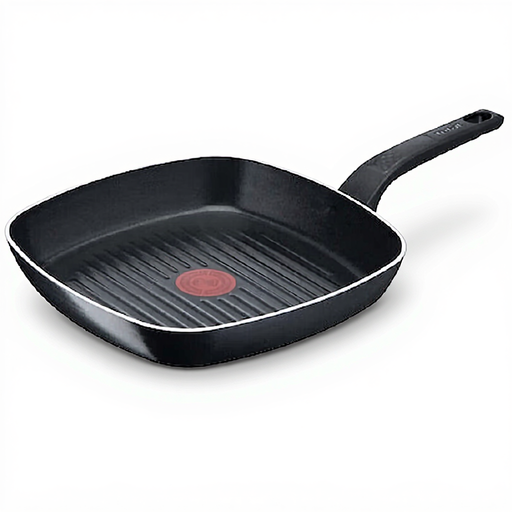
Why this product suits this profile: The square shape and integrated ridges make this model a good introduction to grilling on the hob. It is a lighter alternative to cast iron and designed for straightforward everyday meals.
The product description clearly specifies the non-stick coating, square shape and grill ridges. This makes it easier to assess the care requirements and material differences before buying.
Non-stick coating and grill ridges; described as suitable for steaks, vegetables and breakfast dishes.
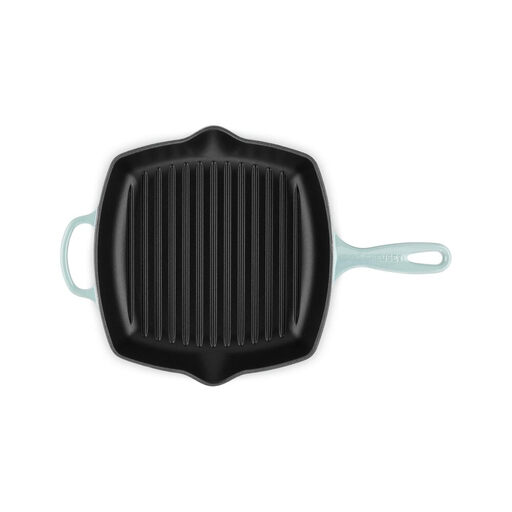
Why this product suits this profile: This 26 cm square grill pan is made from enameled cast iron and, according to the product details, is suitable for gas, induction, ceramic hobs, ovens and BBQs.
The enamel coating reduces the need for traditional seasoning. Pouring spouts and a large helper handle address the typical challenges of draining liquids and lifting the pan safely.
26 cm cooking surface, raised ridge profile, two pouring spouts and a weight of approximately 2.9 kg.
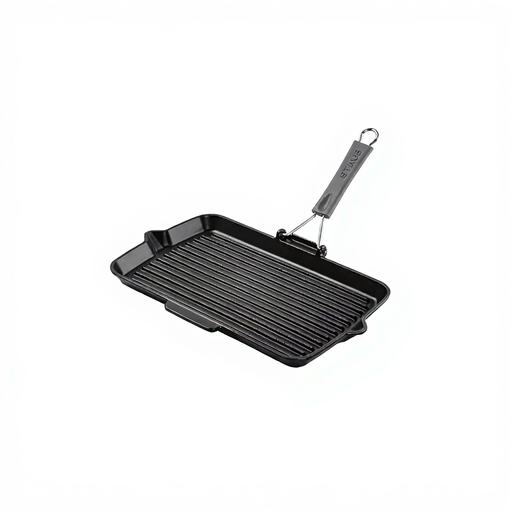
Why this product suits this profile: The elongated grill surface is designed for several steaks, vegetables and BBQ ingredients. The folding silicone handle can be practical when storage space is limited.
The product details specify the dimensions, weight, induction compatibility, oven suitability and pouring opening. This clearly documents the relevant usage limits.
21 × 34 cm grill surface, enameled cast iron, folding silicone handle and suitability for all hob types, including induction.
We have put together a complete, regularly updated list of products that fully meet these strict selection criteria and the safety regulations applicable in the EU.
Many cast-iron models work on induction hobs because the material is magnetic. However, only the relevant manufacturer’s information is definitive. Also check that the base sits flat and that its size matches the induction zone.
A grill pan for oven use is suitable if the material, handle and coating can withstand the stated temperature. Fully cast-iron or enameled models with suitable handles are often versatile. With silicone or plastic components, the maximum temperature must be checked.
With proper care, cast iron can be used for many years. Its lifespan depends particularly on rust protection, the coating, temperature changes and mechanical stress. Damaged enamel should not be ignored; if it is chipped or cracked, assess the pan in accordance with the manufacturer’s instructions.