
Lieferung heute & morgen

Qualitätsgarantie

Willkommens-Angebote freischalten: KOSTENLOSE Lieferung | Bis zu 80 % RABATT | Kostenlose 30-Tage-JoyPlus-Testphase
App herunterladen
A cat tree is far more than just a piece of furniture for cats. It is an essential part of an enriching environment that caters to your cat's natural instincts to climb, scratch, observe, and rest. However, choosing the right model can be a challenge given the variety of sizes, materials, and features available. An unsuitable cat tree is often ignored, whereas a well-chosen one significantly enhances your cat's quality of life and protects your furniture.
This guide is designed to help you make an informed decision. We will introduce you to the various criteria that play a role in the selection process and present a range of models for different needs—from a compact small cat tree for a first apartment to a large cat tower for a multi-cat household.
To find the perfect model for your cat and your living space, several fundamental aspects should be considered.
A sturdy cat tree is the most important criterion, especially if you are looking for a cat tree for large cats or for several very active animals. Look for a heavy, wide base plate that prevents tipping, even when your cat leaps onto it at full speed. The connections between the elements should be robust and the posts thick enough. Many larger models come with an additional wall mount to maximise stability.
The ideal size depends on your cat and the available space. A smaller model under one metre in height may be sufficient for kittens or calmer, small cat breeds. For most cats, however, a large cat tree with multiple levels is recommended as it offers more opportunities for climbing and observation. A cat tree with a condo provides a secure retreat, while perches and hammocks are perfect for relaxing. For a household with multiple cats, a model with various lounging areas and hideaways is ideal to prevent conflicts.
The scratching posts are typically wrapped in sisal. This natural material is extremely durable and perfectly satisfies a cat's scratching instinct. Ensure that the sisal posts are tall enough for your cat to fully stretch while scratching. The lounging surfaces are usually covered with soft plush for added comfort. The materials used, such as particleboard, should be stable and free of harmful substances.
Here is a selection of models that cater to different requirements—from space-saving solutions to comprehensive activity centres.
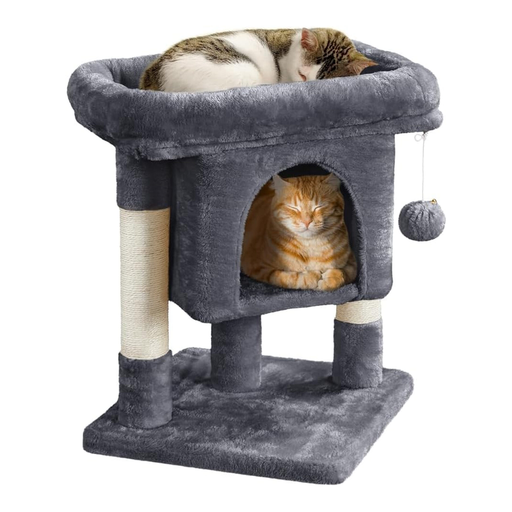
Why it stands out: This model combines functionality with a very compact design. At just under 60 cm tall, it fits effortlessly into smaller apartments or corners without sacrificing essential elements like a condo and scratching posts.
Advantages:
Who is it for? This small cat tree is an excellent choice for owners of kittens, smaller cat breeds, or less active cats. It also works well as a secondary cat tree in another room.
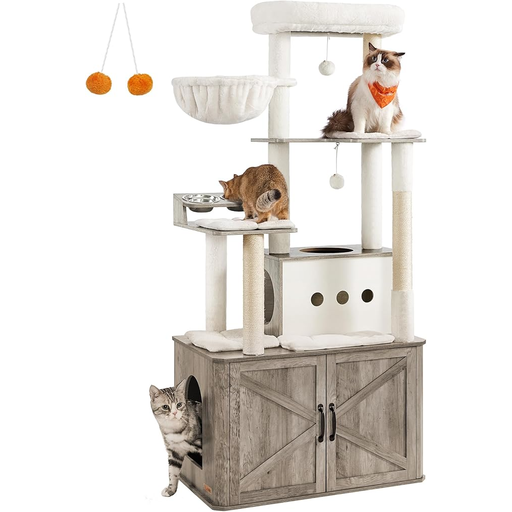
Why it stands out: This model is a true all-in-one cat centre. It cleverly integrates a tall cat tower with a feeding station and a cabinet that can be used for storage or to conceal a litter box.
Advantages:
Who is it for? This cat tree is ideal for cat owners looking for a space-saving and highly functional solution that meets multiple feline needs at once and blends seamlessly into the home decor.

Why it stands out: With an impressive height of over two metres and a multitude of features, this large cat tree is a true paradise for cats that love to climb. It has been specifically designed to meet the needs of multiple cats or large breeds.
Advantages:
Who is it for? This cat tree for large cats like Maine Coons or Norwegian Forest Cats is the ideal choice. It is also perfectly suited for households with multiple cats, as it provides enough space and activity for everyone.
The models presented already cover a broad spectrum. However, if you are specifically looking for a model that integrates an especially cosy sleeping area, there are other specialised designs available.
Discover our selection of models that perfectly combine climbing fun with restful sleep. ? Discover our selection of cat trees with beds here
1. How do I get my cat used to the new cat tree? Place the cat tree in an attractive location, such as near a window or in a room where the family often gathers. You can pique your cat's interest by playing with them near the tree, placing treats on the different levels, or rubbing some catnip on the sisal posts.
2. Where is the best place for a cat tree? An ideal location offers the cat a good overview of the room, such as in a corner of the living room or next to a window. This satisfies their instinct to observe their surroundings from a safe, elevated point. Avoid placing the tree in a remote room, as it will likely be used less there.
3. How do I clean a cat tree? Hair and dust are most easily removed with a vacuum cleaner. Many models have removable and washable cushions. Stains on the plush can usually be treated with a damp cloth and a mild soap solution. Additionally, regularly check all screws and connections to ensure the long-term stability of the cat tree.