
Lieferung heute & morgen

Qualitätsgarantie

Willkommens-Angebote freischalten: KOSTENLOSE Lieferung | Bis zu 80 % RABATT | Kostenlose 30-Tage-JoyPlus-Testphase
App herunterladen
By Joybuy Product Recommendation Officer, Joybuy
A cat tree is more than just a piece of furniture for your cat; it is an essential part of an enriching home, especially for indoor cats. It serves as a playground, an observation deck, a retreat, and, most importantly, a dedicated area for scratching. The right choice not only protects your own furniture but also promotes your pet's well-being and health.
However, the variety of models can be overwhelming. From compact posts to floor-to-ceiling climbing landscapes, the selection is vast. This guide will help you understand the features that define a quality cat tree and make an informed decision that suits both your cat's needs and your living space.
Before you decide on a model, several fundamental criteria should be considered. These ensure safety, durability, and acceptance by your cat.
A cat tree must be stable. This is the most important safety feature, especially if you are looking for a cat tree for large cats or for multiple pets. Look for a wide and heavy base plate that serves as a foundation and prevents tipping. The connections between the individual elements should be robust, and the posts thick enough to withstand even wild play. For models over 150 cm in height, an additional wall anchor, often included, is a sensible safety measure.
The ideal size depends on the number of your cats, their age and activity level, and the available space. A large cat tree serves as a climbing tree for cats, offering more vertical space for climbing and observing, which caters to their natural behaviour. Important features include:
For cat furniture for indoor cats, a versatile set of features is particularly important to provide sufficient stimulation and exercise.
The durability of a cat tree is largely determined by the materials used. The scratching posts should be firmly and completely wrapped with natural sisal rope. This material is resilient and very popular with cats. The plush coverings should be durable and securely attached. The structure itself is often made of engineered wood boards (e.g., particleboard), which must be stable enough to support the total weight.
Based on the criteria above, we have compiled a selection of models that cater to different requirements and living situations.

Why it stands out: At a height of 206 cm, this floor-to-ceiling cat tree offers an impressive vertical playground. It is specially designed for households with multiple or very active cats and provides a wealth of features on multiple levels. According to the manufacturer, the stable construction is designed for a total static load of up to 75 kg.
Advantages:
Who is it for? This cat tree is a great choice for owners of multiple cats or large breeds like Maine Coons or Norwegian Forest Cats. It is suitable for anyone who wants to provide their pets with a comprehensive and stimulating indoor environment and has the necessary space.
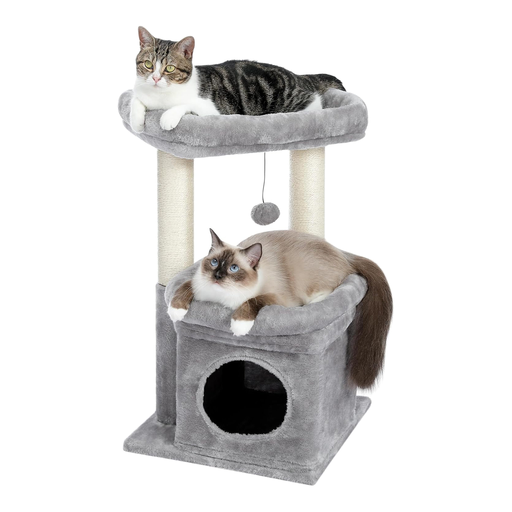
Why it stands out: This model focuses on essential functions within a minimal footprint. Despite its compact size of 42 cm, it offers a generous, padded perch (40x30 cm) with a raised edge for added security and comfort.
Advantages:
Who is it for? Perfect for cat owners with limited space, for kittens being introduced to a cat tree, or as a supplement to an existing, larger model.

Why it stands out: At 143 cm high, this cat tree strikes a good compromise between size and functionality. Its step-like layout makes it easy for cats of all ages, including kittens and seniors, to climb up and down. It combines various elements into a well-balanced total package.
Advantages:
Who is it for? This model is an excellent choice for households with one or two medium-sized cats. It offers a variety of activity and retreat options without dominating the room.
The models presented here cover common needs but represent only a small selection of the available range. Every cat and every living situation is unique.
Haven't found the right model for your needs yet? Discover a wider selection of cat furniture in our Indoor Playhouses category.
1. Where is the best place for a cat tree? The ideal location is a spot from which your cat can easily observe its surroundings, such as near a window or in the living room. Cats are social animals and enjoy being where their humans are. An isolated spot in an unused corner is often less likely to be used.
2. How do I get my cat used to the new cat tree? Place the cat tree in an attractive location. You can encourage acceptance by placing treats on the different levels, playing with a toy like a cat wand on the tree, or rubbing some catnip on the sisal surfaces. Give your cat time to explore the new piece of furniture at their own pace.
3. How do I know when a cat tree needs to be replaced? Regularly check the cat tree for stability and wear. If the sisal posts are badly frayed or worn through, the fabric coverings are tearing, or the entire structure becomes wobbly and can no longer be tightened, it's time for a replacement or to repair individual parts. An unstable cat tree is a safety hazard.