
Lieferung heute & morgen

Qualitätsgarantie

Willkommens-Angebote freischalten: KOSTENLOSE Lieferung | Bis zu 80 % RABATT | Kostenlose 30-Tage-JoyPlus-Testphase
App herunterladen
A cat tree is more than just a piece of furniture for cats. It's a climbing paradise, a safe retreat, and an essential tool for claw care. But the market is overwhelming, and not every cat tree delivers on its promise. As a Joybuy Product Recommendation Officer, I'll help you avoid the common pitfalls and make an informed decision that will keep both your cat happy and your furniture safe.
Many cat owners invest in a cat tree that starts to wobble after a few months, is ignored by their cat, or becomes an eyesore. This is often due to common but avoidable mistakes, driven by clever marketing or inadequate product information.
To avoid a bad purchase, you should check a few core technical features before making a decision. These objective criteria determine the cat tree's safety, durability, and how well your cat will accept it.
A stable cat tree is the most important criterion, especially for households with active or heavy cats. Pay attention to the following points:
The durability of a cat tree depends directly on the materials used.
The ideal size and features depend on the number, age, and character of your cats, as well as the available space.
Based on these criteria, we have identified a few models that are well-suited for different requirements and living situations.
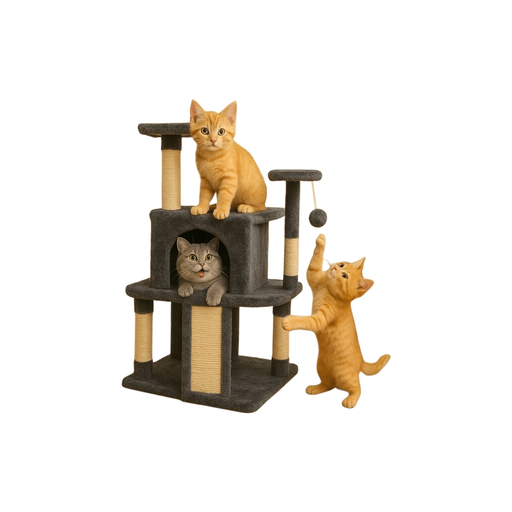
Why this model is a great fit: Ideal for smaller apartments or as an entry-level model. The design utilizes height to provide climbing, playing, and resting spots for cats up to 5 kg on a small footprint.
This model is specifically designed for smaller cats, thus avoiding the instability that occurs when large cats use compact trees. It offers the right features (condo, scratching surfaces) for its target group.
Combines a scratching post and a scratching board with a semi-enclosed condo and play balls on a space-saving 43x43 cm footprint.
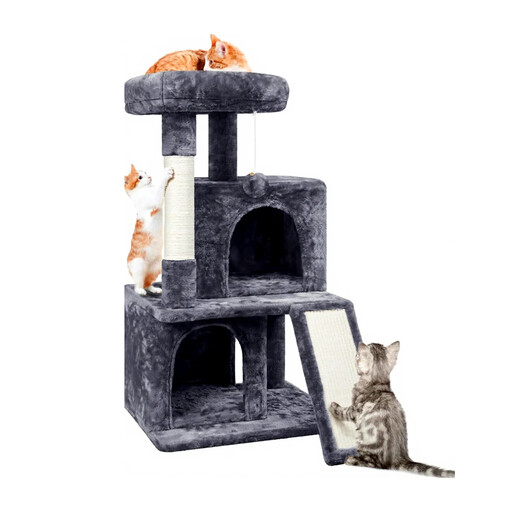
Why this model is a great fit: A well-balanced all-rounder for small to medium-sized cats. It offers a good mix of scratching surfaces, a cozy condo, and an observation perch.
Directly addresses the stability trap with a wide base plate and an included anti-tip kit for wall mounting. The materials (FSC-certified particleboard, sturdy sisal posts) are designed for durability.
Provides high stability through its construction and the additional wall anchor. The combination of a scratching board and sisal posts effectively redirects scratching behavior.
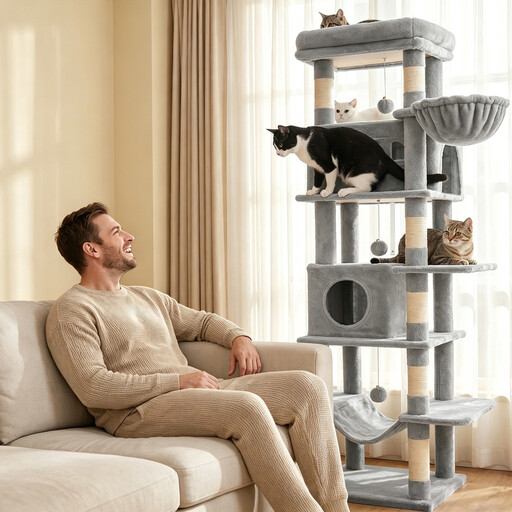
Why this model is a great fit: At 212.5 cm tall and built for up to 6 cats, this tree is ideal for large breeds and multi-cat households. It offers numerous levels, two condos, and a hammock.
The double-layered, integrated base lowers the center of gravity and massively improves stability. 17 thickened support posts and an anti-tip kit ensure the tree won't wobble, even when fully occupied.
The features, including 8 sisal posts, two condos, a hammock, and washable cushions, are explicitly designed for the needs of multiple cats, providing ample space and activity.
We have compiled a comprehensive, up-to-date list of products that meet these strict selection criteria.
Place the cat tree in a spot where the family often gathers, ideally with a view out the window. Make it more appealing with treats, catnip, or your cat's favorite toy. Praise your cat whenever they use the tree to create a positive association.
The ideal location is on a level, solid surface in a busy room. A spot near a window provides entertainment for your cat. Avoid placing the tree in a remote corner, as cats like to be part of the action. Ensure there are no hazards like loose cables nearby.
The lifespan heavily depends on the material quality and intensity of use. A high-quality, stable cat tree can last for several years. Regularly check it for stability and wear. The sisal posts, in particular, will wear out. On some models, individual posts or elements can be replaced, which extends the lifespan.