
Lieferung heute & morgen

Qualitätsgarantie

Willkommens-Angebote freischalten: KOSTENLOSE Lieferung | Bis zu 80 % RABATT | Kostenlose 30-Tage-JoyPlus-Testphase
App herunterladen
A cat tree is more than just a piece of furniture—it's an essential part of a fulfilling life for a cat. It serves as a playground, a sanctuary, and a tool for claw maintenance. However, choosing the right model can be a challenge given the many options available. Scratched furniture, under-stimulated cats, and unstable structures are common problems that result from an unsuitable choice.
This guide is designed to help you make an informed decision. We will present objective criteria and a selection of models designed for different needs and living situations, so you can find a durable and safe cat tree for your feline companion.
Selecting the right cat tree depends on several factors that go beyond mere appearance. To find a safe and long-lasting solution, you should consider the following points.
A stable cat tree is the fundamental prerequisite for your cat's safety. Look for a wide and heavy base plate that serves as a solid foundation. This is especially crucial for a large cat tree or models for large cats to prevent tipping during energetic leaps. Many taller models come with an anti-tip kit for wall mounting, the use of which is highly recommended. The thickness of the sisal posts also contributes to stability; thicker posts offer more resistance and a longer lifespan.
The ideal size of the cat tree depends on your cat and the available space. A tall climbing tree for cats with multiple levels is ideal for active and young cats who love to climb and observe their surroundings from above. For households with multiple cats, models with various lounging areas and condos are recommended to avoid conflicts over the best spots. A cat tree with a cave offers a sheltered retreat that is particularly appreciated by shy cats or those in need of quiet. For small apartments or as a supplementary piece, more compact models are suitable.
The quality of the materials influences both the durability and your cat's acceptance of the tree. The scratching posts should be tightly wrapped with robust, natural sisal so the cat can effectively sharpen their claws. The covering for the lounging areas is usually made of plush fabric. Look for a dense, soft quality that is easy to clean. The engineered wood boards used, often particleboard, should be sturdy and low in harmful substances (e.g., certified according to the E1 standard).
Based on the criteria mentioned, we have compiled a selection of models that cover different requirements—from a floor-to-ceiling play paradise to a compact solution for small rooms.
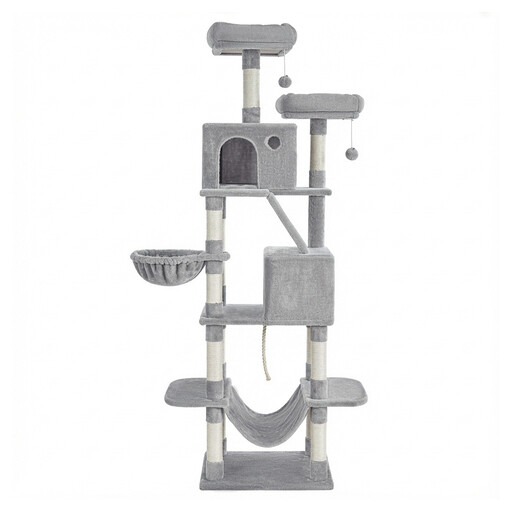
JOYFURNOS, Cat Tree, 206 cm Large Cat Tower
Why it stands out: At a height of 206 cm, this cat tree offers an exceptionally large vertical play area. Its diverse features make it a complete activity centre.
Pros:
Best for: Ideal for owners of multiple cats or very agile animals who are looking for a comprehensive climbing tree for cats with maximum vertical space.
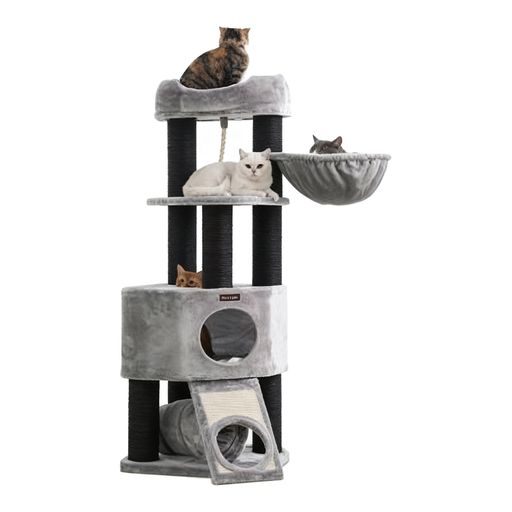
Ochama Medium Cat Activity Tower, 141 cm
Why it stands out: This model places a clear focus on stability. The construction is specifically designed to withstand the energy of large and heavy cats.
Pros:
Best for: An excellent choice for large cats or for owners whose top priority is an extremely stable cat tree that won't wobble even during intense use.
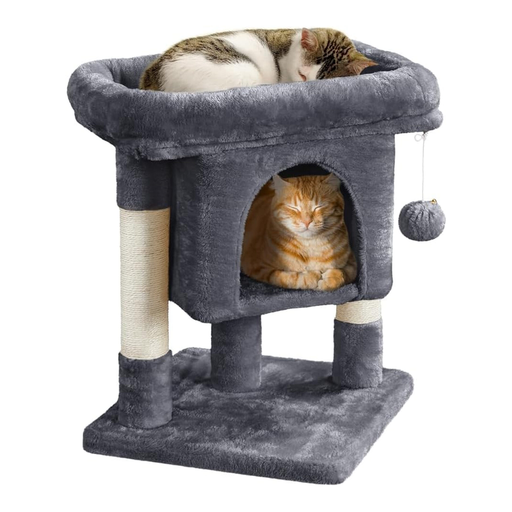
Yaheetech Cat Tree, 60cm, with Cave
Why it stands out: This model proves that a functional cat tree doesn't need much space. Its compact design integrates the most important features into a small footprint.
Pros:
Best for: Perfect for owners of kittens, small cat breeds, or as a second cat tree in another room. Also a great solution for apartments with limited space.
Every cat has its own personality, and every home has its own layout. If the models presented here don't exactly match your requirements, there are many other configurations to discover. From modular systems to special designs with integrated playhouses, the selection is vast.
Explore our wider selection of cat trees with a playhouse to find more models and variations that are a perfect fit for you and your cat.
The ideal location is a place where the family often gathers, such as the living room. Cats are social animals and enjoy watching what's going on. A spot by a window is also very popular as it offers a view of the outdoors. Do not place the cat tree in a remote corner, as it may not be used.
Make the cat tree interesting. Place treats or your cat's favourite toy on the different levels. You can also play with a wand toy on and around the tree to create positive associations. Rubbing some catnip on the sisal posts can also pique their curiosity and encourage scratching.
A cat tree should be replaced when it becomes unstable or the sisal posts are so worn out that the cat can no longer sharpen its claws on them. If the plush fabric comes loose or wooden parts splinter, action is also needed to avoid the risk of injury. On many models, individual sisal posts can be purchased as replacement parts and swapped out, which extends the life of the entire cat tree.