
Lieferung heute & morgen

Qualitätsgarantie

Willkommens-Angebote freischalten: KOSTENLOSE Lieferung | Bis zu 80 % RABATT | Kostenlose 30-Tage-JoyPlus-Testphase
App herunterladen
A cat tree is far more than just a piece of furniture for your cat. It is an essential component for the well-being of indoor cats, offering opportunities to climb, scratch, and retreat, all while protecting your furniture. However, the market is overwhelming, and many models don't live up to their promises. An unstable or unsuitable cat tree is not only ignored by cats but can also pose a safety hazard.
As a Joybuy Product Recommendation Officer, I analyse product information daily to provide you with objective and practical advice. In this guide, I will show you the most common pitfalls to avoid and the critical features you should look for to make a durable and species-appropriate choice for your feline friend.
Many cat owners invest in a cat tree that becomes unusable after a few months or is completely ignored by their cat. This is often due to three common flaws that are not always obvious at first glance.
To avoid a bad purchase, you should check three core technical parameters before making a decision. These are the primary determinants of the cat tree's durability, safety, and acceptance.
Stability is the be-all and end-all. A safe cat climbing tree is characterised by the following features:
The materials used determine how long your cat will enjoy its tree.
Every cat and every household has different requirements. Instead of a one-size-fits-all recommendation, we've matched products based on specific user profiles.
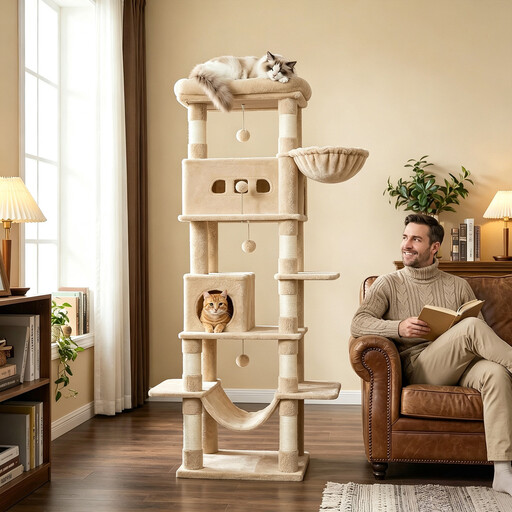
Why This Fits Their Persona: With a height of over 2 metres and a thoughtful layout, this model is designed for up to 6 cats. Two condos, a hammock, and a large viewing platform provide enough separate areas to prevent rivalries and meet the needs of large breeds.
Directly addresses the stability problem with a thickened, widened base plate and an anti-tip device. The 8 posts, fully wrapped in sisal, counteract the issue of low-quality scratching surfaces.
Ample space across six levels; removable and washable cushions for easy cleaning.
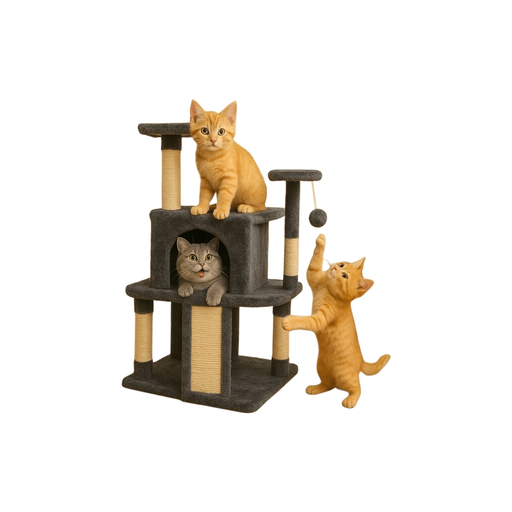
Why This Fits Their Persona: With a small footprint of just 43x43 cm, this model makes optimal use of vertical space. It's ideal for smaller apartments and provides all the essentials across three levels: a semi-enclosed condo, scratching posts, and play balls for cats up to 5 kg.
Solves the "incorrect sizing" problem for small spaces. Instead of focusing on width, it offers height and variety on a compact base without appearing cluttered.
Combines a scratching post, scratching board, and condo on a minimal footprint; good vertical structure for climbing fun.
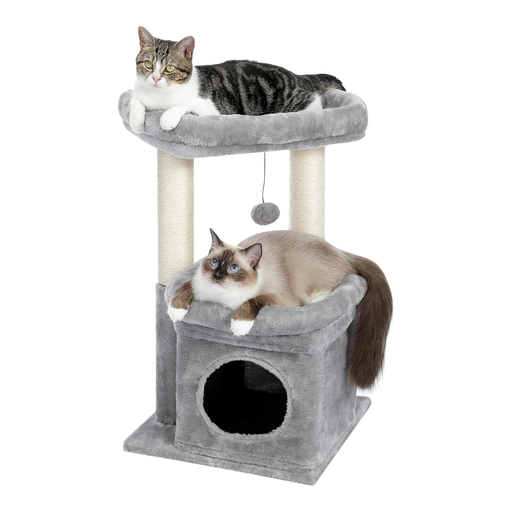
Why This Fits Their Persona: This compact model is an excellent choice for getting kittens accustomed to a cat tree, or as a secondary tree in another room. It provides a scratching surface, a condo, and a perch without taking up much space.
It avoids the mistake of trying to do too much. As a focused, entry-level model, it reliably fulfils its core functions (scratching, resting) instead of being an unstable, overloaded activity centre.
Very compact dimensions and simple assembly; padded perch with a raised edge for a greater sense of security.
We've compiled a complete, up-to-date list of products that fully meet these strict selection criteria and relevant regulations.
1. Where is the best place to put a cat tree? The ideal location is a place where the family often gathers, such as the living room. Cats love to survey their surroundings, so a spot near a window is often very popular. Avoid placing the tree in a narrow hallway or an isolated room, as it will likely be used less there.
2. How can I get my cat used to the new cat tree? Patience is key here. Never force your cat onto the tree. Instead, make it appealing by playing with a toy on it, hiding treats on the different levels, or using a little catnip spray. Praise your cat as soon as it starts to explore or scratch the tree on its own.
3. What is the proper way to clean a cat tree? Regular cleaning is important for hygiene. Cat hair is most easily removed with a vacuum cleaner using an upholstery attachment. For stains on the plush cover, a damp cloth with a mild detergent is usually sufficient. Before buying, check if the cushions or covers are removable and washable—this makes maintenance much easier. Also, regularly check that all screw connections are tight.