
Lieferung heute & morgen

Qualitätsgarantie

Willkommens-Angebote freischalten: KOSTENLOSE Lieferung | Bis zu 80 % RABATT | Kostenlose 30-Tage-JoyPlus-Testphase
App herunterladen
A cat tree is more than just a piece of furniture for cats. It's a climbing paradise, a secure retreat, and an essential tool for claw care that can protect your furniture from scratches. But the market is overwhelming, and many models don't live up to their promises. An unstable cat tree can quickly become a hazard, while inferior materials become unusable after a short time.
As your Joybuy Product Recommendation Officer, I'll help you recognise the common pitfalls and make an informed decision. This guide focuses on the objective criteria that define a durable and species-appropriate cat tree.
Many cat owners invest in a cat tree that turns out to be a bad buy within a few months. Watch out for these three common problems to avoid disappointment:
large cat tree or for active, heavy cats.cat tree with a den that might fit a kitten are often unusable for a full-grown cat or a large cat, as they cannot stretch out or turn around comfortably.To avoid a bad buy, you should focus on three core technical features. These determine the durability, safety, and acceptance by your cat.
The foundation for any sturdy cat tree is its base. A heavy and large base plate lowers the centre of gravity and prevents the tree from wobbling as your cat climbs. As a rule of thumb: the taller the cat tree, the wider and heavier the base should be. For floor-to-ceiling models or an XXL cat tree, an additional anti-tip kit for securing it to the wall is an indispensable safety feature, especially in households with children or very agile pets.
The posts not only serve for claw maintenance but also provide structural stability. Look for a post diameter of at least 8 cm; for a cat tree for heavy cats, 10 cm or more is recommended. It is also crucial that the posts are completely and tightly wrapped with durable natural sisal. This provides the necessary resistance for claw care and ensures a long lifespan for the scratching furniture.
Cats love to observe their surroundings from elevated positions and retreat to safe places. Check the dimensions of the platforms, hammocks, and dens. A lounging area should be large enough for an adult cat to stretch out completely. For a cat tree for multiple cats, several generous resting spots on different levels are ideal to avoid conflicts and provide each animal with its own space.
Based on the quality criteria mentioned, we have identified some models that are suitable for different needs and living situations.
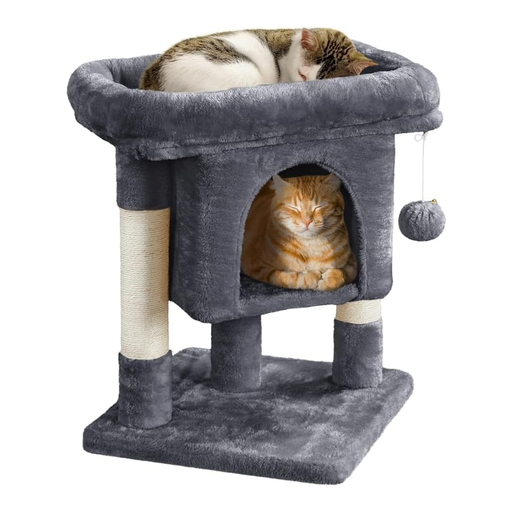
Why This Fits Their Persona: This model is an excellent solution for smaller apartments or as a first cat tree for young cats. It provides all the basic functions—scratching, sleeping, and observing—within a small footprint.
Despite its compact size, the tree features a square, stable base plate and two full-size sisal posts. It thus avoids the pitfall of many small models that skimp on stability and scratching surface.
Space-saving design with an integrated den and lookout perch. According to the manufacturer, the materials are based on FSC-certified engineered wood.
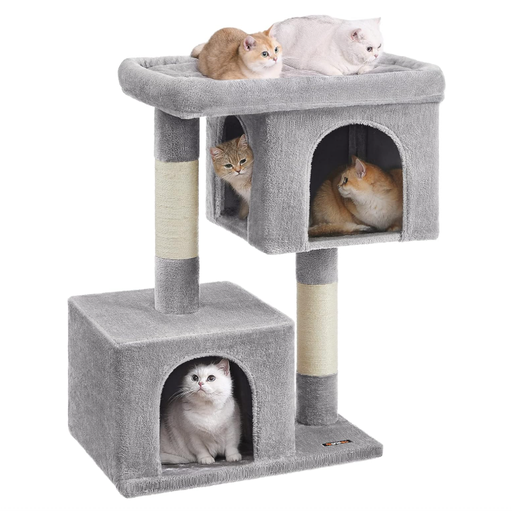
Why This Fits Their Persona: This model was specifically designed for the needs of large breeds like Maine Coons or for households with multiple heavy cats. According to the manufacturer, its load capacity is rated for pets up to 20 kg.
It directly addresses the pitfalls of "instability" and "improper dimensions." The posts have a diameter of 11 cm, the top perch measures 68 x 48 cm, and an anti-tip kit is included.
Reinforced construction with thick posts and a large base plate. Extra-large perches and two spacious dens suitable even for large cats.
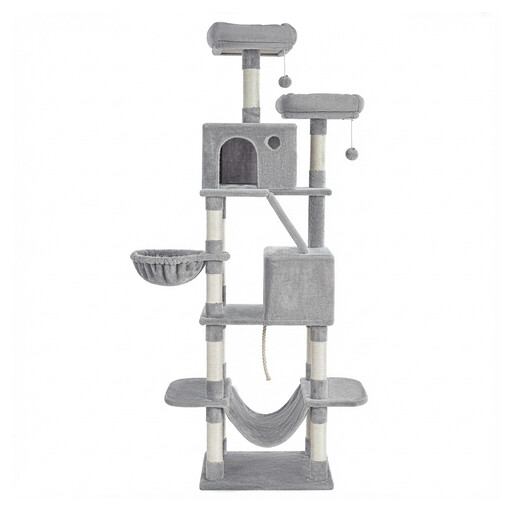
Why This Fits Their Persona: This `cat climbing tree` is a vertical playground. At over two meters tall and with a multitude of features, it offers ample space and variety for several very active cats who love to climb and play.
The reinforced base plate and included anti-tip kit counteract the instability of tall trees. With 13 sisal posts and an additional scratching ramp, it avoids the pitfall of inadequate scratching surfaces.
Tremendous variety with 2 dens, 2 lookout perches, a basket, a hammock, and toy balls. Its high static load capacity of up to 75 kg (according to the manufacturer) makes it ideal for multi-cat households.
We have compiled a complete, up-to-date list of products that fully meet these strict selection criteria and safety standards.
Place the cat tree in a spot where your cat likes to spend time, such as near a window or in the living room. Make the tree more appealing by attaching toys to it or placing treats on the different levels. You can also rub some catnip on the sisal posts to spark their interest in scratching. Avoid forcing your cat; patience is key.
A stable cat tree for heavy cats is characterized by several features: a very large and heavy base plate, thick posts (over 10 cm in diameter), robust screw connections, and ideally, an included anti-tip kit for wall mounting. Check the product description for information on the maximum load capacity.
The lifespan of a cat tree depends heavily on the quality of the materials and the intensity of use. A high-quality model can last for several years. A replacement is necessary when stability decreases (e.g., due to loosened connections that can no longer be tightened) or when the sisal posts are so worn down that the cat can no longer use them for claw care. On many models, individual sisal posts can also be replaced separately.