
Lieferung heute & morgen

Qualitätsgarantie

Willkommens-Angebote freischalten: KOSTENLOSE Lieferung | Bis zu 80 % RABATT | Kostenlose 30-Tage-JoyPlus-Testphase
App herunterladen
Time for a new cat tree? That's a great decision for your cat's well-being and the protection of your furniture. But the selection is vast, and not every model that looks good at first glance lives up to its promise in daily use. Many cat owners know the disappointment: an expensive cat tree becomes unstable after a short time, the materials wear out, or the cat ignores it completely.
As your Joybuy Product Recommendation Officer, I'm here to help you avoid the common pitfalls. We'll focus on the objective features that define a durable cat tree that meets your cat's natural needs, ensuring your investment pays off in the long run.
The 3 most common flaws that make a cat tree useless:
To avoid a bad buy, you should check three core parameters before making a decision. These will determine whether a cat tree is suitable for your cat and your living situation.
Stability is the most important criterion, especially if you're looking for a cat tree for large cats or multiple pets. A sturdy cat tree is characterized by the following features:
The quality of the materials determines how long you and your cat will enjoy the new piece of furniture.
The ideal size depends on the number of your cats, their age and character, and the available space.
Here are some models that represent a considered choice for different requirements and households, based on their objective features.
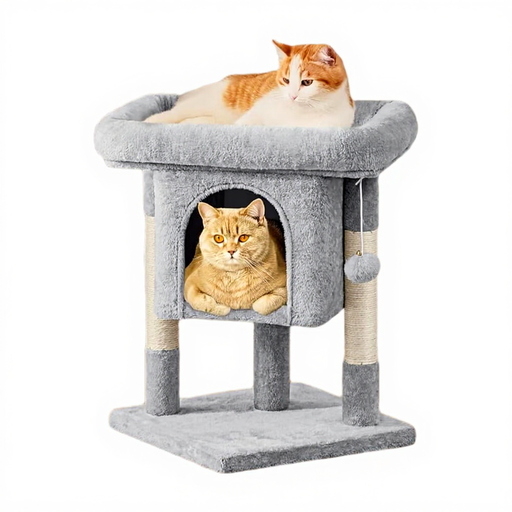
Why This Fits Their Persona: This model is ideal for small spaces or as a first cat tree for kittens. It offers all the essential features in a compact footprint—a secure condo, a lounging perch, and scratching opportunities—without overwhelming the room.
It avoids the "impractical design" trap by offering a cozy condo and a hammock as a genuine retreat for young or small cats, despite its small size.
Space-saving design measuring 40.5 x 40.5 x 59 cm. Provides a great starter set of features with two sisal posts, a condo, and a hammock.
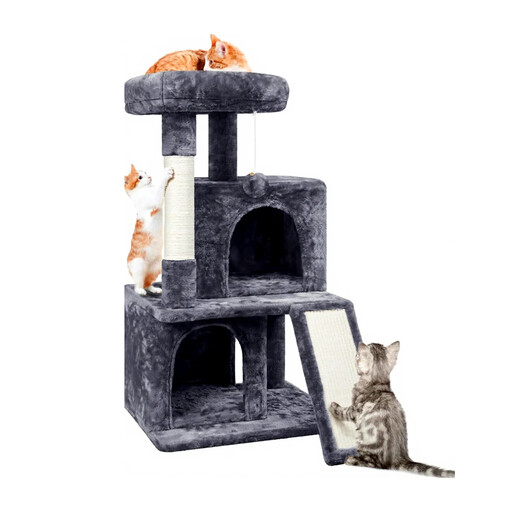
Why This Fits Their Persona: A well-balanced model for the average cat household. It offers a good mix of activity and rest with two condos, a viewing platform, and a scratching board, without taking up too much space.
Directly addresses the "wobbly structure" trap with a wide base plate and an included anti-tip kit for wall mounting, ensuring high safety.
High stability thanks to a wide base and anti-tip anchor. FSC-certified particleboard and robust sisal posts ensure a long service life.
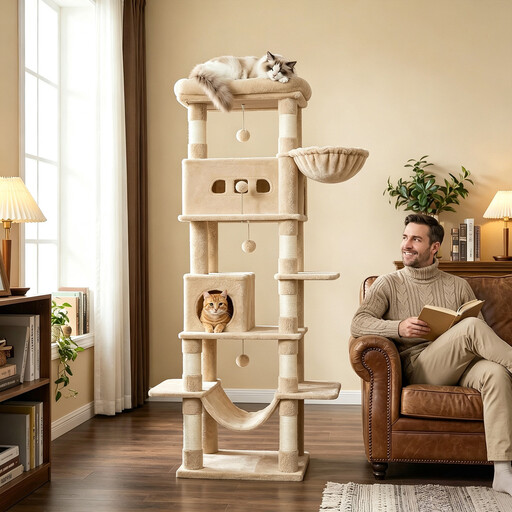
Why This Fits Their Persona: This floor-to-ceiling model is designed for households with multiple cats or large breeds like Maine Coons. With two condos, a hammock, and a large viewing platform, it provides enough separate areas to minimize territorial disputes.
Solves the problems of instability and short lifespan with a thickened, reinforced base, 8 sisal posts, and an anti-tip kit. The structure is designed to withstand the weight and activity of 5-6 cats.
Maximum stability and spatial division for multiple cats. The large viewing platform (60x40 cm) with removable cushions is also suitable for large breeds and is easy to clean.
We've compiled a complete, up-to-date list of products that fully meet these strict selection criteria and safety regulations.
Place the cat tree in a spot where your cat likes to hang out, such as near a window or in the living room. Make it more appealing by attaching toys or placing treats on the different levels. You can also rub some catnip on the scratching surfaces to spark curiosity. Never force your cat onto the tree; let them explore it at their own pace.
Regular cleaning is important for hygiene. Hair and dust are best removed with a vacuum cleaner. Stains on the plush can be treated with a damp cloth and a mild soap solution. Avoid soaking the fabric. For models with removable cushions, these can often be washed separately. The sisal posts can be brushed as needed to remove loose fibers.
A replacement is necessary when safety is no longer guaranteed. Look for these signs: The tree becomes unstable and wobbles excessively, even after tightening the screws. The sisal posts are so worn that the underlying material (often cardboard or plastic) is exposed. Platforms or condos are broken, or the fabric is severely damaged. As a rule, a high-quality cat tree will last for several years with average use.