
Lieferung heute & morgen

Qualitätsgarantie

Willkommens-Angebote freischalten: KOSTENLOSE Lieferung | Bis zu 80 % RABATT | Kostenlose 30-Tage-JoyPlus-Testphase
App herunterladen
A cat tree is more than just a piece of furniture for cats. It serves as a playground, a sanctuary, and an essential tool for claw maintenance. A cat's natural instinct to scratch cannot be suppressed—without a suitable alternative, your sofas, wallpaper, or carpets will quickly fall victim. However, the sheer variety of models can be overwhelming.
As your Joybuy Product Recommendation Officer, I'm here to help you identify the key features. This guide provides objective criteria to help you find a cat tree that meets your cat's needs and blends harmoniously into your home.
Before you make a decision, three central aspects should be considered: stability, size, and material. These factors determine whether your cat will accept the tree and how long it will last.
A stable cat tree is the fundamental requirement for your cat's safety. A wobbly model can quickly become a hazard, especially for active or large pets. Look for a wide and heavy base plate that serves as a solid foundation. For floor-to-ceiling or very large models, an additional wall mount (anti-tip kit) is a wise addition to prevent it from toppling over during wild leaps. This is particularly crucial for a cat tree for large cats like Maine Coons or Ragdolls.
The right size depends on the number of cats you have, their age and activity level, and the space you have available.
The quality of the materials significantly impacts the cat tree's lifespan. The posts should be wrapped in durable sisal. This natural material is resilient and perfect for daily claw care. The perches, caves, and hammocks are usually covered in soft plush for comfort. Check that the sisal ropes are securely glued and the plush covers are neatly finished.
Based on the criteria mentioned, we have compiled a selection of models that cover different requirements.
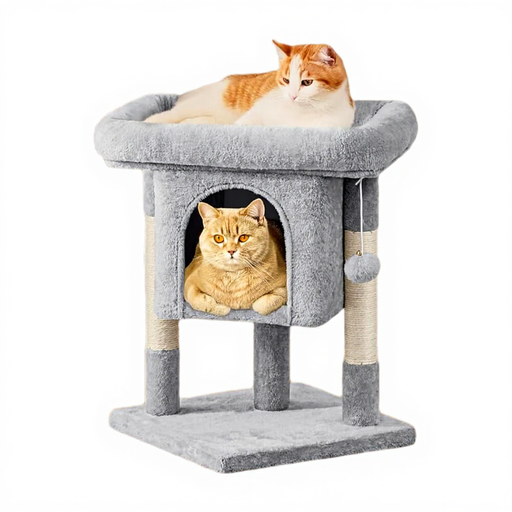
Why it stands out: This model combines a compact design with all the essential elements. It offers a cave, a hammock, and scratching posts on a small footprint, making it a well-designed solution for limited spaces.
Advantages:
Who it's for: This model is a great choice for owners of kittens or small cat breeds who live in an apartment with limited space but still want to provide a fully equipped oasis for play and rest.
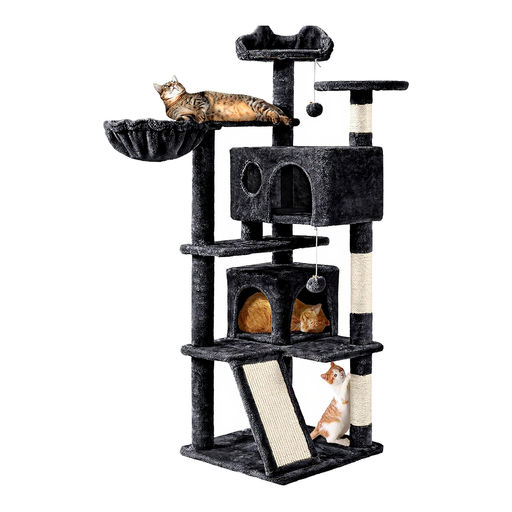
Why it stands out: With its multi-level structure, two caves, and three viewing platforms, this climbing tree is a versatile piece of cat furniture. It supports a range of activities like climbing, scratching, and sleeping, and is designed for various cat sizes. The included anti-tip kit provides extra stability.
Advantages:
Who it's for: Ideal for households with one or more active cats looking for a versatile cat climbing tree with various zones for play and rest. It is suitable for small, medium, and large cat breeds.
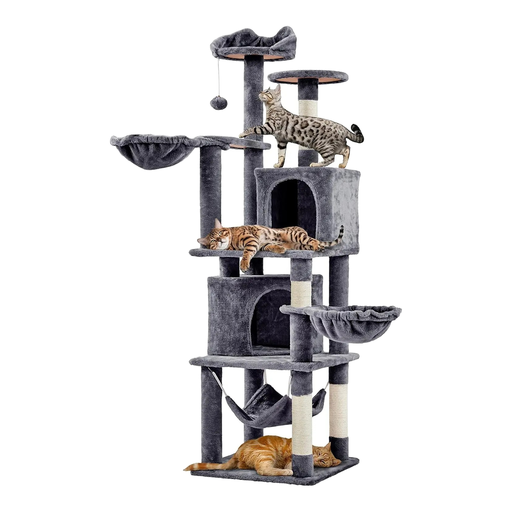
Why it stands out: At almost 175 cm tall and with its extensive features, this XXL model is specifically designed for the needs of large cat breeds and multi-cat households. Two perch beds, two caves, and a hammock offer plenty of space for everyone.
Advantages:
Who it's for: An excellent choice for owners of large cat breeds like Maine Coons or Norwegian Forest Cats, as well as for multi-cat households that need a large and stable cat tree that can accommodate all their pets.
Some cat trees offer the advantage of easily replaceable parts, such as worn-out sisal posts or perches. This increases the product's longevity and is more sustainable. Discover our selection of cat trees with replaceable scratching parts to find a long-lasting solution for your home.
Place the cat tree in an area where your cat often spends time. Make it more appealing with toys, treats, or a little catnip. You can also gently take your cat's paws and mimic a scratching motion on the sisal post. Praise your cat whenever they use the tree on their own.
The ideal location is a room where the family frequently gathers, such as the living room. A spot near a window offers your cat an exciting view. Avoid placing the tree in a remote corner, as it might be ignored. It should be positioned along your cat's natural pathways through the house.
A replacement is necessary if the cat tree becomes unstable and can no longer be tightened, the sisal posts are completely worn out, or the plush fabric is heavily damaged. Regularly check its stability, especially the screw fittings, to ensure your cat's safety.