
Lieferung heute & morgen

Qualitätsgarantie

Willkommens-Angebote freischalten: KOSTENLOSE Lieferung | Bis zu 80 % RABATT | Kostenlose 30-Tage-JoyPlus-Testphase
App herunterladen
A cat tree is more than just a piece of furniture for cats; it is an essential component for the well-being of indoor cats. It serves for claw maintenance, as a climbing and play structure, and as a safe retreat. However, the market is saturated, and many models turn out to be a poor investment. Before you make a decision, it's important to know the typical weak points that often only become apparent after a few weeks of use.
This guide focuses on the objective criteria that define a durable and species-appropriate cat tree, helping you to distinguish marketing promises from genuine quality.
Many cat owners invest in a cat tree only to find that it doesn't stand up to daily wear and tear. Watch out for these three common problems to avoid a bad purchase:
To ensure your new cat tree is a worthwhile investment, you should check three main technical features. These define the product's durability, safety, and functionality.
A stable cat tree is the absolute prerequisite. Stability is primarily determined by two factors:
The longevity of a cat tree depends directly on the materials used.
Calling a large cat tree "large" refers not only to its overall height. More important are the usable dimensions of the individual elements.
Based on the quality criteria mentioned, we have identified some models that are suitable for different needs and living situations.
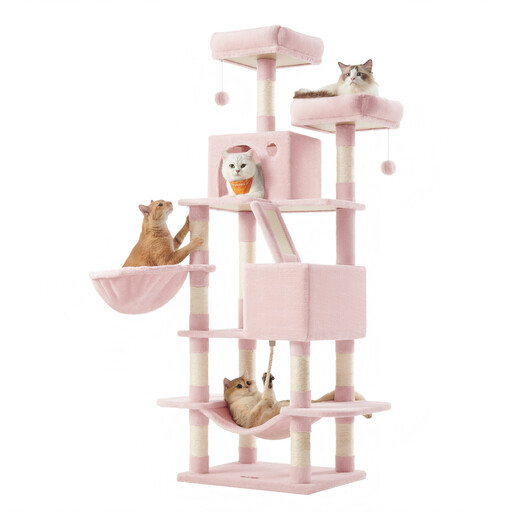
Why this model is a great fit: This model is designed for households with multiple or very large cats. With two condos, two platforms, a hammock, and a basket, it offers enough separate resting and observation spots to prevent conflicts. The height of 168 cm encourages natural climbing behaviour.
The reinforced base plate and the included anti-tip kit counteract the instability trap. The 13 posts wrapped in natural sisal provide ample scratching surface and prevent premature wear and tear. The generously sized lounging areas are also suitable for large cat breeds.
High static load capacity of up to 65 kg according to the manufacturer. With its multitude of elements, it provides a comprehensive environment for activity and retreat for several animals at once.
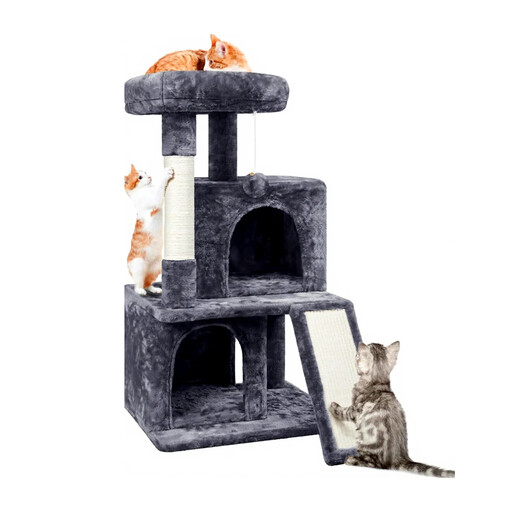
Why this model is a great fit: With a height of 91 cm and a footprint of 49 x 45.5 cm, this cat tree offers a great compromise between functionality and space requirements. It is suitable for single cats in apartments where space is limited, but essential features like a condo and an observation deck are still desired.
The wide base plate and the included anti-tip kit provide the necessary stability. The posts are wrapped with robust sisal, and the construction is based on FSC-certified particleboard, which counteracts the low-quality material trap.
Compact design that combines all basic functions (scratching, sleeping, observing) within a small footprint. Includes a scratching ramp on the base for additional claw care.
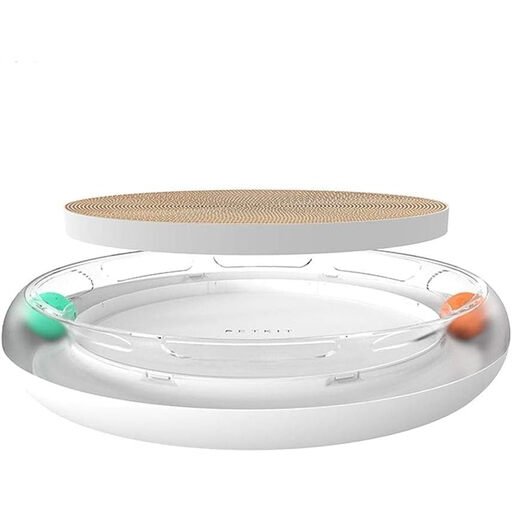
Why this model is a great fit: This product is not a classic climbing tree but a multifunctional activity centre. It is ideal for owners who want to provide maximum engagement in a minimal space, or as a supplement to an existing cat tree. It satisfies the instincts for scratching, hunting, playing, and hiding.
As a low-profile toy, the stability issue of tall trees is eliminated. It bypasses the short-lived material trap by offering the ability to replace individual components like the scratching pad, which extends the life of the overall product.
4-in-1 functionality (scratching pad, ball track, teaser toy, condo) in a very compact design (44 x 44 cm). The interchangeability of wear-and-tear parts offers excellent long-term value.
Sometimes, a traditional cat tree isn't the only solution. For cats that prefer horizontal scratching surfaces or as a supplement to a climbing tree, other specialized products are available.
The ideal height depends on your cat's age, health, and activity level. However, as a minimum, a cat tree should have at least one continuous scratching post of 80-90 cm in height, allowing an adult cat to fully stretch while scratching. For active cats that love to climb, taller, multi-level models or floor-to-ceiling cat trees are a great choice.
Place the cat tree in a location where your cat frequently spends time, such as the living room or near a window. Make the tree attractive by placing treats or toys on the different levels. You can also rub some catnip on the sisal posts to spark interest. Praise your cat whenever they use the tree.
Regular cleaning is important for hygiene. Cat hair is most easily removed with a vacuum cleaner using an upholstery attachment. Stains on the plush cover can be treated with a damp cloth and a mild soap solution. Avoid saturating the fabric. The sisal posts can be brushed to remove dust and loose fibres if necessary.