
Lieferung heute & morgen

Qualitätsgarantie

Willkommens-Angebote freischalten: KOSTENLOSE Lieferung | Bis zu 80 % RABATT | Kostenlose 30-Tage-JoyPlus-Testphase
App herunterladen
A cat tree is more than just a piece of furniture for cats; it's an essential part of a species-appropriate lifestyle, especially for indoor cats. It satisfies their natural instincts to scratch, climb, and play, provides a safe retreat, and protects your furniture at the same time. However, the selection is vast, and making a choice can be overwhelming.
As your Joybuy Product Recommendation Officer, I've made it my mission to offer you clear and objective guidance. This guide will help you understand the key features of a good cat tree and make an informed decision that suits both your cat's needs and your living space.
To find the right climbing tree for your cat, several fundamental criteria should be considered. These three points are crucial for making a good choice.
A stable cat tree is the most important prerequisite for your cat's safety. A wobbly model will be avoided by cats and, in the worst case, could tip over. Look for a heavy, wide base plate that serves as a solid foundation. High stability is essential, especially for a large cat tree or a model intended as a cat tree for multiple cats. Many models come with an anti-tip kit for wall mounting, which provides additional security. The thickness of the posts also contributes to stability.
The ideal size depends on your cat and the available space. Active and young cats often prefer a tall climbing tree for cats that allows them to climb and observe from a height. Older or calmer cats might be content with a smaller model.
The features should match your cat's preferences. A cat tree with a hammock and condo offers both cosy sleeping spots and secure retreats. Observation platforms at different heights are ideal for curious pets, while toys like pompoms or ropes stimulate their play instinct.
The longevity of a cat tree is largely determined by the quality of its materials. The scratching posts should be fully and tightly wrapped with durable sisal. This is the preferred material for claw maintenance. The plush covering should be hard-wearing and securely attached to withstand intensive use. Look for a clean finish without any protruding screws or sharp edges.
Based on the criteria above, we have compiled a selection of models that cover different needs.

Why It Stands Out This mid-sized model offers a variety of features on a compact footprint. At 143 cm tall, it combines climbing opportunities with cosy rest areas, making it a versatile all-rounder.
Advantages
Who It's For This model is a great choice for households with one or two smaller cats. It offers a balanced mix of play, scratch, and sleep options without taking up too much space.
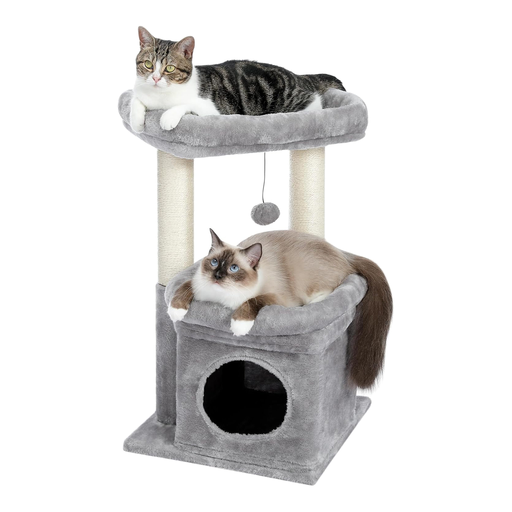
Why It Stands Out This compact cat tree focuses on the essentials: a comfortable lounging area and sturdy scratching posts. Its low height makes it ideal for small rooms or as a supplement to a larger cat tree.
Advantages
Who It's For Ideal for cat owners with limited space, for kittens, or for cats that don't prefer great heights. It also works perfectly as a secondary cat tree in another room.

Why It Stands Out At 168 cm tall and with extensive features, this large cat tree is specifically designed as a cat tree for multiple cats. It offers enough space and activities for a multi-cat household.
Advantages
Who It's For This model is the right choice for owners of multiple cats, large breeds, or very active pets who need a comprehensive play and retreat area.
If these recommendations don't include the perfect model for you, or if you prefer a different size, colour, or set of features, you're sure to find a suitable alternative in our wider selection.
Explore our entire collection of Cat Trees with Play Towers.
Place the new cat tree in a spot where your cat likes to spend time, such as the living room. Make it more appealing by placing toys on it or rubbing some catnip on the sisal posts. Praise your cat when they use the tree. Patience is key here.
The height depends on your cat's activity level and age, as well as the available space. For most cats, a height of at least 130 cm is ideal, as they enjoy surveying their surroundings from above. However, more important than the absolute height is that the cat tree is stable and offers various levels for climbing and resting.
Hair is best removed regularly with a vacuum cleaner or a lint roller. Stains on the plush can be treated with a damp cloth and a mild soap solution. Be careful not to soak the fabric. The sisal posts can be cleaned with a brush if necessary.