
Lieferung heute & morgen

Qualitätsgarantie

Willkommens-Angebote freischalten: KOSTENLOSE Lieferung | Bis zu 80 % RABATT | Kostenlose 30-Tage-JoyPlus-Testphase
App herunterladen
A cat tree is a functional piece of cat furniture that addresses a cat's fundamental behavioural needs. It not only serves for claw maintenance but also provides vertical climbing surfaces, private retreats, and observation posts. Selecting the right model depends on objective criteria such as stability, the materials used, the size of the cat, and your available space. An informed decision not only protects your furnishings but also promotes your pet's well-being.
The selection of a suitable cat tree is based on technical specifications and functional features. The following parameters are relevant for making a rational purchasing decision.
Stability is the primary safety feature. A sturdy cat tree prevents tipping, especially with active or heavy cats.
Durability and acceptance by the cat are heavily dependent on the materials.
The dimensions and layout should suit the available space and the number and size of your cats.
Based on an analysis of product specifications and functional design, here are three models with different specialisations.

Why We Recommend It: This model combines an impressive height of 168 cm with a multitude of functional areas. With 13 separate sisal scratching posts and an additional scratching ramp, it offers an exceptional number of options for claw care. The inclusion of two condos, a hammock, a basket, and two observation perches makes it a complete activity centre. The specified total static load capacity of up to 65 kg indicates a robust construction designed for multiple cats.
Pros:
Best For:
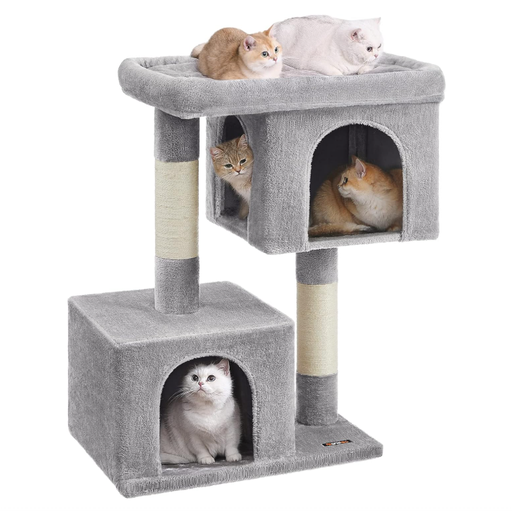
Why We Recommend It: This model is explicitly designed as a cat tree for large cats. The specifications substantiate this claim: a load capacity of up to 20 kg, a very large top perch (68 x 48 cm), and thick posts with an 11 cm diameter. The construction from sturdy particleboard and the included anti-tip kit are engineered to withstand the forces generated by large breeds like Maine Coons or Ragdolls. The two spacious condos also offer plenty of room for larger cats.
Pros:
Best For:

Why We Recommend It: With a height of 90 cm and a footprint of 49 x 44 cm, this cat tree is a space-saving option that still offers diverse functions. It integrates two fully sisal-wrapped posts, a scratching board, a top perch, a curved lounger, and a small play condo. A practical detail is the removable and washable mat on the top platform, which simplifies cleaning. The included replacement toy is a useful bonus.
Pros:
Best For:
If the focus is less on a large climbing structure and more on a dedicated, ground-level retreat, specialised products can be a sensible addition or alternative. You can find a selection of corresponding resting places in our Cat House Bed category.
1. How do I get my cat used to the new cat tree? Place the cat tree in an area where your cat frequently spends time. You can encourage acceptance by placing toys or treats on the different levels. Rubbing catnip on the sisal posts can also spark interest. Avoid forcing the cat to use the tree.
2. Where is the best place to put a cat tree? An ideal location is a spot from which the cat has a good view of the room, such as near a window (without access to tilted windows or cords) or in the living room. Placing it near furniture that was previously used for scratching can help redirect this behaviour to the tree.
3. How is a cat tree properly cleaned? Plush surfaces can be regularly cleared of hair with a lint roller or a vacuum cleaner. Stains should be spot-cleaned with a damp cloth and a mild soap solution. Periodically check all screw connections for tightness and retighten them as needed to ensure long-term stability.