
Lieferung heute & morgen

Qualitätsgarantie

Willkommens-Angebote freischalten: KOSTENLOSE Lieferung | Bis zu 80 % RABATT | Kostenlose 30-Tage-JoyPlus-Testphase
App herunterladen
As a Joybuy Product Recommendation Officer, I see cat owners trying to make the right choice for their pets every day. A cat tree is more than just a piece of furniture; it's an essential part of a cat's environment, especially for indoor-only cats. It serves for claw maintenance, as a playground, and as a safe retreat. But the market is flooded with models whose weaknesses often only become apparent after a few weeks. This guide will help you navigate the common pitfalls and make a durable, safe choice.
Many well-intentioned purchases end in disappointment because fundamental flaws were overlooked. Pay special attention to these three points to avoid wasting your money:
cat tree that sways with every jump will be avoided by cats for safety reasons. The causes are often a base plate that is too light or too small and posts that are too thin. For active or large cats, this can even pose a danger.cat tree unsightly.cat climbing tree must match the size and behaviour of the animal. If the lounging areas are too small, the condos too tight, or the posts too short for a full-body stretch, the cat will only reluctantly accept the tree and may turn back to your furniture.To avoid the problems mentioned above, you should carefully check three technical aspects before buying. These largely determine the longevity and acceptance of the cat tree.
Making a cat tree stable is a matter of physics. The most important factor is a heavy and wide base plate, which lowers the centre of gravity of the entire structure. As a rule of thumb: the taller the cat tower, the larger and heavier the base must be.
Another crucial point is the diameter of the posts. A thick scratching post (typically 8 cm in diameter or more) offers significantly more resistance to the forces generated during jumping and climbing. For a large cat tree or a model for multiple cats, this is a non-negotiable criterion. For very tall models, an additional wall anchor, which is often included, is essential to ensure safety.
The quality of the sisal is crucial for the main function of scratching. Look for thick, firmly glued, and seamlessly wrapped sisal rope. It should be rough and durable to allow for effective claw care over a long period.
The plush cover should have a high fabric density (specified in g/m?) to be robust against claws and cleaning. The underlying boards are usually made of wood-based materials. MDF or sturdy particleboard are a solid foundation here, whereas very thin or low-quality pressboard can break under stress.
The features should meet your cat's needs. A cat tree with a condo offers a protected retreat, which is important for many animals. The hammocks and observation platforms should be large enough for a fully grown cat to stretch out comfortably. This is especially important when choosing a cat tree for large cats like Maine Coons or Norwegian Forest Cats. A small cat tree may be sufficient for kittens or as a second tree, but it should still offer stable scratching options.
Based on the objective criteria mentioned above, we have identified some models that are suitable for different households and needs.
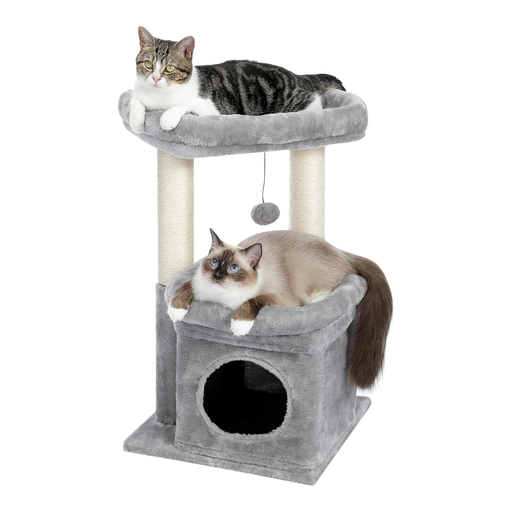
Why It's a Match: Ideal for small apartments or as a secondary tree. It provides the essential functions—scratching, sleeping, and observing—with a minimal footprint, without cluttering your living space.
It avoids the pitfall of improper sizing for its purpose. Instead of being a "large" tree that's too small, it's a well-designed, compact cat tree with a sufficiently large perch (40x30 cm) and two full-fledged sisal posts.
Combines a cosy condo and an elevated perch on a very small base. The materials are based on CARB-certified boards.
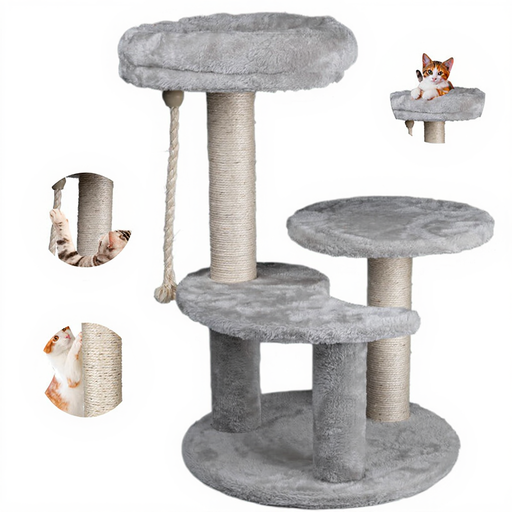
Why It's a Match: This model offers multiple levels and a play rope at a medium height, making it a great choice for young, playful cats or households with two smaller cats that love to climb and interact.
It bypasses the stability trap with a three-post design that distributes weight over a wider base. This makes it more stable than many single-post models of a similar height.
Offers plenty of variety in a compact space with 3 platforms and a play rope. The two sisal-wrapped posts provide ample scratching surface.
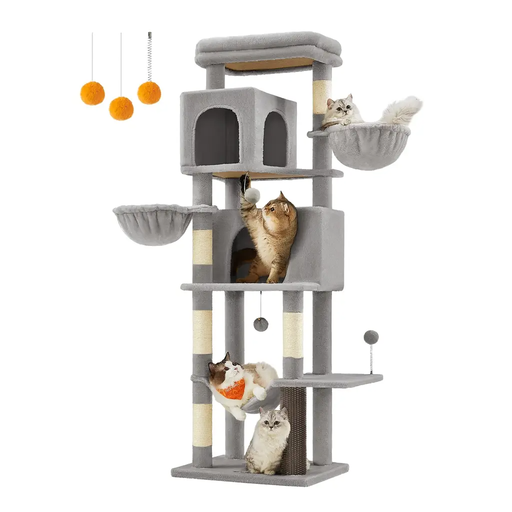
Why It's a Match: This floor-to-ceiling `cat tower` is specifically designed for the demands of multi-cat households or `large cats`. It offers numerous perches, condos, and scratching posts, minimizing conflicts over resources.
It directly addresses the biggest weakness of tall cat trees—instability—through a solid particleboard construction and an included anti-tip kit for secure wall mounting. This is essential for a tree of this height.
Extensive features with 2 condos, 2 hammocks, a hanging basket, and multiple scratching posts. The tall design satisfies cats' natural instinct to climb and observe.
We've compiled a complete, up-to-date list of products that meet these strict selection criteria and safety requirements.
Place the cat tree where the family often gathers, such as the living room. Cats are social animals and enjoy watching what's going on. A spot near a window provides additional entertainment. Avoid putting the tree in a remote corner, as it might be ignored there.
Make the new tree interesting. You can spray it with catnip, place favourite toys on it, or hide treats on the different levels. Praise your cat extensively when it uses the tree. Never force your cat onto the tree; let it explore at its own pace.
The lifespan heavily depends on the material quality and the intensity of use. A high-quality, stable cat tree can last for several years. The parts that experience the most wear are the sisal posts. On some models, these posts can be replaced individually when worn out, which significantly extends the life of the entire piece of furniture.