
Lieferung heute & morgen

Qualitätsgarantie

Willkommens-Angebote freischalten: KOSTENLOSE Lieferung | Bis zu 80 % RABATT | Kostenlose 30-Tage-JoyPlus-Testphase
App herunterladen
A cat tree is more than just a piece of furniture for cats; it is an essential component for the well-being and species-appropriate environment of our feline friends. It serves as a climbing paradise, an observation deck, a private retreat, and, of course, a necessary tool for claw maintenance. However, the market is saturated, and many models quickly turn out to be a bad buy. Wobbly structures, low-quality materials, and impractical designs often lead to the expensive climbing tree being ignored, while the sofa suffers once again.
As your Joybuy Product Recommendation Officer, I'll help you navigate the common pitfalls. We will focus on the crucial features that distinguish a good cat tree from an unsuitable one, so you can make an informed decision.
Many cat owners invest in a cat tree that becomes unusable after just a few months. This is often due to three common flaws that are not obvious at first glance:
To avoid a bad buy, you should check three technical aspects before making a decision. These are the primary determinants of the cat tree's safety, functionality, and lifespan.
A stable cat tree is paramount, especially for households with large cats or 2 cats. Look for the following features:
The durability of a cat tree is directly dependent on the materials used.
The ideal size and features depend on your cat and your living space.
Here are some models tailored to the specific requirements of cats and their owners.
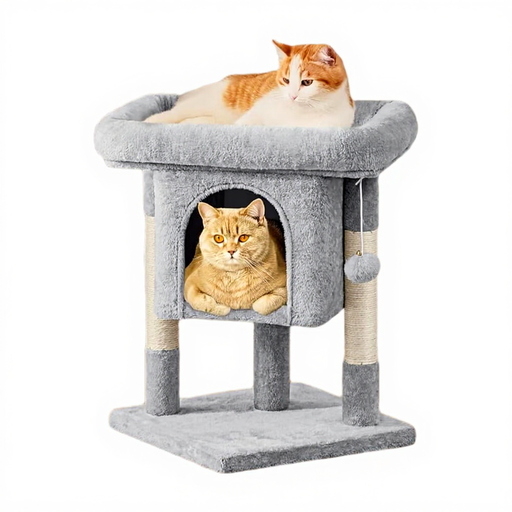
Why this model is a great fit: Ideal for kittens or small to medium-sized cats in apartments with limited space. Its compact dimensions of 40.5 x 40.5 x 59 cm allow for space-saving placement in a corner without sacrificing essential features like a cosy condo and scratching surfaces.
This model avoids the mistake of incorrect sizing. It is specifically designed for smaller cats, offering appropriate stability and features for its size, rather than being a scaled-down, unstable replica of an XXL tree.
Combines all basic functions (sleeping, scratching, observing) in a minimal footprint. The soft plush cover and condo provide a secure retreat for shy or young cats.
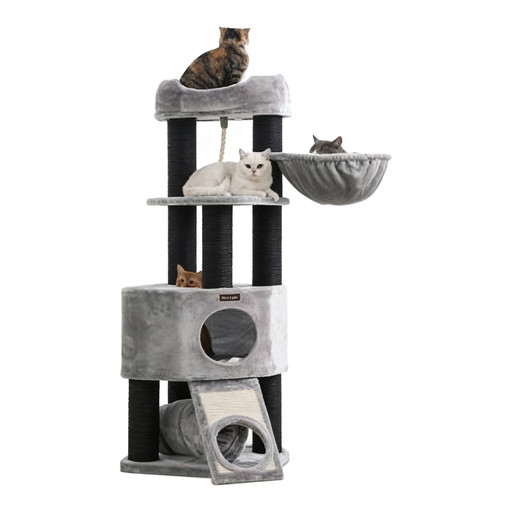
Why this model is a great fit: Specially developed for large or very active cats. The design focuses on maximum stability through a double-reinforced base plate and extra-thick sisal posts with an 11.3 cm diameter.
This model directly addresses the most critical issue: lack of stability. The thicker-than-average posts and reinforced base minimise wobbling, even during energetic leaps. The included anti-tip kit for wall mounting is a crucial safety feature here.
Exceptional stability and durability. The spacious hammock and roomy condo offer even large cat breeds plenty of space to relax.
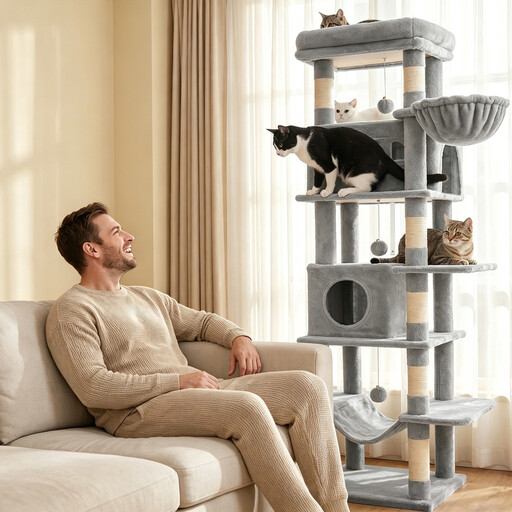
Why this model is a great fit: A complete activity centre for demanding multi-cat households. With a height of over 2 metres, six levels, two cat houses, and a hammock, this climbing tree offers enough space for up to six animals, helping to avoid conflicts over resting spots.
It solves the problem of instability under heavy load with a dual-layer, integrated base that lowers the centre of gravity. The built-in anti-tip kit is essential for a structure of this size and ensures the tree remains secure even at full occupancy.
An enormous variety of climbing, playing, and resting zones. The 8 strategically placed sisal posts provide scratching opportunities on all levels, effectively redirecting scratching behaviour to the tree.
We have compiled a complete, up-to-date list of products that fully meet these strict selection criteria and UK safety regulations.
Place the cat tree in a location where the family often gathers or one that offers a good view, such as near a window. You can initially entice the cat onto the tree with toys or catnip. Praise them when they use it. Avoid forcing the cat, as this can create a negative association.
The ideal height depends on the cat and the available space. Active and young cats often prefer tall climbing trees (over 150 cm) that give them a good overview. For older or less mobile cats, a medium-height model with easily accessible levels is more suitable. It is important that at least one scratching post is tall enough for the cat to stretch out completely while scratching.
Pay attention to the product specifications for weight and the dimensions of the base plate. A rule of thumb is that the base plate should be at least 50x50 cm, and the tree should have a high dead weight (over 15 kg for medium to large models). Also, check if an anti-tip kit for wall mounting is included – this is a clear indicator that the manufacturer takes stability seriously.