
Lieferung heute & morgen

Qualitätsgarantie

Willkommens-Angebote freischalten: KOSTENLOSE Lieferung | Bis zu 80 % RABATT | Kostenlose 30-Tage-JoyPlus-Testphase
App herunterladen
As the owner of a large cat like a Maine Coon, Ragdoll, or Norwegian Forest Cat, you know that off-the-shelf solutions are rarely enough. A standard cat tree often can't handle your pet's weight, strength, and space requirements. The result isn't just a disappointed cat, but also a wasted investment. Before you choose a new cat tree for large cats, it's crucial to understand the common weak points that often only become apparent after your purchase.
Many models marketed as "XXL" or "sturdy" prove to be inadequate in practice. The three most common problems are:
A good climbing tree for a cat of this size is an investment in its safety and well-being. The following criteria will help you make an informed decision.
To avoid a bad buy, you should check three core technical parameters. These features are crucial for longevity and safety, especially in a multi-cat household or for heavy breeds.
A cat tree's stability starts at its foundation. A sturdy cat tree needs a heavy and wide base plate. A footprint of at least 60 x 50 cm is a good starting point for floor-to-ceiling models. Some high-quality models feature a double-layered or reinforced base plate, which increases the total weight and lowers the center of gravity. A total weight of over 20 kg is another indicator of a robust design. Additionally, an anti-tip kit for wall mounting is an absolute necessity for any tall cat tree to prevent accidents.
The posts are the skeleton of the cat tree. For large cats like a Maine Coon, the sisal-wrapped posts should have a diameter of at least 10 cm, ideally 11 cm or more. Thicker posts not only offer a larger scratching surface but are also structurally far more resistant to the leverage forces created during jumping and climbing. Pay attention to the diameter specification in the product details—it's a clear indicator of quality.
A cat tree with a condo and hammock is only species-appropriate if the cat can actually fit inside. Measure your cat when it's fully stretched out and compare the dimensions with the specifications for the perches and condos. A perch should ideally have a diameter of 45 cm or more. For condos, not only the footprint but also the height is relevant so the cat can move around comfortably. Hammocks should have reinforced seams and a high weight capacity rating.
Based on the criteria above, we have identified a few models suited for the specific needs of large cat owners.
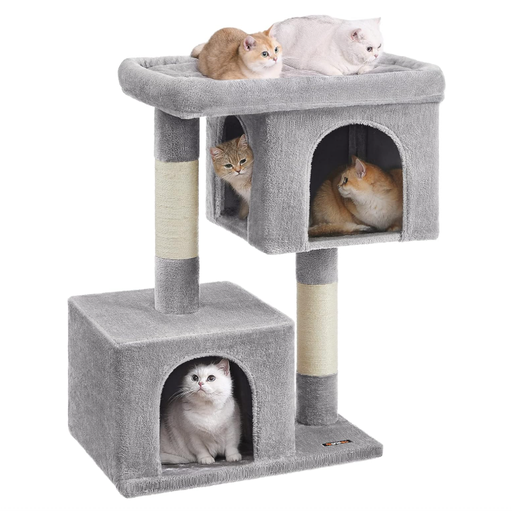
Why This Fits Their Persona: This model is explicitly designed for the needs of cats weighing up to 20 kg. It offers a solution for owners who are frustrated with perches where their large cat can't fit.
The extra-large top perch (68 x 48 cm) solves the problem of surfaces being too small. The thick posts (11 cm) and the included anti-tip kit counteract the risk of instability.
High weight capacity up to 20 kg; exceptionally large top perch; two spacious cat condos.
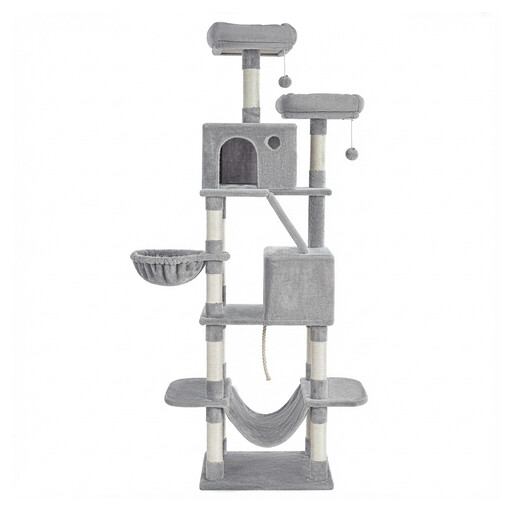
Why This Fits Their Persona: For households with multiple cats, including large ones, that need plenty of vertical space for climbing, playing, and resting. Its sheer size and variety of features prevent competition for the best spots.
At 206 cm tall, with 13 scratching posts, two condos, a hammock, and a basket, this tower offers enough space and activity to distribute wear and tear, preventing overuse of single parts. The large, reinforced base provides the necessary stability.
Impressive height and feature variety; high total static load capacity (up to 75 kg according to the manufacturer); numerous scratching options.
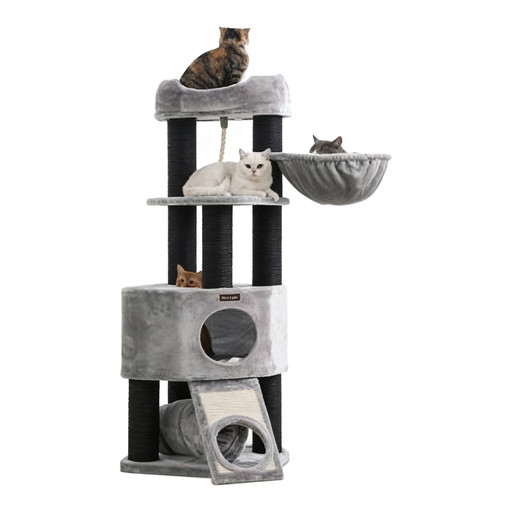
Why This Fits Their Persona: Ideal for owners of large cats living in apartments with limited space. This model utilizes vertical height without demanding an excessive footprint, and its main focus is maximum stability.
This model combats instability with extra-thick sisal posts (11.3 cm diameter) and a double-reinforced base plate. The anti-tip kit for wall mounting is also a mandatory feature.
Excellent stability due to extra-thick posts; compact footprint (50 x 50 cm); reinforced base plate.
We have compiled a complete, up-to-date list of products that fully meet these strict selection criteria and German safety regulations.
The safest method is to use the included anti-tip kit. This usually consists of a strap and mounting hardware used to anchor the top level of the cat tree to a load-bearing wall. This prevents the tower from tipping forward, even when a heavy cat leaps onto it with full force. Mounting to a solid wall (e.g., concrete or a wooden stud frame) is preferable to attaching it to a simple drywall.
For large and heavy cat breeds like the Maine Coon or Ragdoll, a post diameter of at least 10 cm is an essential requirement. Models with posts of 11 cm, 12 cm, or more offer significantly greater stability and durability. Thinner posts can break or loosen under the load, posing a serious safety risk.
Yes, as long as they are designed for a higher load capacity. On an XXL cat tree, look for hammocks with a sturdy metal frame and a mounting system that distributes weight across four points. The fabric should be durable and the seams reinforced. Check the manufacturer's specified maximum weight capacity for the hammock to ensure it is suitable for your cat's weight.