
Lieferung heute & morgen

Qualitätsgarantie

Willkommens-Angebote freischalten: KOSTENLOSE Lieferung | Bis zu 80 % RABATT | Kostenlose 30-Tage-JoyPlus-Testphase
App herunterladen
Owners of large cat breeds like Maine Coons, Norwegian Forest Cats, or Ragdolls know the challenge: a standard cat tree often only lasts a few months against the energy and weight of these animals. The search for a suitable cat tree for large cats can be frustrating, as many models look impressive but have critical flaws. This guide will help you avoid common purchasing pitfalls and choose a model that is safe, durable, and cat-friendly.
Much cat furniture is designed for average-sized cats. With large, heavy animals, design flaws quickly lead to instability and premature wear. Pay close attention to these three points to avoid a bad investment.
To ensure your new cat tree for multiple cats or a single large cat is a worthwhile investment, you should carefully examine three technical features.
A sturdy cat tree starts at its foundation. The base plate should cover the largest possible area (e.g., 60 x 50 cm or more) and be made from a heavy material like a thick MDF or solid wood panel. A low centre of gravity, achieved by placing heavy elements in the lower third of the tree, further increases stability. For floor-to-ceiling models or a 170 cm cat tree, an additional wall mount (anti-tip device) is a crucial safety feature, especially in homes with very active cats.
For large and strong cats, a post diameter of at least 10 cm—or even better, 12 cm or more—is recommended. These posts not only offer a larger scratching surface but are also structurally more resilient. Ensure the sisal rope has a diameter of at least 8 mm and is wrapped tightly and seamlessly around the post. Glued sisal is more durable than sisal that is merely stapled on.
The features must fit the cat. A full-grown Maine Coon needs a lounging area of at least 45 x 35 cm to be able to stretch out. A cat tree with a hammock and condo is only useful if these elements are generously sized. Hammocks should have a sturdy metal frame and be rated for a weight of over 10 kg. The entrances to the condos must be wide enough for the cat to pass through comfortably.
Instead of making a one-size-fits-all recommendation, we have identified models tailored to specific needs and households.
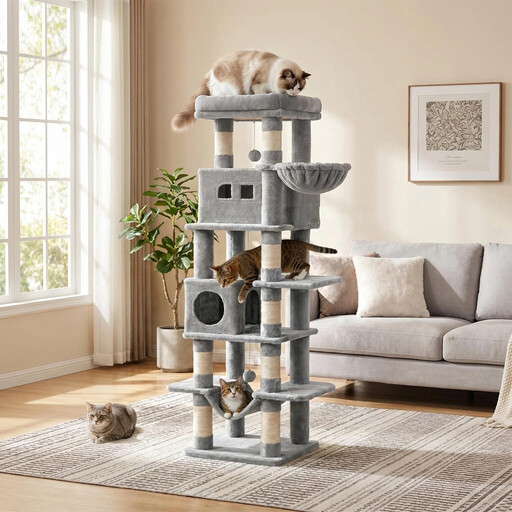
Why This Fits Their Persona: This model is designed as a multifunctional climbing tree for large cats and, with two condos, a hammock, a basket, and multiple platforms, it offers enough separate retreat and observation spots to minimise conflicts in a multi-pet household.
The widened, double-reinforced base plate and the included anti-tip kit counteract the typical instability of tall cat trees. The 17 support posts ensure high structural integrity.
According to the manufacturer, it is suitable for up to 6 cats (6.8 kg each). The removable and washable cushions make cleaning easy.
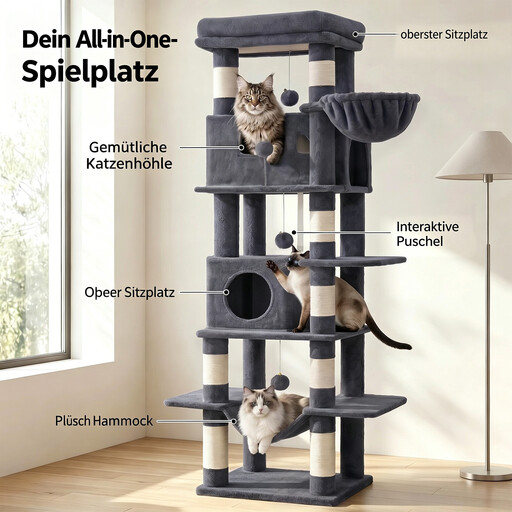
Why This Fits Their Persona: This model specifically addresses the needs of large cats with its generous dimensions. The spacious cat condo (50x40 cm) and the large top platform (50x30 cm) provide even heavy animals with enough space to stretch out and relax.
It avoids the pitfall of undersized lounging areas, which is a problem with many XXL models. The 8 posts wrapped in natural sisal also offer ample scratching opportunities across five levels.
The thoughtful arrangement of the levels, with distances of 20 to 30 cm, is ideal for the climbing behaviour of large cats. The robust construction provides the necessary security.
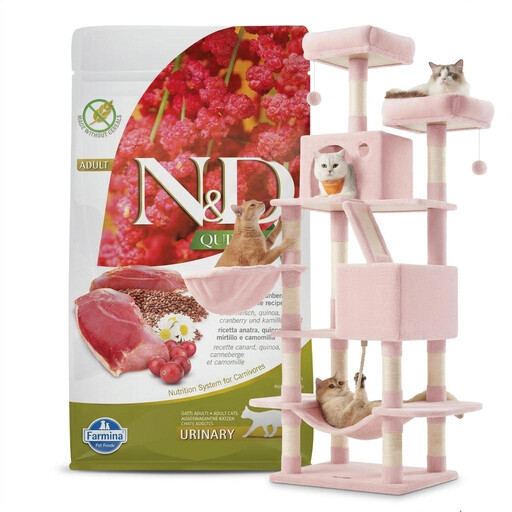
Why This Fits Their Persona: This bundle is a practical solution for cat owners looking for a complete starter kit. It combines a large, multi-level cat tree with specialised cat food, covering two essential needs at once.
With a height of 168 cm, 13 scratching posts, two condos, and a hammock, this tree is far from an undersized entry-level model. It offers a solid and functional setup right from the start.
The main advantage lies in the convenience of the package. You get a versatile piece of cat furniture and high-quality food in a single delivery.
We have compiled a complete, up-to-date list of products that fully meet these strict selection criteria and relevant safety standards.
Height is less crucial than stability and the size of the lounging areas. A 170 cm cat tree is ideal for cats that love to climb, as long as it has a wide base or a wall anchor. More importantly, the top platform must be large enough to provide a secure lookout point.
Place the tree in a location where your cat likes to spend time, such as near a window or in the living room. Make the tree more interesting by attaching toys to it or placing treats on the different levels. You can also rub some catnip on the scratching surfaces to spark their interest.
Plush covers and cushions should be cleaned regularly with a lint roller or a vacuum cleaner with an upholstery attachment. Some models offer removable and washable cushions, which makes cleaning much easier. The sisal posts can be brushed down as needed to remove hair and dirt. Avoid using harsh chemical cleaners.