
Lieferung heute & morgen

Qualitätsgarantie

Willkommens-Angebote freischalten: KOSTENLOSE Lieferung | Bis zu 80 % RABATT | Kostenlose 30-Tage-JoyPlus-Testphase
App herunterladen
As the owner of a large cat like a Maine Coon, Ragdoll, or Norwegian Forest Cat, you know the challenge: a standard cat tree often only survives the energy and weight of your companion for a few months. Wobbly structures, perches that are too small, and thin scratching posts are not just an annoyance—they also pose a safety risk.
This guide will help you bypass common marketing traps and find a cat tree that is truly suitable for large, heavy, or multiple cats. We focus on the crucial features that define a durable and safe cat tree.
Many cat trees available on the market are not designed for the stress of large breeds. Watch out for these three common weaknesses to avoid a bad investment:
To ensure your new cat tree meets the demands, you should check three key technical parameters before buying. These define its stability, safety, and longevity.
Stability is the most important criterion for a cat tree for large cats. A secure footing is ensured by two elements:
Additionally, an anti-tip kit for securing the tree to a wall is a safety necessity for any tall cat tree.
An XXL cat tree or a large cat tree is defined not just by its height, but primarily by the size of its functional elements. Large cats must be able to stretch out completely on the lounging surfaces.
The longevity of a cat tree depends directly on the materials used.
Here are three models tailored to different needs and cat profiles.
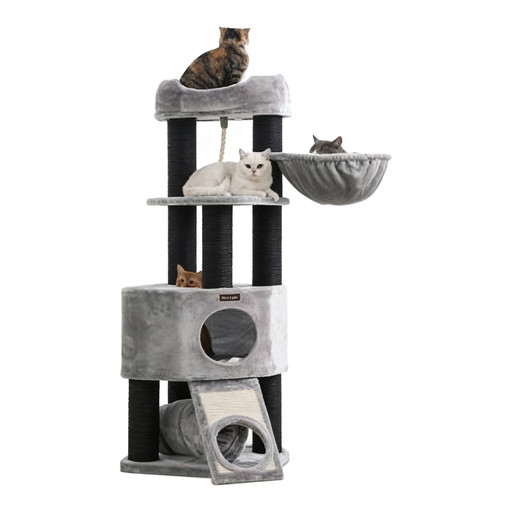
Why this model is a great fit: This model offers an excellent balance of height, comfort, and extreme stability. It is specially designed for the needs of large, heavy, or very active cats that love to climb and play.
The design counters the stability trap with extra-thick sisal posts (11.3 cm diameter), a double-reinforced base plate, and a mandatory anti-tip kit for wall mounting. This creates a robust triangular support system.
The combination of high stability and thoughtful comfort elements, like a deep hammock, a spacious condo, and an elevated viewing platform, makes it an all-in-one retreat.
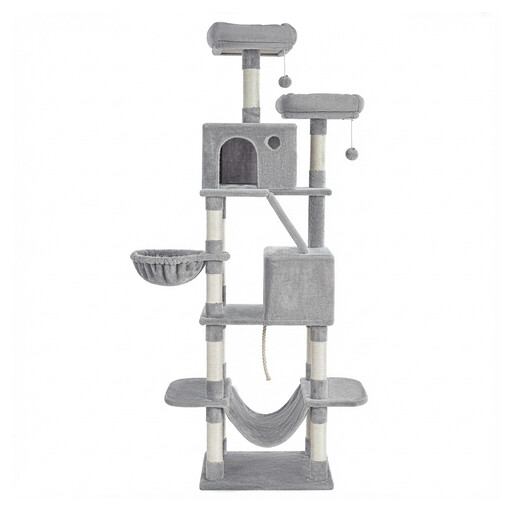
Why this model is a great fit: At over two meters tall and with a multitude of levels, this cat tree is ideal for multi-cat households or for particularly avid climbers who need vertical space.
This model avoids the "one-size-fits-all" trap by offering ample space and separate zones (2 condos, 2 perches, multiple platforms) for several cats. The high total static load capacity of up to 75 kg (according to the manufacturer) ensures the necessary safety.
Its enormous height of 206 cm and features including 13 scratching posts, two condos, a hammock, and a basket offer maximum opportunities for activity and retreat on a small footprint.
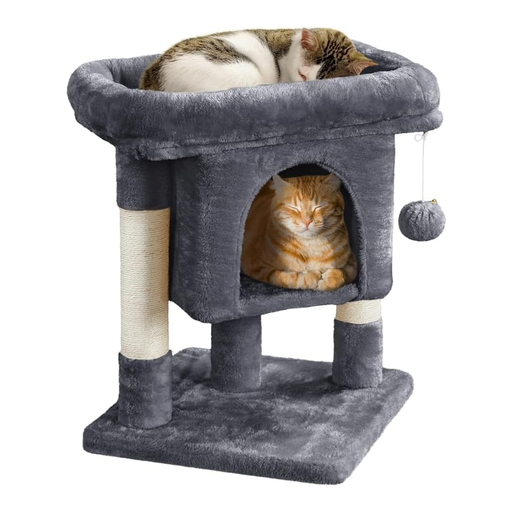
Why this model is a great fit: This compact model is a great choice as a first cat tree for kittens or as a space-saving, additional scratching and sleeping spot in a second room. It is explicitly designed for small to medium-sized cat breeds.
This model is not intended for large cats, thus avoiding the trap of false expectations. Its strength lies in its solid construction for its intended purpose: providing a stable base for smaller cats and kittens without claiming to be suitable for large breeds.
Its very compact dimensions (40.5 x 40.5 x 59 cm) and small footprint make it ideal for small apartments or as a secondary tree alongside a larger main cat tree.
A cosy and secure retreat is just as important as a place to play. Discover our selection of cat caves that meet strict criteria for comfort and durability.
The safest method is to use the included anti-tip kit. This bracket or strap set connects the top level of the cat tree to a wall. It is crucial to attach it to a load-bearing wall (e.g., concrete or masonry) and not just drywall. Additionally, check all screw connections for tightness after assembly and at regular intervals thereafter.
The frame of a well-constructed, sturdy cat tree can last for many years. The parts that typically wear out are the sisal posts and the plush covers. With intensive use by one or more large cats, these parts may need to be replaced after 1-3 years. Models that allow for individual posts to be replaced are a sustainable and cost-effective choice in the long run.
Give your cat time to get used to the new piece of furniture. Place the cat tree in a location where the family frequently gathers, such as the living room. Rub some catnip on the scratching surfaces and perches to spark interest. Playing with a cat wand on and around the tree can also help create positive associations.