
Lieferung heute & morgen

Qualitätsgarantie

Willkommens-Angebote freischalten: KOSTENLOSE Lieferung | Bis zu 80 % RABATT | Kostenlose 30-Tage-JoyPlus-Testphase
App herunterladen
As the owner of a large cat like a Maine Coon, Ragdoll, or Norwegian Forest Cat, you know the problem: standard cat trees often become a wobbly affair after just a short time. They are simply not designed for the weight and power of large breeds. The result is not only frustrating but can also be dangerous for your pet.
This guide will help you identify the crucial features of a durable and safe model and avoid common purchasing pitfalls.
Many cat trees advertised as "large" or "XXL" prove to be inadequate in practice. Watch out for these three common weaknesses to avoid a bad investment.
To ensure your new large cat tree can withstand the strain and is species-appropriate, you should check three technical parameters.
The foundation is the key to a stable cat tree. Two metrics are crucial here:
A large climbing tree is used intensively. The quality of the sisal determines the longevity of the scratching surfaces. Ensure the sisal rope has a diameter of at least 6 mm and is wrapped tightly around the post. High-quality models avoid using only glue and also secure the rope mechanically at the ends. This prevents entire sections from coming loose after the first few scratching sessions.
A cat tree for a Maine Coon or other large breeds must offer suitable resting areas. The perches should have a diameter of at least 45 cm so the cat can stretch out comfortably. The same applies to a cat tree with a hammock and condo: the hammock must be deep and robust, and the condo should be large enough for the cat to turn around in easily. A cat tower for multiple cats also benefits from generous platforms to avoid conflicts over the best spots.
Here are some recommendations tailored to the different needs of large cat owners.
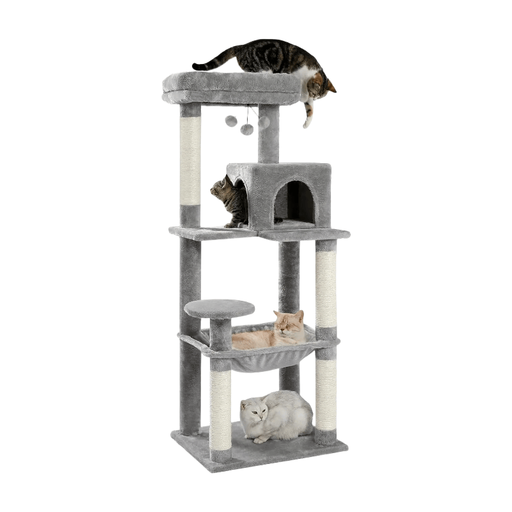
Why This Fits Their Persona: With a viewing platform, cozy nest, and hammock, this model offers various rest and play zones on multiple levels. It is ideal for households with several cats, as it caters to different preferences and provides ample space.
The stability system, with its reinforced posts and a thickened, wide base plate (55x45 cm), actively counteracts wobbling (Pitfall 1).
The top perch is removable and machine-washable, which simplifies cleaning. The toy balls are replaceable.
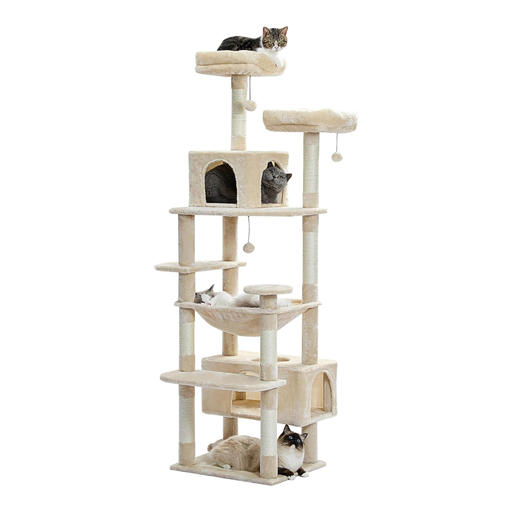
Why This Fits Their Persona: At 184 cm tall with an 8-level structure, this cat tree is a paradise for cats who love to climb. It provides a vertical playground that caters to the natural climbing instincts of large and active cats.
The robust construction with reinforced particleboard and a wide base ensures stability (Pitfall 1). The oversized resting areas are explicitly optimized for breeds up to 10 kg, thus avoiding the problem of undersized perches (Pitfall 3).
The use of 100% natural sisal rope on seven posts ensures high durability of the scratching surfaces.
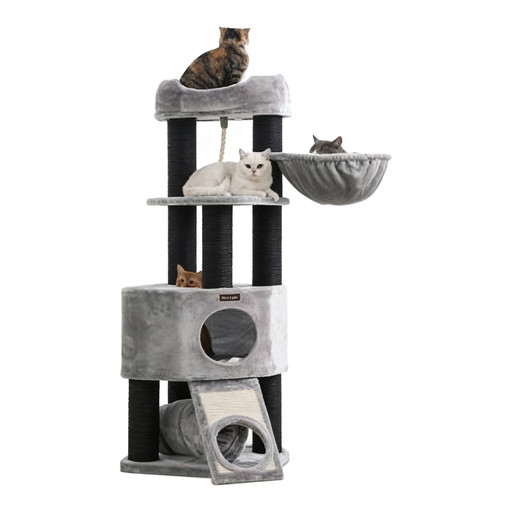
Why This Fits Their Persona: For owners of particularly heavy or boisterous cats where absolute safety is the top priority. This model is uncompromisingly designed for stability.
This model combats the stability trap (Pitfall 1) with a triple-safety design: extra-thick sisal posts (11.3 cm), a double-layered base plate, and an included anti-tip kit for wall mounting.
The combination of extremely thick posts and the mandatory wall anchor creates the highest level of safety, even under very heavy use.
We've compiled a complete, up-to-date list of products that fully meet these strict selection criteria and safety requirements.
You can achieve maximum stability through a combination of several factors. Place the cat tree on a level, solid surface, ideally in a corner or against a wall. The most important step for tall models is to use an anti-tip kit that anchors the cat tree to the wall. Also, regularly check all screw connections and tighten them as needed.
The lifespan heavily depends on the material quality, the number of cats, and the intensity of use. With a high-quality model featuring thick posts and tightly wound sisal, you can expect a lifespan of several years. A major advantage is that for many modular systems, worn-out sisal posts are available as spare parts and can be replaced individually.
Give your cat time to get used to the new piece of furniture. Make the cat tree more attractive by sprinkling some catnip on the perches, placing treats on the different levels, or encouraging climbing with a teaser wand. The location is also crucial: cats love to observe their surroundings, so a spot with a good view, such as near a window, is often more popular than a remote corner.