
Lieferung heute & morgen

Qualitätsgarantie

Willkommens-Angebote freischalten: KOSTENLOSE Lieferung | Bis zu 80 % RABATT | Kostenlose 30-Tage-JoyPlus-Testphase
App herunterladen
As the owner of a large cat like a Maine Coon, Ragdoll, or a robust domestic cat, you know the problem: standard cat trees are often overwhelmed in no time. They wobble, the perches are too small, and the posts wear out quickly. The result is not only a dissatisfied cat but also a potential hazard in your living room. This guide will help you identify the crucial features of a suitable model and avoid common purchasing pitfalls.
Many cat trees are not designed for the weight and power of large cat breeds. Watch out for these three design flaws to avoid a bad investment:
To ensure your new cat tree can withstand the demands, you should check three core parameters. These features are critical for durability and safety.
A stable cat tree is essential. Stability is determined by several factors:
The posts are the backbone of the cat tree. A cat tree with thick posts not only offers more stability but also a more durable surface for claw care.
An XXL cat tree should not only be tall but also intelligently designed. It must meet the needs of one or multiple cats.
Here are some models tailored to the specific needs of large cat owners that incorporate the quality features mentioned.
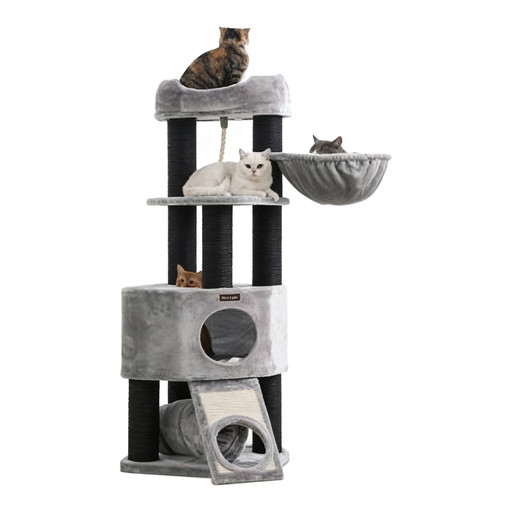
Why This Fits Their Persona: This model is specifically designed to handle the stress of large and heavy cats. The construction clearly focuses on maximum stability and durability, ideal for breeds like Maine Coons or Norwegian Forest Cats.
The double-reinforced base plate and extra-thick posts counteract typical instability. The mandatory anti-tip kit provides additional security at the wall.
Extra-thick sisal posts (11.3 cm diameter) and a robust, double-layered base plate provide excellent stability.
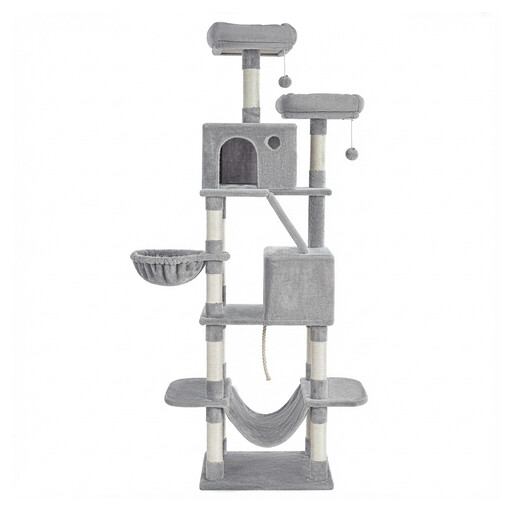
Why This Fits Their Persona: With its impressive height and numerous levels, caves, and perches, this cat tower offers enough space for multiple cats at once. It allows the animals to get out of each other's way and claim their own territories.
The large, reinforced base and a high static load capacity of up to 75 kg (according to the manufacturer) prevent instability, even when multiple cats are playing on it simultaneously. The many perches solve the problem of limited space.
Offers diverse retreat and observation spots with 2 caves, 2 viewing platforms, a hammock, and a basket. The 13 sisal posts distribute scratching activity.
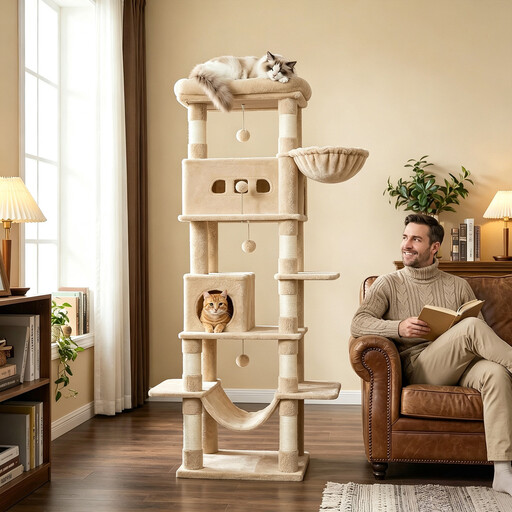
Why This Fits Their Persona: This model is ideal for apartments with a limited footprint. It makes optimal use of the room's height, offering cats climbing, playing, and sleeping opportunities on six levels without taking up much floor space.
Despite its slim design, a reinforced base and an anti-tip kit provide the necessary stability. The scientifically designed spacing between levels facilitates ascent and descent, making the tower safe.
Six-level structure with thoughtful spacing for easy climbing. The removable cushions on the perches make cleaning easier.
We've compiled a complete, up-to-date list of products that meet these strict selection criteria and safety requirements.
Most tall cat trees come with an anti-tip kit. This usually consists of a strap or bracket and the appropriate screws. Attach the cat tree to a load-bearing wall (e.g., concrete or a wooden stud), not just a drywall. Position the cat tree, mark the drill spot on the wall, drill a hole, insert a wall anchor, and firmly screw the strap or bracket to the wall and the cat tree.
In a multi-cat household, having enough retreats is crucial to avoid conflicts. Choose a model with at least as many perches and caves as you have cats. A cat tree for multiple cats should also have multiple entry and exit points so the animals don't get in each other's way. High stability and load capacity are also of utmost importance here.
The lifespan heavily depends on the material quality and usage. A model with thick posts, a robust construction, and high-quality sisal can last for several years with good care. Wear-and-tear parts like sisal posts or plush covers can be replaced on some models, which further extends the lifespan. Regularly check all screw connections and tighten them as needed.