
Lieferung heute & morgen

Qualitätsgarantie

Willkommens-Angebote freischalten: KOSTENLOSE Lieferung | Bis zu 80 % RABATT | Kostenlose 30-Tage-JoyPlus-Testphase
App herunterladen
As the owner of a large cat like a Maine Coon, Ragdoll, or Norwegian Forest Cat, you know the challenge: a standard cat tree often only survives your companion's playful energy for a few months. Unstable structures, perches that are too small, and thin posts are not just frustrating—they're a safety hazard.
This guide, created by the Joybuy Product Recommendation Officer, will help you navigate the common pitfalls of buying a cat tree. We'll focus on the crucial features that define a durable and safe cat tree for large cats, ensuring your investment is worthwhile and your furniture is spared.
Many products on the market are labelled "large" or "XXL" but fail in practice. Watch out for these three common weaknesses to avoid making a bad purchase:
To ensure your new cat tree meets the demands, you should check three technical aspects before buying. These define whether a model is truly stable and suitable for heavy cats or a multi-cat household.
A cat tree's stability starts at the ground. A heavy, thick base plate is the most important feature for preventing wobbling and tipping.
The posts are the skeleton of the cat tree. Their quality determines its longevity and safety.
A cat tree with a condo and hammock is only a true retreat if the dimensions are right.
Based on the criteria above, we have identified a few models suitable for different needs and households.
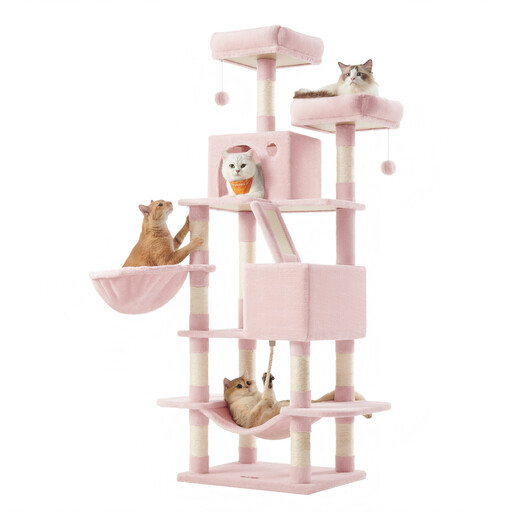
Why This Fits Their Persona: With its height of 168 cm, two condos, a hammock, and multiple platforms, this model offers enough space and variety for a multi-cat household or particularly avid climbers.
The reinforced base plate and a specified total static load capacity of up to 65 kg directly address the problem of instability. The 13 sisal posts provide ample scratching surfaces to prevent conflicts.
High load capacity and a variety of lounging and play options (two condos, hammock, basket) on different levels.
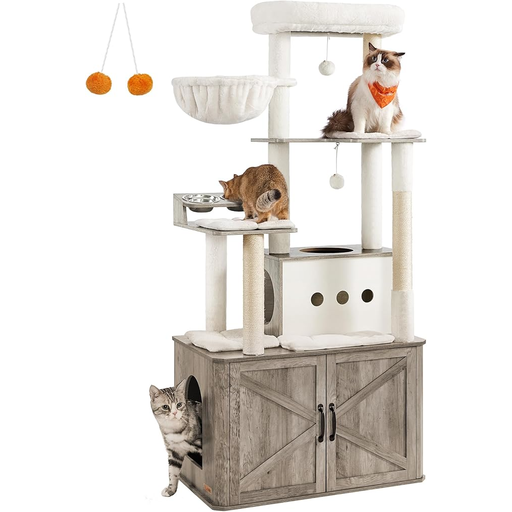
Why This Fits Their Persona: This model is ideal for anyone looking to maximise functionality in a small space. It combines a tall climbing tree with a cabinet for the litter box and an integrated feeding station.
The heavy base cabinet (28.6 kg total weight) acts as a massive foundation, providing exceptional stability. This counteracts the top-heaviness typical of tall, narrow trees.
Space-saving all-in-one design that integrates climbing, eating, and a litter box area. The cushions are removable and machine-washable.
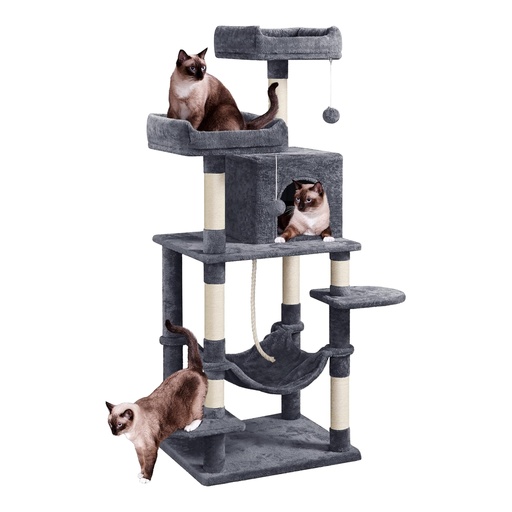
Why This Fits Their Persona: This model offers a good height and essential features like a condo and perches at an attractive price. It's a solid option for owners of a single large cat who are looking for a functional solution.
Although the base plate has standard dimensions, an anti-tip kit for wall mounting is included. This is a pragmatic solution to effectively solve the stability problem in this price range.
Excellent value for money. The use of FSC-certified particleboard is a plus for eco-conscious buyers.
If you'd like to compare more models vetted for stability and durability, you'll find a wider selection in our main category.
A stable cat tree should not wobble when a full-grown cat jumps on it with force. A simple test: apply lateral pressure to the top platform. If the tree gives way significantly, it is potentially unsafe for a large cat. Look for a heavy base plate (over 4 cm thick), a post diameter of over 10 cm, and always use the included anti-tip kit for wall mounting.
Patience is key here. Make the new climbing tree more attractive:
Durability is directly linked to the materials. Ideally, the structure consists of a solid engineered wood base, posts made of solid wood or thick, reinforced cardboard tubes, and a covering of durable plush fabric. The most important element, the sisal rope, should be thick (at least 8 mm) and firmly glued down to withstand months of scratching.