
Lieferung heute & morgen

Qualitätsgarantie

Willkommens-Angebote freischalten: KOSTENLOSE Lieferung | Bis zu 80 % RABATT | Kostenlose 30-Tage-JoyPlus-Testphase
App herunterladen
Purchasing a cat tree for large breeds like the Maine Coon, Ragdoll, or Norwegian Forest Cat places different demands on the product than for their smaller counterparts. Standard models are often not designed for the heavier body weight and greater force these animals generate when jumping and playing. An undersized or unstable cat tree can pose a safety hazard and is often rejected by the cat. Therefore, the selection should be based on an analysis of stability, material quality, and cat-appropriate dimensions.
This guide focuses on the technical parameters that define a sturdy cat tree and presents a selection of models designed for the needs of large, heavy, or multiple cats.
The functionality of a cat tree for large cats is determined by three core factors: stability, material properties, and dimensions.
Structural stability is the most critical parameter. A large cat tree must remain secure even under dynamic loads, such as when a 10 kg cat leaps onto the top platform.
The longevity of a cat tree is directly dependent on the materials used.
Large cats need more space. The features must be tailored to their body size.
Based on the technical criteria mentioned above, we have compiled a selection of models suitable for households with large or multiple cats.
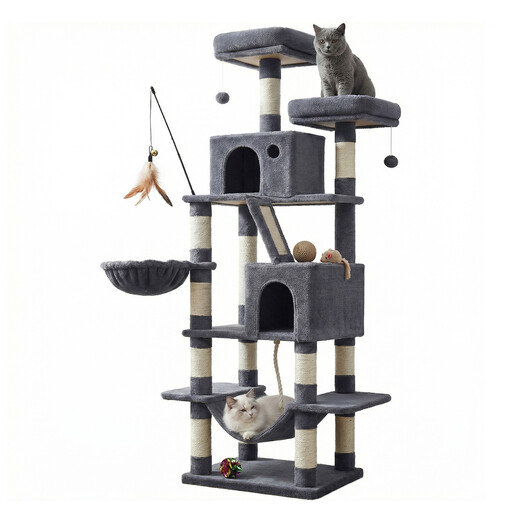
Why we recommend this product: At 168 cm, this model offers a considerable height and a comprehensive set of features that meet the needs of active cats. The combination of 13 scratching posts, two condos, and multiple perches makes it a versatile all-in-one solution. The specified maximum static load capacity of 65 kg and the included anti-tip kit address the need for stability.
Advantages:
Who it's for: This model is suitable for households with one or more normal to large-sized cats looking for a versatile cat tree with a condo and hammock that offers both vertical climbing opportunities and various retreat spots.
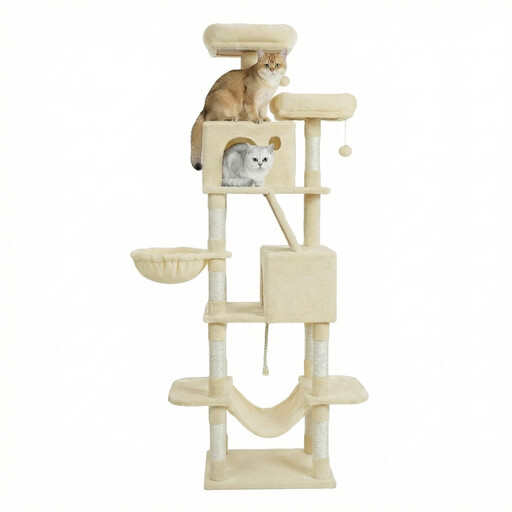
Why we recommend this product: With a height of 206 cm, this XXL cat tree is an excellent choice for cats with a strong climbing instinct. The tall design and numerous levels create a vertical paradise for play. The maximum static load capacity of 75 kg, combined with the anti-tip kit, indicates a construction designed for very active or multiple cats.
Advantages:
Who it's for: Ideal for owners of particularly avid climbers or for households with multiple pets that require a very tall and robust cat climbing tree to provide sufficient space and activity.
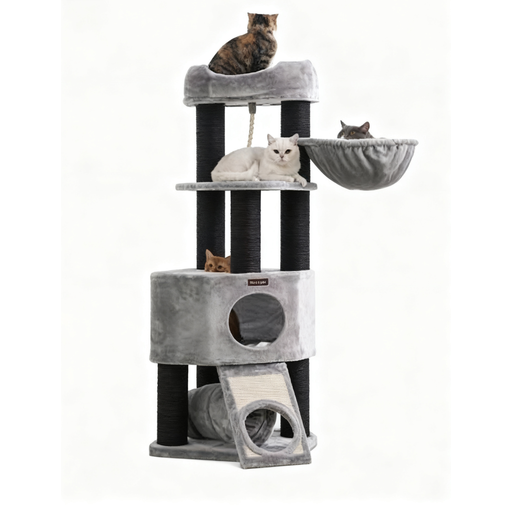
Why we recommend this product: This model explicitly focuses on maximum stability. With extra-thick sisal posts (11.3 cm diameter), a double-layer base plate, and a weight of 23.2 kg, it is designed to withstand the stress from very large and heavy cat breeds. Although at 141 cm it is not as tall as other models, its main advantage lies in its robust construction.
Advantages:
Who it's for: Especially recommended for owners of very large and heavy cat breeds (e.g., adult Maine Coon males) or for particularly boisterous pets where an absolutely sturdy cat tree is the top priority.
A well-structured cat tree brings order to your cat's play and rest patterns. If you also value clear structures in other areas of your life, such as your home office, taking a look at organisational aids could be worthwhile. For this, discover our selection of letter trays to design your workspace efficiently.
1. How large should a cat tree for large cats be? The height should ideally exceed 140 cm to satisfy their climbing instinct. However, the dimensions of the perches and condos are more important. Platforms should have a diameter of at least 40-50 cm so the cat can stretch out comfortably. The base plate should also be generously sized for good stability (e.g., 50 x 50 cm or larger).
2. How do I securely install a cat tree? For maximum safety, especially with tall models, the cat tree should be secured to a solid wall using the included anti-tip kit. Place the cat tree on a level, firm surface. Regularly check all screw connections for tightness, as they can loosen over time due to the cat's movements.
3. Which cat tree is suitable for two or more cats? A cat tree for multiple cats should have several perches on different levels, especially at least two elevated viewing platforms. This allows the animals to get out of each other's way if needed and claim their own territories. Models with a wide base, high weight, and multiple condos are well-suited for this purpose.