What should you look for when buying?
Start by working out the portion per batch and the cooking time you need. Then compare how easy the appliance is to clean and how much space it takes up at the venue.
| What matters |
What to check before buying |
Who is this important to? |
| Space for your portions |
Compare the area and height of each basket, as well as the number of batches you expect to cook. |
If I’m preparing florets for several participants, I need to be able to divide them between the usable baskets. Around 36% of consumers have portion capacity as their main concern. |
| Coordinating cooking times |
Check whether cooking zones can be controlled separately, and how the timer and water supply work during cooking. |
If I want the cauliflower and a side dish to be ready at the same time, I need to be able to coordinate their different cooking times. Around 29% of consumers prioritise coordinating cooking times. |
| Cleaning after several batches |
Check separately whether the baskets, lids and drip trays are dishwasher-safe. |
If several batches during a class leave me with lots of parts to clean, I want to know which ones can go in the dishwasher. Around 21% of consumers are mainly concerned about the cleaning involved. |
| A safe spot at the venue |
Check the appliance’s dimensions when assembled, where you can put hot parts, and how much clearance the instructions require. |
If my worktop space is limited, the appliance needs to fit safely, with enough clearance and space for hot baskets. Around 14% of consumers have limited counter space as their main concern. |
Joybuy products
The following Joybuy appliances are described as egg cookers or egg cookers with a steaming function. Their product information mentions steaming vegetables, but doesn’t confirm how many cauliflower florets will fit in one class batch. For the exact version, also check the required conformity documentation and the requirements for food-contact materials.
 No image available
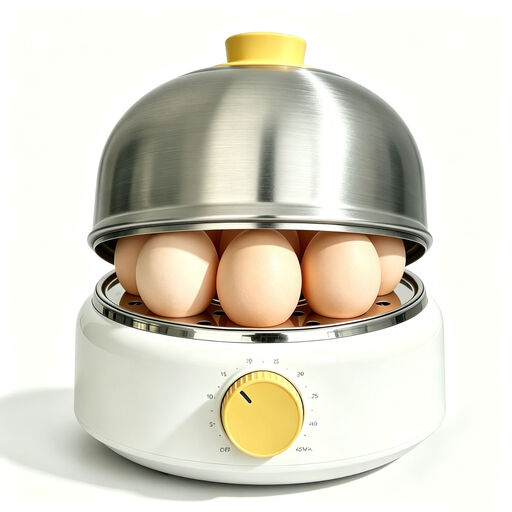
Stainless steel egg cooker for 7 eggs with doneness settings
The product description also mentions steaming vegetables. Before buying, check that the basket area suits the cauliflower portion you have planned.
45-minute timer and overheat protection, according to the product title; removable parts are described as dishwasher-safe.
View at Joybuy
 No image available
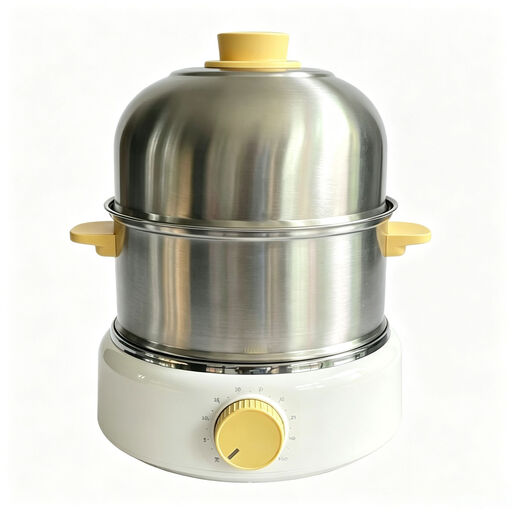
Stainless steel egg cooker, 400 W, two levels for 18 eggs
The product description lists vegetables as suitable for steaming. Check whether the available space is enough for the amount of cauliflower you plan to cook.
400 W and two levels for 18 eggs, according to the product title. It also lists doneness settings, a timer and overheat protection. The description says the removable parts are dishwasher-safe.
View at Joybuy
Frequently asked questions
How can I tell whether the baskets will hold enough for my class?
Compare the size and quantity of the florets with the usable area of each basket, and allow for extra batches if needed. A figure such as 6 l total describes the capacity, not the area of an individual level.
How can I avoid overcooking cauliflower?
Set the cooking time to suit the size of the florets and check that they have the texture you want as they cook. The Federal Centre for Nutrition notes that cooking cauliflower for too long takes away its delicate flavour. However, this doesn’t establish one standard cooking time for the appliances mentioned here.
Can the Steba DG 2 be used in a commercial teaching kitchen?
According to Steba’s instructions, the DG 2 is intended for domestic use indoors, not for commercial use. Whether a particular cookery class counts as commercial use depends on how the appliance is used. If necessary, choose an appliance explicitly suitable for that purpose.
Are all the parts dishwasher-safe?
No. Check the information for each component. For the VC1451, Tefal lists certain removable parts as dishwasher-safe; Steba lists individual spare parts for the DG 2. This doesn’t tell you anything about other parts of the appliances or whether spare parts will be available in future.
What markings and material requirements apply when buying in Germany?
Electrical appliances covered by the EU Low Voltage Directive 2014/35/EU, that is, those with a rated voltage of 50 to 1,000 V AC, must meet the relevant conformity requirements, including CE marking. The European Union’s Your Europe website explains that the manufacturer is responsible for conformity; CE is not an independent quality mark. Under Regulation (EC) No 1935/2004, parts intended to come into contact with food must also meet food-contact material requirements under normal or foreseeable conditions of use. Check the evidence for the exact version on offer; a material description such as “stainless steel” or “BPA-free” is not enough on its own.


